

In the 6th session of Chandoo.org podcast, we focus on making you a better analyst.
Before we proceed in to the session, let me remind you:
Subscribe to Chandoo.org Podcast
Do you know that you can subscribe and receive latest episodes of our podcast right to your ears? Use one of the below links to get started.
- For iPhone or iPod or iPad: Click here to subscribe.
- Andriod Phones & Tabs: Click here to subscribe on Stitcher. (You can download Stitcher free app from that link)
- Windows Phone: For Windows phone, search your podcasts app for our show.
- Or… As always, you can get latest episodes, show notes & resources from our Podcast page.
What is in this session?
One of the most popular questions I get, goes like this:
I recently became an analyst. I want to succeed in my work. How do I go about it?
So in this episode, lets explore the road map to becoming a better analyst.
 In this podcast, you will learn,
- Announcement about Easter Egg hunt
- Why become a better analyst?
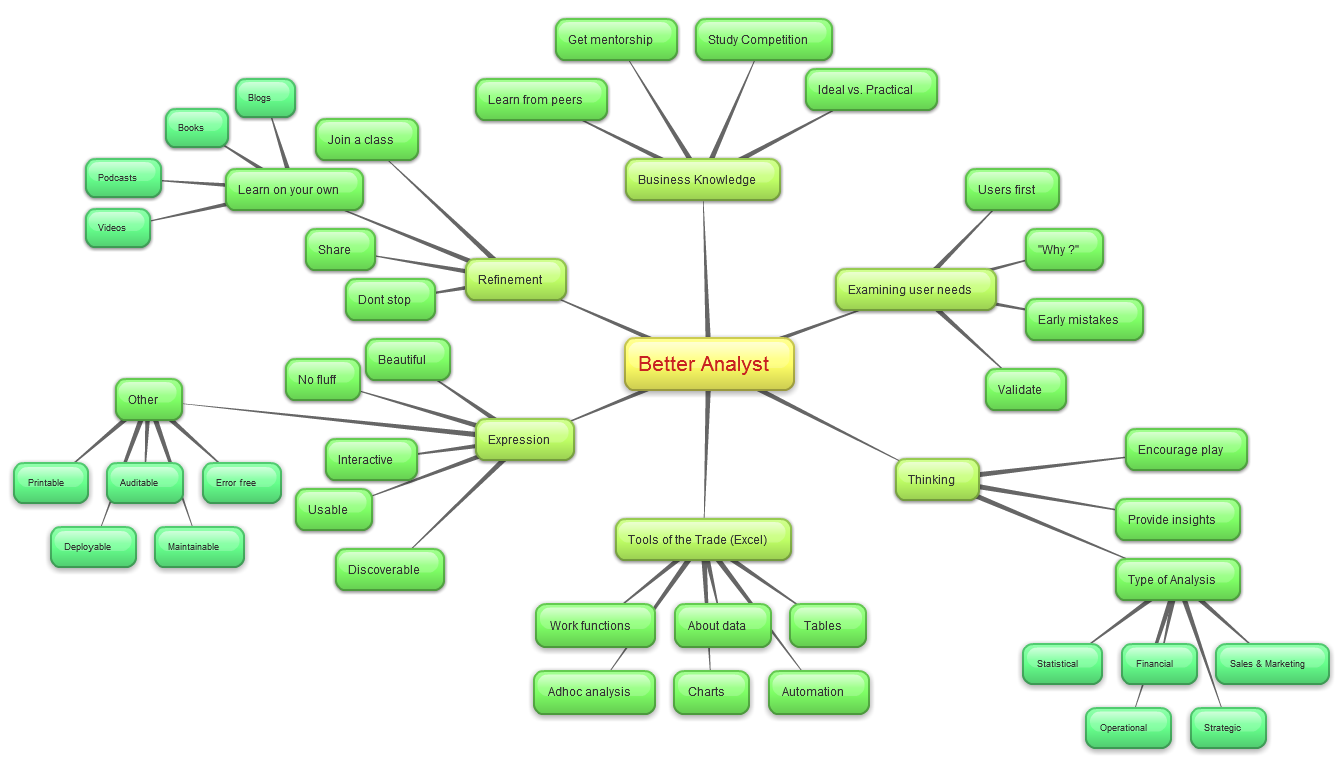
- The road map for becoming a better analyst – BETTER framework
- B for Business Knowledge
- E for Examining user needs
- T for Thinking about analysis
- T for Tools of Trade ie Excel
- E for Expression
- R for Refining yourself
- Conclusions
See the mind-map aside (click on it to expand) to understand the BETTER framework.
Go ahead and listen to the show
Podcast: Play in new window | Download
Subscribe: RSS
Links & Resources mentioned in this session:
Easter Egg Hunt:
Courses mentioned:
Case Studies
Resources to learn Excel
- Functions
- Understanding Data
- Excel Tables
- Ad-hoc Analysis Tools in Excel
- Pivot Tables
- Filters
- Slicers
- Charting & Reporting
- Automation & VBA
Making Interactive Charts in Excel
Spreadsheet Errors & Auditing
- Handling Errors in Spreadsheets
- Using IFERROR function
- Spreadsheet Auditing & Risk Management – 4 part article
- Go to Special – your best friend for spreadsheet auditing
Transcript of this session:
Download this podcast transcript [PDF]
Are you becoming better analyst?
As a CEO of a small company, most of my time is spent on analysis & decision making. So I am always looking for ways to improve my skills.
What about you? How do you become better at your job. Please share your tips, ideas & inspiration in the comments.


12 Responses
another superb podcast, thanks a loooot for great ideas 🙂
like the mindmap
Thanks for a great podcast Chandoo, superb mindmap!
Thank you for this. Wish i had it 10 years ago when i started the career! Still a lot of great advice. A great reminder to never stop refining!
Thanks again.
hi chandoo excuse me for late answer to your message . then how are you i wish for you and your family golden life thanks alot again i appratiate and thank you goodby please send to me some note
Hi Chadoo
Thank you for such a great job, your website is already on my bookmarks and I am learning a lot from you. =)
Regards!
Dear Chandoo,
Thank you so much for sharing this insightful podcast. Due to your limitless and altruistic collaboration to MS Excel world knowledge, you have inspired me to initiate a community of Excel users in Lima, Peru named “Excel Spyders”. I aim to share my tips and tricks in English and Spanish to help Latin American professionals become better at Excel and data analysis. I hope you received this message and potentially meet over skype. It would be a pleasure to meet you.
Saludos,
Carlos from Excel Spyders
Dear Chandoo,
I am a beginner of Data Analyst, I would like to learn and wished to become Expert in Analyst and also to grasp in depth knowledge & skills in MS excell on my finger tips.
So, plz share it from the beginning .
Thanks & best regards,
Ali.
Thanks chandoo for sharing its really helpful road map keep going, actually i want to share something about business analyst that may help someone; Business analysts (BAs) are responsible for bridging the gap between IT and the business using data analytics to assess processes, determine requirements and deliver data-driven recommendations and reports to executives and stakeholders.
I am learning data analytics. But I am from non-tech background. Is it good for me or not. Please guide me.