This is the fifth installment of project management using excel series.
Preparing & tracking a project plan using Gantt Charts
Team To Do Lists – Project Tracking Tools
Project Status Reporting – Create a Timeline to display milestones
Time sheets and Resource management
Part 5: Issue Trackers & Risk Management
Project Status Reporting – Dashboard
Bonus Post: Using Burn Down Charts to Understand Project Progress
Tracking issues and risks is where most of the project management time goes. Once the project planning and organizing activities are in good shape, most of the project management activities are around risk management and issue tracking. In this installment of project management using excel, we will learn how to create a simple issue tracker template using excel and how to analyze issues using excel.
Issue Tracker Template
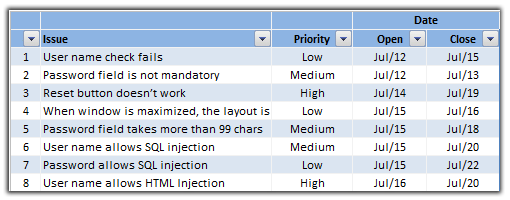
Excel is perfect for making an issue tracker template. Its grid structure and easy interface makes it totally easy to create and maintain an issue log. Here is a simple issue tracker template you can create in less than a minute.
![]()
The above template becomes very easy to manage with excel features like data validation, filters and tables (lists in 2003 and earlier).
More Robust Issue Log Template
While the above issue tracker template is good for most project needs, often you might need something little more robust. Of course, doing this is just a matter of adding few columns. For eg. it is common for project managers to keep track of the various types of issues and who is logging them, who is closing the issues. Here is an issue log template that is more robust.
![]()
Analyzing and Reporting Issue Status
Issues are part of everyday project management. It is important to keep track of various issues in the project and understand their progress. There are various ways to monitor the progress of issues using excel charts and pivot tables. In this tutorial, we will learn how to make the open vs. closed issues chart (see below).
![]()
- To make the chart, we will use the issue tracker data from the template shown above.
- We need to generate issue counts for the last 30 days from a chosen date like this:

- The counts can be easily generated by using the COUNTIF Excel formula [Excel SUMIFS formula tutorial] like this:
=COUNTIF(issueOpenDates,Date) - We can easily make the counts cumulative.
- Finally select the 3 columns above and make a line chart with 2 series. Adjust the chart formatting you have a simple “open vs. closed issues in the last 30 days chart”
- The above chart can be a great way to start discussion about issue run rate.
Risk Management using Excel
We can use similar ideas to prepare a risk management plan using excel. The risk log is similar to issue log. But when it comes to risk analysis, the usual practice is to make a risk matrix to highlight key risks. This can be easily done in excel with the help of Risk maps. This is your home work to figure out (or click on the below risk map image to download the template).
Download the Issue Tracker Templates
You can download the excel issue log template from here. Click the below link based on your excel version and the file type you prefer.
- Download Issue Tracker Template
- Download Issue Tracker Template [Excel 2003 compatible file]
- Download 24 Project Management Templates for Excel
What next?
The ideas presented here can be extended to do more complex analysis of issues and risks in your project. However the issues tracker systems can only go so far if we don’t ask right questions. Often when the project is going through a rough patch, it might be better to keep the issue trackers simple and focus on the work.
In the next installment of project management using excel, we will combine all the five parts and build a project status reporting dashboard.
If you are new to the series, please read the first 4 parts as well.
- Preparing & tracking a project plan using Gantt Charts
- Team To Do Lists – Project Tracking Tools
- Project Status Reporting – Create a Timeline to display milestones
- Time Sheeet Templates and Resource Management using Excel
- While at it, also check out the bonus post about Burn Down Charts.
What is your experience with issue tracker systems
Share your ideas and opinions on using issue trackers. What is the best and worst you have seen? In one project, we have used a very complicated issue log (actually a defect log) that took almost 5 minutes to create an issue. The system would produce nice looking 3d bar and 3d pie charts depicting the issue distribution, ownership and status. Our morning scrums were a disaster when someone choose to present these. What about you?
Resources for Project Managers
Check out my Project Management using Excel page for more resources and helpful information on project management.


12 Responses to “29 Excel Formula Tips for all Occasions [and proof that PHD readers truly rock]”
Some great contributions here.
Gotta love the Friday 13th formula 😀
Great tips from you all! Thanks a lot for sharing! bsamson, particularly you helped me on a terribly annoying task. 🙂
(BTW, Chandoo, it's not exactly "Find if a range is normally distributed" what my suggestion does. It checks if two proportions are statistically different. I probably gave you a bad explanation on twitter, but it'd be probably better if you fix it here... 🙂 )
Great compilation Chandoo
For the "Clean your text before you lookup"
=VLOOKUP(CLEAN(TRIM(E20)),F5:G18,2,0)
I would like to share a method to convert a number-stored-as-text before you lookup:
=VLOOKUP(E20+0,F5:G18,2,0)
@Peder, yeah, I loved that formula
@Aires: Sorry, I misunderstood your formula. Corrected the heading now.
@John.. that is a cool tip.
Hey Chandoo,
That p-value formula is really great for a statistics person like me.
What a p-value essentially is, is the probability that the results obtained from a statistical test aren't valid. So for example, if my p value is .05, there's a 5% probability that my results are wrong.
You can play with this if you install the Data Analysis Toolpak (which will perform some statistical tests for you AND provide the P Value.)
Let's say for example I've got two weeks of data (separated into columns) with the number of hours worked per day. I want to find out if the total number of hours I worked in week two were really all the different than week one.
Week1 Week2
10 11
12 9
9 10
7 8
5 8
Go to Data > Data Analysis > T-Test Assuming Unequal Variances > OK
In the Variable 1 Box, select the range of data for week 1.
In the Variable 2 Box, select the range of data for week 2.
Check "Labels"
In the Alpha box, select a value (in percentage terms) for how tolerant you are of error.
.05 is the general standard; that is to say I am willing to accept a 95% level of confidence that my result is accuarate.
Select a range output.
Excel calculates a number of results: Average (mean) for each week's data, etc.
You'll notice however that there are two P Values; one-tail and two-tail. (one tail tests are for > or .05), the number of hours I worked in week two is statistically equivalent to the number of hours I worked in week one.
So here’s a way you might want to use this. You put up a new entry on your blog. You think it’s the best entry ever! So you pull your webstats for this week and compare it to last week. You gather data for each week on the length of time a visitor spends on your website. The question you’re trying to prove statistically is whether there’s an average increase in the amount of time spent on your website this week as compared to last week (as a result of your fancy new blog post). You can run the same statistical test I illustrated above to find out. Incidentally, it matters very little to the stat test whether the quantity of visitors differs or not.
Anyhow, the Data Analysis toolpack doesn't perform a lot of stat tests that folks like me would like to have access to. In those cases I have to either use different software, or write some very complicated mathematical formulas. Having this p-value formula makes my life a LOT easier!
Thanks!
Eric~
Fantastic stuf..One line explanation is cool.
Thanks to all the contributors
OS
Take FirstName, MI, LastName in access (you can fix it to work in excel) capitalize first letter of each and lowercase the rest and add ". " if MI exists then same for last name:
Full Name: Format(Left([FirstName],1),">") & Format(Right([FirstName]),Len([FirstName])-1),"") & ". ","") & Format(Left([LastName],1),">") & Format(Right([LastName],Len([LastName])-1),"<")
I teach excel, access, etc etc for a living and i have my access students build this formula one step at a time from the inside out to show how formulas can be made even if it looks complicated. Yes I know I could just do IsNull([MI]) and reverse the order in the Iif() function but the point here is to nest as many functions as possible one by one (also I illustrate how it will fail without the Not() as it is)
Extract the month from a date
The easiest formula for this is =MONTH(a1)
It will return a 1 for January, 2 for February etc.
if in a column we write the value of total person for eg. 10 if we spent 1.33 paise each person then how we get total amount in next column and the result will in round form plzzzzz solve my problem sir................... thank u
@Anjali
If the value 10 is in B2 and 1.33 paise is in C2 the formula in D2 could be =B2*C2
If the values are a column of values you can copy the formula down by copy/paste or drag the small black handle at the bottom right corner of cell D2
kindly share with me new forumulas.
How to convert a figure like 870.70 into 870 but 871.70 into 880 using excel formula ? Please help.