

Today, lets understand how to use Calculated items feature in Pivot tables. We will use a practical problem many of us face to learn this feature – ie calculating conversion ratio from a list of sales calls.
This is inspired from a question posted by Nicki in our forums,
I have a spreadsheet source data full of sales enquiries which have the Status – Lost, Booked or Pending. Each sales enquiry relates to a particular location. I have created a pivot table which counts the enquiries and displays them with the Locations in rows and the Status in the columns. I have got a row total showing the total number of sales enquiries for each location. I also want my table display the sales conversion number, ie the booked enquiries as a % of the total enquiries. How do I do this?
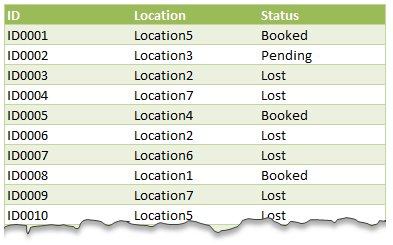
A look at the data
Lets say, you have some data like this and you want to understand what is the conversion ratio by location.
Setup a pivot table
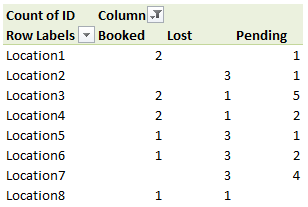
The first step is to just create a pivot table from this data. Put locations in row labels area, status in column labels are and ID in values area. Now you will have a count of items for each status in each location. Something like this:
Add a calculated item to get conversion ratio
Now we want to calculate how much percentage is “booked” status items in all items for a location. To do this,
- Select any column label item in the pivot table.
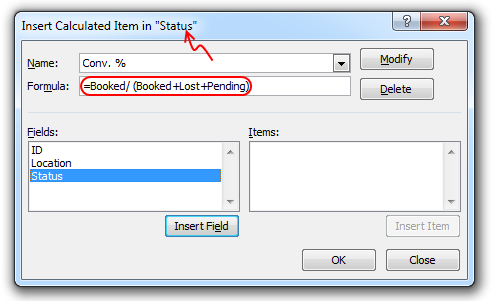
- Click on Pivot Options > Fields, Items & Sets > Calculated item

- Give your calculated item a suitable name like Conv. %
- Write the formula = Booked / (Booked + Pending + Lost)
- Click ok.
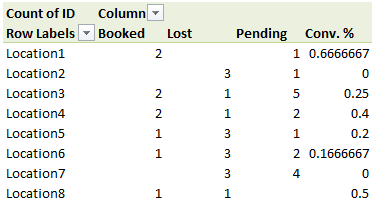
Now you should see another column in your pivot table with calculated item – Conversion %.
Formatting Conversion % in Percentage format
While we got what we wanted, it is not looking alright. We need to format the conversion % so that it looks alright. For this,
- Right click on any value in pivot table
 Go to value field settings
- Click on number format
- Select custom
- Type the custom formatting rule [>=1]0;[<1]0%;””
- This will automatically transform all numbers smaller than 1 (ie all conversion %s) to percentage format while keeping everything else normal.
- Done!
Resource: Learn more about custom number formatting
A video tutorial explaining this & more
Since calculated items can be somewhat tricky, I made a short video explaining how this works. In the video you can also see how to use Power Pivot measures to calculate conversion ratios easily. Watch it below (or on our youtube channel).
Download Example workbook
Click here to download example workbook. It has both regular and powerpivot based calculations. Go ahead and examine them. Enjoy.
Do you use Calculated items?
I find calculated items to be very tricky to work with. In most cases, I try to add extra calculations to original data table or use formulas instead. But this example is a good case where calculated item is perfect.
What about you? Do you use Calculated items? In what situations you use them? Please share your experiences and tips using comments.
Convert your self to a Pivot table pro…
If you are use Excel pivot tables & data analysis features, then you will find below resources very useful.


19 Responses to “How to Distribute Players Between Teams – Evenly”
An excellent solution, especially for large data sets.
Another solution without using solver would be to assign the player with the highest score to Team 1, the 2nd to team 2, 3rd to team 3, 4th to team 3, 5th to team 2, 6th to team 1, 7th to team 1 and it continues. This method would end up with a Std Dev of 0.001247219. This works best with a distribution with lower Std Dev for the dataset.
Full Disclosure: this is not my idea, remember reading something a few years ago. Think it may have been Ozgrid
thinking back I now remember why I read about it. About 10 years back I had to distribute around 300 team members into 25-30 odd teams. Used this method based on their performance scores. I used the method I described to do this and the distribution was pretty fair.
Solver would have saved me a ton of time though 🙂
I think the issue with you first Solver approach was that you took the absolute value of the sum of team deviations (which should always be zero except for rounding) instead of the sum of the absolute values (which is a reasonable measure of how unbalanced the teams are).
Here's another simple algorithm you could use: you start from the top (with players sorted from high to low), and at each step allocate the next player to whichever team has the smallest total so far. You can implement it dynamically with some formulas so it will update automatically when the data changes.
If the scores were more widely distributed (so that this might end up with not all teams the same size), you could add a constraint to only pick among the teams which currently have fewest players at each step, or just stop adding to any team when it hits its quota.
When I tried it on the sample, I got the three teams below, with a STDEV of 0.000942809 (i.e. about half of what Solver got to).
Team 1: John, Hugo, Tom, Josh, Eric, Zane, Charles, Andrew
Team 2: Barry, Michael, Kenny, Joe, Xavier, Patrick, Oliver, William
Team 3: Henry, Steven, Ben, Frank, Kyle, Edward, Cameron, Lachlan
Thanks for sharing!
Hi,
I was looking at all the solutions and this is closest to what I intended to do. I am dividing a bunch of players into 3 soccer teams. Players availability is also a factor while deciding the teams.
So the steps the excel needs to do is as follows:
1) In availability column if "yes" go to next
2) Equally divide 'Goalkeepers', 'Strikers', 'Defenders' basis their quality
So the end result gives each 3 teams a balance of players playing at different positions.
Can this be done on Google spreadsheet with only availability as an input from the user and rest calculates by itself.
Sorry for asking such a pointed question, but I have been struggling to find a solution for it for sometime now!
Hi Ishaan,
I am working on a similar problem at the moment, so I am wondering if you ever found a solution and if you are willing to share what you did.
Hi everyone, this is a variation of the famous Knapsack Problem https://en.wikipedia.org/wiki/Knapsack_problem.
I had to use a VBA implementation recently as part of a problem, where we ar trying to allocate teams of an organization into different locations (we are a large company with many different team). The goal was to optimally allocate teams to individual buildings without putting too many teams into one building and not splitting teams apart.
As we had around 400 teams of different sizes, solver couldn't handle it anymore. Luckily there is a Knapsack algorithm implementation in VBA readily available on the internet :).
I also went with a heuristic approach first!
An interesting mathematical solution but what if Eric and Xavier can't stand each other or Patrick is best friends with Steven - the real life problems that effect "even" teams.
@Joe
You can add more criteria like
If Eric and Xavier can't stand each other
=OR(AND(E15=1,E16=1),AND(F15=1,F16=1),AND(G15=1,G16=1))
It must be False
If Patrick is best friends with Steven
=OR(AND(E5=1,E17=1),AND(F5=1,F17=1),AND(G5=1,G17=1))
It must be True
Note that the 2 formulas above are exactly the same
except for the ranges
One must be True = Friends
One must be False = Not Friends
Nice Post!
Just one question What if number of players are not even or equally divisible.
Nice post Hui!
I download your workbook and just try to change in options the Precision Restriction from 10E-6 to 10-8 and the Convergence from 10E-4 to 10E-10. The process take almost the same time, but the results was great.
The standard deviation I got was 0,000471.
Team 1: John, Tom, Kenny, Frank, Eric, Xavier, Edward, Zane
Team 2: Steven, Hugo, Ben, Joe, Josh, Oliver, Cameron, William
Team 3: Barry, Henry, Michael, Kyle, Patrick, Charles, Andrew, Lachlan
Great application of Solver! Thanks for the link!
Great explanation. Well done... However, I tried with 6 teams of 4 players and solver never did finish.
How about vba code for the same data set.
I have 3 column A B C wherein A has text and B has number Wherein C is blank. And in C1 been the header C2 where I want the name to come evenly distributed the number which is in Column B.
My Lastcolumn is 1000.
Sorry if I'm being slow here, but how is 'Team Score' calculated? I've gone through the explanation several times but it seems to just appear.
@Hrmft
This process uses the Solver Excel addin
Solver is effectively taking the model and trying different solutions until it gets a solution that meets all the criteria
Then solver puts the solution into the cell and moves to the next cell
So yes it appears to "just appear"
Hi ! Thank you so much ! Works great 🙂
I cannot get the fourth Equation to work in my excel spreadsheet
You have =($E$2:$G$25=0)+($E$2:$G$25=1)=1 as a SUMIF solution, I have, =($F$2:$H$13=0)+($F$2:$H$13=1)=1 as my solution but it does not work. The only thing I changed is the ranges. Any suggestions?
Thank you.
Jim
I cannot get the fourth Equation of TURE or FALSE statements to work in my excel spreadsheet You have =($E$2:$G$25=0)+($E$2:$G$25=1)=1 as a SUMIF solution, I have, =($F$2:$H$13=0)+($F$2:$H$13=1)=1 as my solution but it does not work. The only thing I changed is the ranges. Any suggestions?
Sorry I left some of it out in the previous question,
Thank you. Jim