This is a guest post by Krishna, a football lover & one of our readers. He is also a student of Chandoo.org online VBA classes.
The wait for lifting the most valued priced in football for Germans was finally over. For a football fan, world cup is best time that is scheduled every four years and that if your favorite team lifting the trophy is like your crush is going on a date with you. 🙂
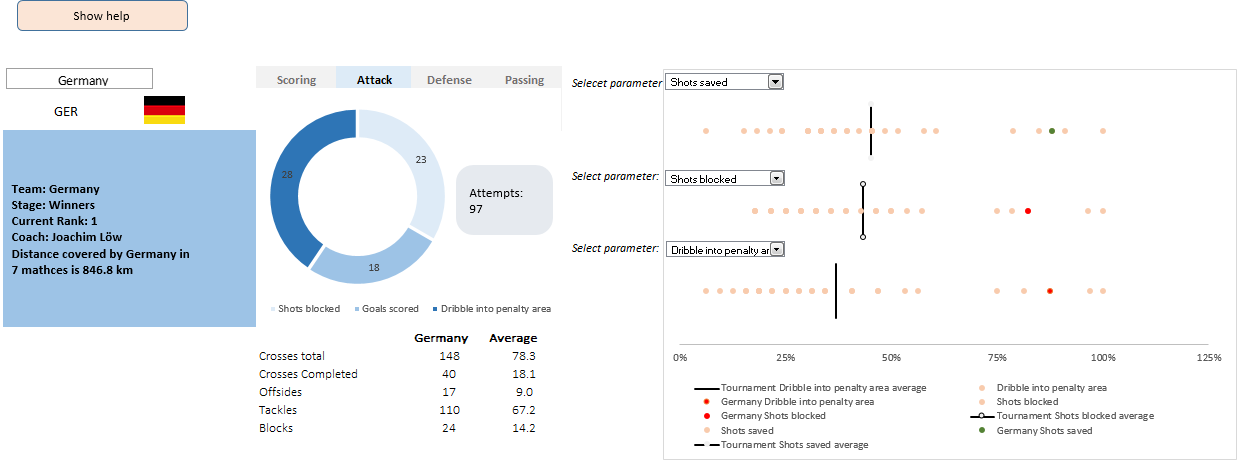
A sneak-peek at the final dashboard
Here is the final dashboard (it has more functionality than depicted). Click on it to enlarge.
Download the dashboard workbook
Click here to download the workbook. Refer to it while reading this article for most benefit.
How it all began…?
So, after the world cup, I have thought to analyze this tournament using excel. And also Chandoo’s podcast session 13 made me more excited to start on this.
I have started the by searching for information over net and thanks to FIFA for having all the information at one place.
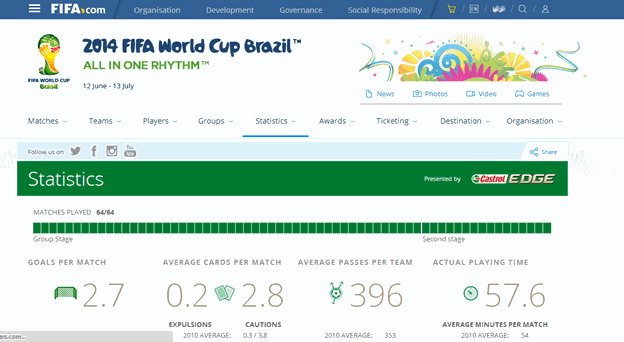
1. Planning of dashboard
I have made some dashboards and I think one of the essential steps to do is to plan what all needs to be represented in our dashboard. Having a checklist helps me to focus more on making it more interactive and creative rather than digging out for the data. In this dashboard, I wanted to show analysis of individual teams, matches played, and comparison of teams. However, I have added the top performers of World Cup in later stages.
2. Collecting data
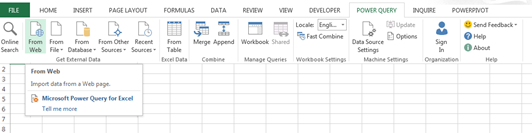
Having all the data on single site is great, however exporting to excel might seem a bit cumbersome because of formatting issues. So, it’s better to use PowerQuery (a Microsoft add-in) to extract the data from sites. (I came to know about PowerQuery, PowerView and PowerPivot though Chandoo podcast session 3, an interview with Mike Alexander). This provides us the data in tabular form and that saves a lot of time in formatting, especially when you copy from web.
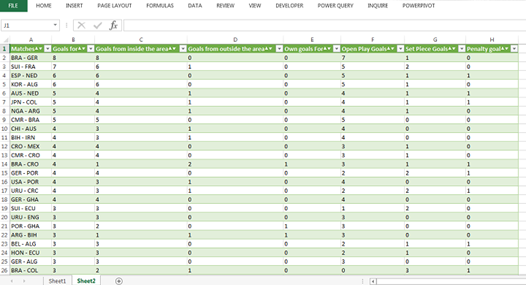
Once, I have the data for goals scored, I have collected data for other parameters as well and the stats are matched for the respective matches between the teams using Index-Match.
Now, we have the data related to matches played between the teams.
Similarly collect data for the teams. (FIFA.com has huge resource of information collected for this world cup)
3. What makes a team
Now, we need to make the right graphs for data representation.
For the first part of the dashboard (performance by teams) there are four areas that I wanted to show independently. I was tired of using the form controls. So, I have used the select cells control which requires a small macro and some form of conditional formatting to do the magic. For more on this technique refer to Interactive Sales Chart tutorial.
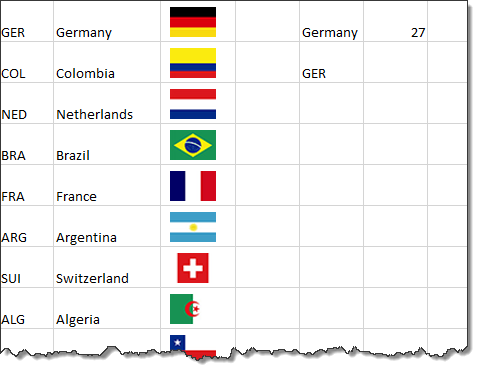
Now for the country selected there should be a flag. Here I have named all the flags with abbreviation of each country. A macro code is used to select the country flag which is the ‘Flag’ (selected cell) cell.
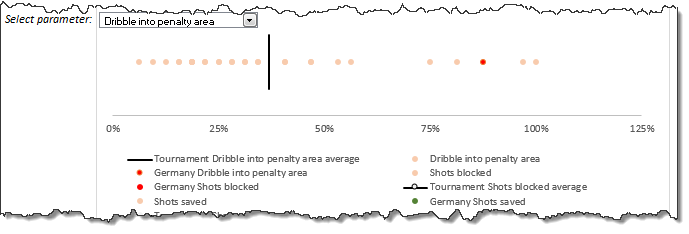
Scatter plot in the dashboard
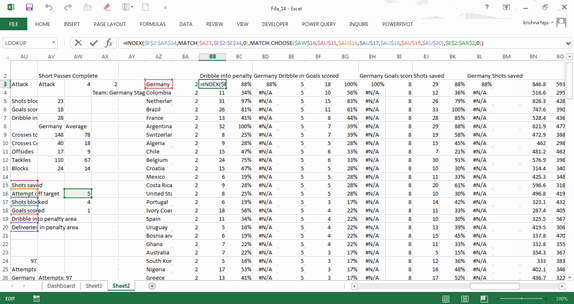
The chart on the right is scattered plot, where the data points are selected as per the categories selected in the drop-down. I have used Index, Match and Choose functions to select the data points for the all the teams. The pic below is for the “Dribble into penalty area” that is under “Attack”.
INDEX($E$2:$AR$34,MATCH($AZ3,$E$2:$E$34,0),MATCH(CHOOSE($AW$16, $AU$15,$AU$16,$AU$17,$AU$18,$AU$19,$AU$20), $E$2:$AR$2,0))
Which is
INDEX($E$2:$AR$34,MATCH($AZ3,$E$2:$E$34,0),MATCH(CHOOSE($AW$16, $AU$15,$AU$16,$AU$17,$AU$18,$AU$19,$AU$20), $E$2:$AR$2,0))
INDEX($E$2:$AR$34,MATCH(Germany, Teams selected,0), MATCH(Dribble in to penalty area, row headers,0))
INDEX(Data table,1st row,19th column) = 28
Similarly the data points required for the graph are populated.
Now, for finishing, add a small box that gives few details about the team. Here, we need to accommodate all the data in the box that can be done using CONCATENATE or just simply use “&”
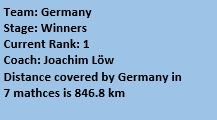
For e.g.,
=”Team: “&linkedCellFlag &CHAR(10) &”Stage: ” &INDEX($E$3:$F$34,MATCH(linkedCellFlag,$E$3:$E$34,0),2)
linkedCellFlag :named range for the selected team and Char(10) is required to provide ample space to goto next line.
The output will be (if I selected Germany):
Team: Germany
Stage: Winners
And similarly use & to add the data into the cells
So putting all together the final output is (yes I am a bot bad in choosing the right color scheme)
4. Match vs. Match ()
So now moving on to the next phase of the dashboard, the analysis of matches played.
Here, when I select two teams, say, Germany vs. Argentina, the match stats for corresponding teams must come up. Here, there are two things that we need to check:
- When I select Germany as my first team, I need to select all the teams against whom Germany played in this World Cup
- When selecting the match like GER vs. ARG, we need to have the same result even though I have chosen ARG vs. GER
To solve these two situations I have used the following method:
- Make a matrix of the teams played against every other teams as shown below. I have sorted the teams based on groups and using IF,MATCH, IFERROR populate the array as shown below
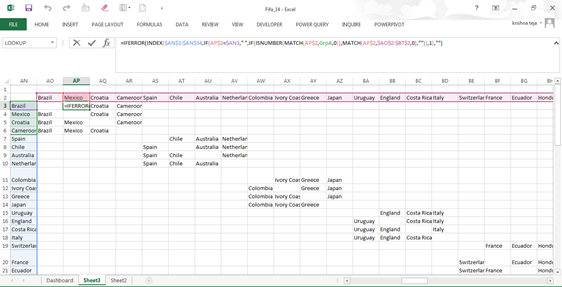
Formula used:
IFERROR(INDEX($AN$3:$AN$34,IF(AP$2=$AN3,” “, IF(ISNUMBER(MATCH(AP$2,GrpA,0)), MATCH(AP$2,$AO$2:$BT$2,0),””)),1),””)
For case of the selected cell, if, Brazil = Mexico, <<blank>>, If Brazil is part of Group A, then value of the team in header Row (AO2:BT2)
Similar procedure is followed for the other matches
For the drop down,
The index number (for eg., Brazil is the 1st team in the drop down bar, hence it has number 1) of the team selected and MOD (number,4) is evaluated. Corresponding teams are added from (i) (if the selected team is Spain, index number is 5, then teams are Chile, Australia and the Netherlands). Similar process is done for teams proceeded into later stages of the tournament is done.
Evaluation of the match
For the matches, when we select the teams, let say, Brazil vs. Croatia, here the home team is Brazil and away team in Croatia. So the index number assigned is “1-3”. I have defined the index number for each of the teams using CONCATENATE, INDEX, MATCH functions.
=CONCATENATE(MATCH(LEFT(F40,3), $AM$3:$AM$34,0),”-“,(MATCH(RIGHT(F40,3), $AM$3:$AM$34,0)))
F40= BRA-CRO
Hence, the formula becomes
CONCATENATE(MATCH(BRA),$AM$3:$AM$34,0),”-“,(MATCH(CRO),$AM$3:$AM$34,0)))
CONCATENATE(1,”-“,3)
Which gives 1-3
In case, I have selected to Croatia first and Brazil second, then I would have it as “3-1”, which doesn’t match with the list of matches. Hence in that case, we need to invert the number to “1-3”.
So finally, got the numbering right, which leaves us to lookup values for each category. So when I have seen initially, the list is too long. So I have decided to subgroup them.
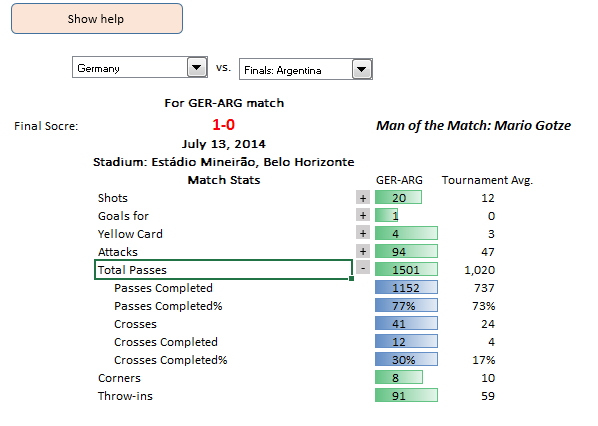
On an average the match stats that most of us look are shots, goals, suspension, attacks, procession. However, showing many statistics is often too dangerous. So, I have adjusted to the top stats and sub stats can be viewed if one like to. For example, one wants to look in-depth about goals scored, total attacks and total passes then small box in Column AG (the one highlighted) can be used to hide the rows or show the rows accordingly. A small macro to hide/show rows is sufficient for the same.
5. Where do the teams stand
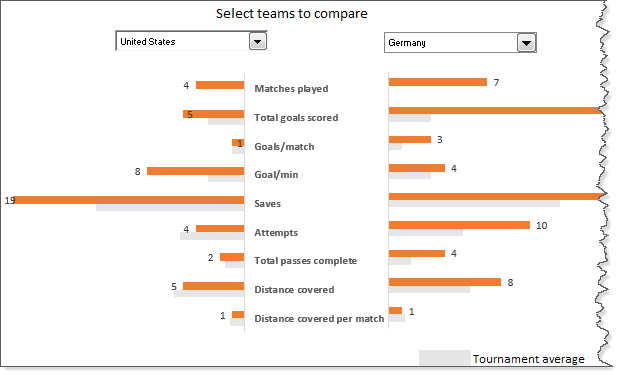
Now the third part to compare any two teams in the tournament and compare with tournament average. So this would be just a graph with all the data available. So I thought of animating the graph.
Before animation, an important thing to note is to check for the dimension of the variables we are analyzing. Since, all the data is coming on the same graph, plotting goals scored (e.g. 18) and total passes complete (e.g. 4200) in same would not help us. Hence, use total passes complete (in 100s) is to be checked. Similarly for other parameters.
For animation of the graph, I have done a similar as mentioned Chandoo in Excel VBA classes. (That course is really awesome. If you are looking to know more on excel VBA, I recommend you to join)
Top 5 teams
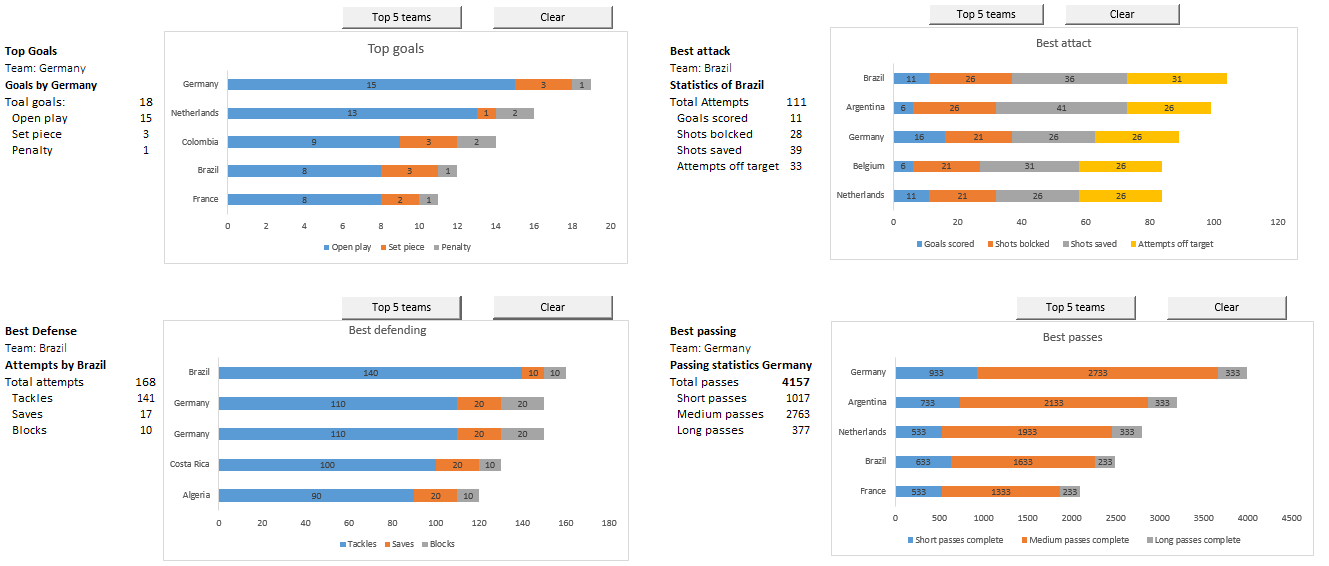
And at last, the comparison of top 5 teams. This is done using INDEX,LARGE formula.
INDEX($E$3:$N$34,MATCH(LARGE($I$3:$I$34,1),$I$3:$I$34,0),1)
In I3:I34, there are values of total goals scored by a team. Here we get Germany
In similar way we can check out for the remaining by substituting 1 with other numbers.
The charts are animated in the similar way as done in the previous graph, although an additional dimension is added.
So this is it. Make final touches by specifying the appropriate hyperlinks to the each section and maintaining the formatting is essential.
Thanks Chandoo for encouraging me to write a guest post.
Added by Chandoo: Thank you Krishna
Many thanks to Krishna for sharing his dashboard file & explanation with all of us. Your work is a proof of how much we can accomplish with Excel.
If you like this article,please say thanks to Krishna.
Want to learn how to create dashboards like these?
Then check out:


41 Responses to “Calculate Elapsed Time in Excel [Quick Tips]”
Hi Chandoo,
To calculate time lapses in excel I usually use the DATEDIF function. Even though is undocumented by MS there is a great explanation of its use in Chip Pearson's site :
http://www.cpearson.com/excel/datedif.aspx
Is pretty easy to use and has great flexibility.
See you and keep Excelling!!!
Another great article, I will be linking to it on my blog.
Oliver:
Yes, I think that DATEDIFF do it better.
Great post! This a fantastic tutorial on calculating elapsed time in Excel that could be helpful even to a novice user. Keep up the useful tips!
Also, the Office community on Facebook could really benefit from you knowledge! Check it out at http://www.facebook.com/office
Cheers,
Andy
MSFT Office Outreach Team
hi, Chandoo !!!
for elapsed time , we can use this unique formula either for hours, minutes or seconds : NOW()-A1)
but using respective special number formats
for hours : [h] ==> 46553
for minutes : [m] ==>2793212
for seconds : [s] ==> 167592763
We can also use mean duration for years (orbital period of the Earth around the Sun : i-e tropical year) which is : 365.25 days
and mean duration for month : 365.25/12 days
be Excelent !!!!
@Oliver... Thanks for the pointer to datediff(). I will update the post with information about this as well.
@Glen... thanks for the linklove 🙂
@Andy... Welcome. Thanks for telling us about the office community on FB.
@Modeste ... that is very cool. I will remember these formatting codes for an upcoming article on number formatting codes 🙂
Great tip Chandoo! I use the formula to calculate years elapsed all the time. It can seriously help save a ton of time with calculations. Also, NETWORKDAYS is one that helps and can seriously impress a boss. Keep up the great work here!
No problem! I will definitely be directing people with tough Excel questions to your blog. Keep up the great posts!
Andy
MSFT Office Outreach Team
Hi,
always great posts and a good way to start my day
but regarding the elapsed time calculations: have you never noticed that there is a result difference between using =TODAY()-A1 and using =NETWORKDAYS(A1,TODAY())?
try it for A1= a Monday such as 21sep09 and "today" is e.g. a Thursday; you get 3 or 4 respectively as a result, depending on the formula used; this is because formula =networkdays() always includes both the startdate and the end date and not only the time between these 2.
This is easily corrected/compensated bij always adding a -1 to the =networkdays() formula because the majority of us will count startday as day 0 and then the result will be consistent across the different formulas.
However, you then get into trouble if you calculate the networkdays for a date further in the past and where either the start or end date falls in a weekend.
just thought to point this out as to me these formula's are not interchangeable just like that!
have a great day!
Paul
=DATEDIF([DOJ],TODAY(),"Y") & " Y, " & DATEDIF([DOJ],TODAY(),"YM") & " M, " & DATEDIF([DOJ],TODAY(),"MD") & " D"
This will fix your 30 Days problem
I calculated the time diff between two date+ times by subtracting 2 cells & custom formatted it to "d hh:mm" format.
E.g.
Cell A1 04-Jan-12 6:00 PM
Cell A2 05-Jan-12 4:45 PM
Cell A3 0 22:45 (formula: =A1-A2)
Wat shud i do 2 not display the "zero" values i.e. no. of days in this case is zero hence the cell shud display " 22: 45" and not "0: 22: 45".
@Amol
Try the Custom Format code:
[
<1] hh:mm ; [>=1] d “d” hh:mmHi Chandoo,
If possible to compute the interval of time and date in one column.
In column C I would like to compute the total days and hours . What formula ? Please help
Example.
Column A Column B
2/13/12 3:30 AM 2/14/12 12:00 AM
In referenc to Elapsed time in months
To calculate the elapsed time in months, we can use the formula =(NOW()-A1)/30. This returns the value in 30 day months.
I use to apply formula =ROUND((TODAY()-A1)/30,0). Today, I faced a peculiar situation, A1 has date 01-Mar-2009, and today being 01-Mar-2012, it should be 36 months, but it is showing 37 months!!
Any suggestions to avoid such errors?
Regards,
Prasad DN
All I want to do is add up a series of times and receive a reply that gives me a total. What I used to do was subtrace the end time from the start time and format the result as [hh]:mm but this doesn't seem to work anymore. How has Bill Gates confounded me?
@Pete
I use Excel 2010 and it still works
The times must be entered as times in the format hh:mm:ss or hh:mm without seconds
Adding up times is as simple as =Sum(Range) or =Sum(A2:A10)
then using a Custom Number format as you have mentioned [h]:mm
If this isn't working, 2 ideas
1. Check your times are times and not text
2. Can you share your data or file with us?
My hospital tracks times from patient arrival to various procedures or treatments. When those times cross over midnight, the regular formulas (2nd time minus first time) don’t work because the result is negative and Excel (2007) won’t show a negative number in time format.
I couldn’t find a solution here (chandoo.org) but found one elsewhere that worked and it’s very simple. I would like to share it.
Assuming 1st time in A1 (column for patient arrival time) (11:00 PM), and 2nd time in B1 (column for x-ray given) (12:30 AM)). Should be 1:30 elapsed time.
=B1-A1+(B1<A1) [This comparison is the key to the solution.]
=12:30 AM – 11:00 PM + (12:30 AM < 11:00 PM)
=0.0208 – 0.9583 + (True)
=-0.9375 + (1) [This is the key! If it is false, Excel adds 0. If it’s true, Excel adds 1 and that is what corrects the negative number. Now Excel can interpret the number as a time.]
=0.0625
Converted to hh:mm = 1:30
I wrapped this formula inside an IFERROR one to alert my data entry person if she messed up and applied it to lots of different columns and it has worked wonderfully. No more complaints from the data entry person who just plugs in times from medical charts.
Very interesting solution. Thank you so much for sharing it with all of us.
HI,
I am working on a Xl application..
I want to capture time between two clicks.
Ex, in my application during run somewhere I press OK button and then I click Cancel.. I want to measure time between these two clicks... Is it possible??
Pls help on this...
@shashidhar
The answer is Yes
You will have to add an appropriate VBA event to start and stop a timer.
There are techniques which can time to the millisecond so maybe look those up on the net
WOW!!!!!! I truly love your excel time format program! WHOOOO! I am very interested in how the time formats "update" (manually on a physical keyboard) that "updates" the time into its respective decimal time formats, such as:
YYYY.yyyy, HH.hhh, etc...
How do those formulas or equations work if not in Excel mode? Example: TI calculators, Word, or any other computer language programming? Just wanted to see how it works. E-mail me at Ultra64848689Ti@gmail.com.
Thanks again for an EXCELLENT Excel program into decimal time formats!
Here's an idea: how about creating an APP for iOS and Android? Just wanted to point that out. =-D
Regarding the elapsed time in months:
I made this function to determine the time elapsed since a date using the number of days in each respective month. It's a simple subtraction and I think it works very well:((Year Today-Year A1)*12++(Month Today - Month A1)+(Day Today/Days in Month Today)-Days A1/Days in month A1)
Here's the function:
=((YEAR(TODAY())-YEAR(A1))*12)+(MONTH(TODAY())-MONTH(A1))+(DAY(TODAY())/DAY(DATE(YEAR(TODAY()),MONTH(TODAY())+1,0))-DAY(A1)/DAY(DATE(YEAR(A1),MONTH(A1)+1,0)))
Have a Merry Christmas everyone!!
I need the ability to calculate how much progress we have made between two dates and I want to represent that as a percentage.
I am thinking this would be a combination of today, networkdays & dividing the days elapsed vs the total days. Then it should be as easy as formatting my cell. Any help would be greatly appreciated.
@Christian
Your correct
dates are just numbers and so you can use simple math to derive the percentage
=(Date Now-Start Date)/(End date-Start date)
that will give you a number between 0 and 1
which you can format as a %'age
is there a way out to calculate the productivity for an employee
The day start is at 08:00 and day end is 20:00
The start date / time is recorded and end date / time is recorded
I want to calculate the timelapse taking into consideration the day begin and dayend time.
If the work begins and ends the same day, a simple formula b1-a1 would compute the productivity.
But if the process remains incomplete and is carried over to the next day, then timelines to be computed accordingly
to clarify,
if start time of an activity is 03/15/2015 18:00 hrs and end time is 03/16/2015 11:00 hrs, then the resultant formula should be 5 hrs (ie 18:00 to 20:00 hrs on day1 + 08:00 to 11:00 hrs on day2) ie 2+3
please guide.
Venkatesh, try (b1-a1)-0.5
This will subtract the fixed amount of time between shifts, 12 hours. If the time between shifts varies, then you could reference other cells that contain the variables.
Please help. when I use the networking days formula I get a date (2-may-00) I want actual number of days. I managing projects and I need to know how many days have passed since we received a project to the current date. Please help Thanks
@Aria: Just format the cell as general or number. that will fix the problem.
You rock! I looked at 17 other sites and they all did not work. Yours did. Thanks!
Hi folks ...
calculating age in years , months and days
=text(now()-a1,"yy")&" y " &text(now()-a1,"mm")-1 &" m "&text(now()-a1,"dd") & " d"
Hi, the Elapsed time in days [ =TODAY()-A1 ] works great however, if I do not have a date in A1, it shows 42157. Anyway to get it to display 0 or a Null value?
@Dan
=If(A1="",0,TODAY()-A1)
I get #NAME? and the formula does not work.
Hi Chandoo,
This might be a challenge - I am looking to calculate elapsed time between two columns
Start date Complete date
9/9/2015 7:21 10/2/2015 11:01
I need to take into account the following:
1) The employee works 7:00-3:15 pm each day
2) Std Work hours are 7hrs 45 min each day
3) Need to take into account all holidays in between start and end date
4) Work week is Mon through Friday.
Can you help?
Thanks!
Hi, i have a certain name (wilium) in column A and against this name i have 2 option, 1 Done and 2 Inprogress. i want that i count done again wilium and count inprogress against wilium separately. which formula will work for it??
Hi, i have a certain name (wilium) in column A and against this name i have 2 option, 1 Done and 2 Inprogress in column C. i want that i count done again wilium and count inprogress against wilium separately. which formula will work for it??
Year, month, day results for DoB.
The formulas I have found on the net and the datedif function do not work. This is what I came up with using a Microsoft support paper dated April 1997 with some modifications:
IF(OR(A2>$A$1,ISBLANK(A2)),"",IF(YEAR($A$1)=YEAR(A2),0,IF(MONTH($A$1)>=MONTH(A2),YEAR($A$1)-YEAR(A2),YEAR($A$1)-YEAR(A2)-1))&" years "&MONTH($A$1)-MONTH(A2)+IF(AND(MONTH($A$1)<=MONTH(A2),DAY($A$1)<DAY(A2)),11,IF(AND(MONTH($A$1)=DAY(A2)),12,IF(AND(MONTH($A$1)>MONTH(A2),DAY($A$1)=DAY(A2),ABS(DAY($A$1)-DAY(A2)),DAY(EOMONTH(A2,0))-DAY(A2)+DAY($A$1))&" days")
Check it out...
Hi, Augustin
what about :
calculating age in years , months and days
=YEAR(NOW()-DoB)-1900 & " y " & MONTH(NOW()-DoB)-1 & " m " & DAY(NOW()-DoB) & " d"
Hi Chandoo,
I am looking for help with the elapse time formula. I have a recruitment tracking sheet where we track the number of days the positions are opened, and when they are finally closed.
The opened positions will have a running turnaround time (TAT) formula and I am using this formula:
=NETWORKDAYS (start_date, TODAY (), Holidays2018)
Now, without disrupting the running TAT formula, how do I then get the TAT to stop when we have a final end date? All the information below is row:
- start_date --> Cell A
- TODAY () --> cell B
- end_date --> Cell C
Hope you are able to help. Thanks!
Interesting question. Try this:
Thank you for this helpful article. I was trying for days now to figure it out. Now the only issue I have is that if I do not have a value inputed for =TODAY()-[@[Date Precured]] Date Precured then it shows 44055. How can I get it to leave it blank if there is no data? Thanks again!!!