A Huge Collection of Spreadsheets for Teachers [What Excel Can Do]

Share

Facebook
Twitter
LinkedIn

Way back in November, I received this email from Tom, a senior researcher at the Center for Learning Innovation in Australia.

I’ve been developing & have published spreadsheet applications for teachers for some time now. In particular, I have animations, adventure scenarios etc that can be used to create games for the classroom. I need to promote these so teachers eventually try these and use them. … Perhaps you could post some of these on your site.

What a noble cause, I thought. So I wrote back to him and invited him to share his files along with a guest article. Tom acted quick and emailed me his article and Excel workbooks by Thanksgiving day. I was too lazy and got lost in the flow of things. But now, I am very very glad to feature his work.

There are so many valuable tricks, ideas and powerful concepts buried in his workbook. I encourage everyone to play with his file (you need to enable macros) so that you can learn a thing or two. If you are a teacher, feel free to use the files to make your classroom teaching even more awesome.

What can you do with a spreadsheet? by Tom Benjamin

Collection of Spreadsheets for Teachers - Excel examples & teaching aids

The spreadsheet was the original ‘must-have app’ that started the PC revolution because it allowed non-programmers to create loops. It is often overlooked in an era of countless cute free online calculators and interactivities. But few of the latter are easily deconstructed and customised to fit specific classroom needs, let alone being dressed in period costume to become a historical set or adventure cockpit for a an edu-game.

Now that Excel has incorporated graphic tools and form controls it is no longer ‘the boring old uncle’ of software. Its appearance can be as exciting as whatever graphic image you import into it. Its interactivity is as exciting as the context you give it in terms of setting the quest or adventure.

The accompanying spreadsheets cover a range of classroom applications. As demo’s they are intended to give you ideas rather than being a ‘finished product’ resource –ie- you need to look at the formulae to see how it works then change the content to fit your own purpose. These are available as free Creative Commons resources so you may deconstruct and re-purpose to your heart’s content. The main classes of spreadsheet covered here are as follows:

Graphics: Sheets 1-6

The clip art, vector drawing tools and general formatting provisions in Excel allow it to be used as a PowerPoint slide. Without even using formulae, graphic images can be used to hide clues, and elements can be moved around the screen, such as peeking under the ‘rocks’ in the dungeon example. This basic use fits in well with interactive white boards (IWBs). Vector drawing offers capabilities beyond the bitmap imagery in much IWB software. One effective technique is to use the huge library of special fonts such as scientific, i-Ching, Zodiacal, Roman Numeral, Arabic, WebDings and other symbols. Thus, a clue or answer can come up as an image rather than a number.

A dungoen built using Excel Charts, Form Controls, Clip art and other features - a good way to create puzzles and interactive learning tools for students

Although PowerPoint is better-equipped to display animated scenes, videos, sound, and animated .gifs, Excel can display changing frames merely by clicking between sheets manually, allowing complex visual animation. Software is readily-available to de-construct videos, animations and complex simulation modelling output into individual frames. Simple animation can be created by putting such a sequence of images on separate worksheets. The presenter can then scroll through these rapidly either via a form control button or merely hitting the next worksheet tab. This works especially well for full-screen graphics.


Charts: Sheets 7 -24

Charts can be dressed up with graphic borders, colours, and image elements so that they are scarcely recognisable as graphs. The ‘rocket cockpit’ example shows how steering wheels, instrument control panels, and simulated instruments of all types can be created merely by surrounding them with graphic borders. In primary school these might merely be used as visual display items, for instance the flickering torches and spider web in the Dungeon example. Or these could be linked to a formula so that they only flickered or appeared when a wrong answer was given. Setting the mood for such games falls outside the spreadsheet realm but the graphic images used in an adventure game can be set as backgrounds or images in a spreadsheet. Thus, pictures of the various decks of the ship in a pirate adventure could become background images. The player would then work from sheet to sheet inputting words or numbers which would make something happen in the scene, such as the sail rising or the cannon shooting, all of which could take place within a chart by converting its bar graph or pie graph elements to picture backgrounds.


Slider formula controls: Sheets 7-24

In addition to text and numerical input, Excel allows sliders and spinners to control cells. These cells can then trigger events in the sheet. Especially useful for vivid graphical display are protractors made from pie charts as attached. Contour maps are versatile as they can create pictures using colours and image-fills. The attached examples show clues being generated by moving a slider.


More complex animations can be created by linking the picture-filled elements of a chart with ‘0-1’ ‘on-off-switch’ formulae. Examples are shown in the attachments. Again, these are limited only by their quality and imaginative use. Full-blown videos or animations created in other software can be exported to individual frames. Moving a slider can then call up the individual frames. A ‘virtual puppet’ and ‘news desk’ are shown as examples. It would be more commonly applied to illustrating a concept difficult to show with live-action such as the satellite fly-by. The latter could be linked to formulae showing the distance from Earth, velocity etc. These values can be taken from more sophisticated software rather than trying to calculate them with Excel formulae.

A virtual puppet made using slider control is a good way to tell stories and engage students

Again, the imagination of the presenter is key in that a quick visual simulation may not need to be exact to illustrate a classroom concept. It need only be as good as what might have formerly been portrayed by a sweep of the chalk on a blackboard. The big advantage of the spreadsheet over the chalkboard may be less its imagery than the fact that it can be saved, improved and re-used rather than wiped after the session.


Artificial intelligence and interactive: Sheets 24-27

Human judgment of complex rating decisions can be simulated merely using in-built mathematical formulae without resorting to logical formulae, much less programming. Pearson correlations are a built-in function and other matching formulae are easily programmed. The attached example uses the Spearman Rank-Order formula to score the similarity of a launch sequence against an ‘ideal’ sequence-order.  Research has consistently shown that such seemingly ‘simple’ formulae can reliably outperform even highly-trained professionals if given a good set of answer criteria.

The value of such artificial intelligence models in the classroom is that they can interact with the learner and that they can be seen to be fair and unbiased provided the criteria for judgment are made explicit to the learner. The Bidding Game and Balloon Launch Sequence examples demonstrate such uses. They are easy to create as they use built-in functions so are limited only by their imaginative use.
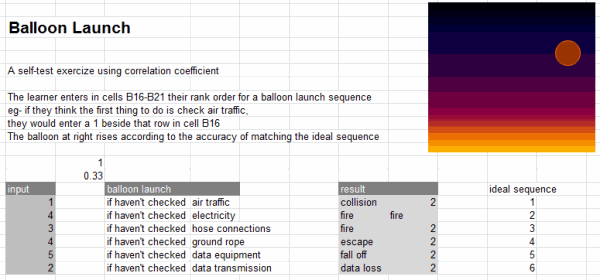
Baloon launch sequence - simulation exercise in Excel - a good way to understand complex models using simple tools like Excel

If we want our programme to really seem lifelike we can add language interaction. This is important if learners are supposed to be typing in queries like “how tall is…?” or “who is…?” but decide to play around and input irrelevant and irreverent comments. Excel has a range of logical ‘lookup’ expressions that can be combined with formulae to create responses.

The number of cells was a limitation in earlier spreadsheets but the 65536 rows now available allows for at least some limited language response. The random number function refreshes with each entry so that a more life-like interaction can be achieved by linking a rand() function to a cell such that the value changes to an integer drawing randomly from a set of response words/phrases. The final worksheet example ‘the crashing bore’ shows what can be done using commands to parse the input string, a look-up to identify key words, another lookup to match responses to those words, and a random function to prevent the same answers reappearing.   More complex interaction could be achieved by constraining user input to specific questions like “how much”, “where is” etc, using weightings, and pattern-correlating against the input string. Graphics can make the ‘chatterbot’ answer-machine interaction seem more life-like or appropriate (like HAL9000 the computer from 2001: A Space Odyssey).

Download the Excel Files

Please click here to download the Excel Workbook for Teachers [this file is 9MB, so give it sometime to download]

Also, Tom made a simple Excel skills test. Click here to download and test your Excel skills.

Thank you Tom

A big thanks to Tom for sharing this valuable work with all of us. I have already learned some good tricks from his workbook (creating image slide-show thru charts+scroll-bar, running formulas on click of button, using contour charts etc.). I am sure you too will find some interesting areas of application or learn some valuable things by examining his workbook.

If you like this workbook, please say thanks to Tom.

Also, if you are teacher, please share your experience of using Excel in teaching effectively.

More tools & Ideas for Teachers:

Facebook
Twitter
LinkedIn

Share this tip with your colleagues

Excel and Power BI tips - Chandoo.org Newsletter

Get FREE Excel + Power BI Tips

Simple, fun and useful emails, once per week.

Learn & be awesome.

Welcome to Chandoo.org

Thank you so much for visiting. My aim is to make you awesome in Excel & Power BI. I do this by sharing videos, tips, examples and downloads on this website. There are more than 1,000 pages with all things Excel, Power BI, Dashboards & VBA here. Go ahead and spend few minutes to be AWESOME.

Read my storyFREE Excel tips book

Overall I learned a lot and I thought you did a great job of explaining how to do things. This will definitely elevate my reporting in the future.
Rebekah S
Reporting Analyst
Excel formula list - 100+ examples and howto guide for you

From simple to complex, there is a formula for every occasion. Check out the list now.

Calendars, invoices, trackers and much more. All free, fun and fantastic.

Advanced Pivot Table tricks

Power Query, Data model, DAX, Filters, Slicers, Conditional formats and beautiful charts. It's all here.

Still on fence about Power BI? In this getting started guide, learn what is Power BI, how to get it and how to create your first report from scratch.

60 Responses

  1. My most often used variation of this is to remove blanks from a list.

    Suppose column A contains information but some of the rows are blank. I want to return a continuous list of information without the blanks so I do…

    Your original formula looks like this:
    =IFERROR(INDEX($B$1:$B$20,SMALL(IF($A$1:$A$20=$E$2,ROW($A$1:$A$20)),ROW()-2),1),””)

    I want to look for non-blanks and all my data is in column A so I change it to:
    =IFERROR(INDEX($A$1:$A$20,SMALL(IF($A$1:$A$20″”,ROW($A$1:$A$20)),ROW()-2),1),””)

    Ctrl+Shift+Enter, fill down and ta-da! A nice continuous list of information without any blanks.

    1. =IFERROR(INDEX($A$1:$A$20,SMALL(IF($A$1:$A$20″”,ROW($A$1:$A$20)),ROW()-2),1),””)

      The original post chopped out my ‘does not equal’ for some reason. This is how it should look

      1. And again ?????

        My sincerest apologies Sohail, I didn’t mean to trash your comments section like this. I’ll stop replying now.

    2. Hi Sir,

      I am not able get any value by using below formula.
      =IFERROR(INDEX(DeliveriesMaster!$H:$H,SMALL(IF(Criteria!$A$3=DeliveriesMaster!$A:$A,ROW(DeliveriesMaster!$H:$H)-7,””),ROW()-3)),””)

      I want try

      help me

  2. Great stuff. I laughed. I cried. I hurled.

    Personally I would use a PivotTable and Gordon Ramsay. But hey…as long as we cook the books, then each to their own, I’d say.

  3. I won’t recommend the use of ROW()-2 because everything gets mess if you insert a row(s) before the row 2. The alternative would be ROWS(E$3:E3).

    Regards

    1. Hi Elias,
      I tried doing what you have suggested here.
      Ading any additional row messes up everything like you siad. But using the formula that you have suggested, shows only one value for the entire array. Would you please help me undersatand your method. I feel I may not be doing it correctly.
      Regards

  4. I’ve been using data with multiple occurrences for awhile now, and was glad to see the question I’ve been trying to ask and don’t know how finally got answered. Now if I can be brave enough to use this, is another question.
    What I usually do is just add another column to the end of my data =IF((COUNTIF($B$2:B2,B2))=1,1,””) where B is my unique identifier and then just do multiple COUNTIFS with it.
    For multiple Occurrences and Criterias, I just add another column to Concatenate my unique identifier and the other criteria =$B2&” “&$C2, then add another column using the same =IF((COUNTIF($B$2:B2,B2))=1,1,””) but this time use the column where I placed the concatenated data.
    Any ideas how to lessen the number of columns I use without using any Arrays or VBA’s?

    1. Hi Mando,
      Are you pretty much asking for an alternative way to do this without VBA/Array Formulas? If so, I would recommend not doing that, Arrays make things a bit easier. The method you wrote looks like it will increase work, I’m always in search of efficiency in the long term 🙂

  5. It’s both illogical and unnecessary to use a construction for SMALL’s (or LARGE’s) k parameter which consists of the ROW function (either in its unqualified form, i.e. ROW(), or with a reference, e.g. ROW(A1)) +/- some constant.

    Not only is such a construction necessarily dependent upon the row number in which the user decides to place the initial formula in the series, but it is also susceptible to error upon row insertions within the sheet.

    ROWS (i.e. ROWS($1:1), or ROWS(A$1:A1) if you prefer) gives precisely the same results, though suffers from neither of these two drawbacks:

    http://excelxor.com/2014/08/25/row-vs-rows-for-consecutive-integer-generation/

    Regards

  6. @Elias and XOR LX, great point and while I use the construct you mentioned in other things, I never really gave it too much thought since I owuldn’t readily insert rows in this sort of thing.

    I love the rule of ROW(A1) +/- constant being illogical! Any time I can eliminate something from my arsenal due to redundancy is good. Much appreciated and once again this sort of exchange is precisely why we love Chandoo 🙂

  7. I like this technique a lot and *will* be using it. However how can it be done in 2D. E.g I have a 3 by four table (12 items) and each items is either an “Apple” or an “Orange”. I want to get the row and column position of each occurrence of “Apple” and of “Orange”? How would I do this?

  8. @Mr J

    When you say “row and column position”, do you mean relative positions or absolute? For example, if your table was in A10:D12, and the first occurrence of “Orange” was in cell B11, would you want 11 (absolute) or 2 (relative) returned for the row position?

    Regards

  9. The master database contain name, designation, salary, passport no, expiry date, joining date, project no. camp name, floor no., flat no., room no., around 20 more column, and this is more than 500 staff member.

    i want to make report for the camp and i want use the employee ID to transfer their name, designation, flat no., and their room no only to other sheet using VBA code.

    Please help me.

    Thanks

  10. This was a great post and I learned a lot. i am attempting to do exactly what this post was about with the exception of direction, i want to go across not down. is this possible?

  11. To summarize for those who will not take the time to go through the whole comments list (and who therefore will avoid some brain overload and save some grey cells), use at the end of your array formulas

    ROWS($1:1) instead of ROW()-2

    it additionally is more intuitive for understanding the formula:
    ROWS($1:1) => displays 1st result
    ROWS($1:3) => displays 3rd result

    Thanks all for this posts & comments

    Skrattoune

    1. in the Multiple Occurrences fomula, we couldnt get the second line since its not appear, but when we check your file, i saw there is {} brackets before equal but when we extract it we couldnt see it. how to do that?

  12. Very useful post. I worked with the downloadable workbook and did some experimenting to see how each part of the formulas worked. Although I understood most of it, I have a question. What if I wanted the results of my search for each person to be listed by column instead of by row?

  13. Hi all,
    thanks for the contribution, it helped a lot.

    But what if I need to get the average of the multiple values I get?
    Is there a way to get the average of these multiple values directly (without listing them beforehand…my sheet is already busy)?

    thanks a lot.

  14. Mr. Doo, you are so funny! I did not know the multiple occurrences could be done without a (trial and error) macro.
    You make it fun to make a complicated task a Can – Do ! Thanks!

  15. Hi,
    It looks super helpful.
    However, whatever I do it feels I’m almost there… but every time it’s a mirage.
    I’ve a (very) big data table consisting of multiple parameters (about 10) for every value in column A. A problem – same A value may (or may not) appear multiple times in my big table. Luckily, the repetition is always in clusters – one after another (and after the cluster ends, there is no more same A).
    The goal – I’ve a subset of data consisting of arbitrary values of column A (each one repeats only once), and I want to get all the parameters for all them (including for the as much as there is same A values). With you function, it fills nicely automatically for only the first A, but only once (without considering multiple occurrence), and then jumps to the next one.
    Is there a way to solve this (without tediously manually inserting N rows number for N A’s)? I prefer not using macro’s.
    Thank you,
    Julia

  16. Does anyone know how to summarise the following data to return the record vertically under the expected result?

    Much appreciated …

    Data is from A1 to D3
    Name “Asset Name#1″,”Asset Name#2″,”Asset Name#3”
    ABC Asset 1 Asset 2
    ZXY Asset 1

    Expected Result:
    Name: Asset Name
    ABC Asset 1
    ABC Asset 2
    ZXY Asset 1

  17. Hi

    What if I have multiple criteria I need to do this for? So in your example, instead of just “Tom Yorke”, I had a list of first and last names I needed to identify all instances of in a larger file. How would I go about doing that? Thanks!!

  18. Hi,
    I have 2 sets of name lists in a spreadsheet and need to find whether the same set of names repeat in the consecutive rows. can anyone please help me.

  19. hi dear
    i have a list of persons(First name space last name) in column A. multiple values are equal to first name and last name. ie. A kumar, b kumar alok das, alok ranjan. now i want multiple entries of all matching first name or second name as per my choice, what is the solution.

  20. Hi,
    I have 10 rows. in row 1 there are multiple columns. in few colums some values are present. just i wants to count the coulmn number of first record. how do i get it ?

    example

    A B C D E F G H I J
    10 13 19 12 –> here number 10 position is 3
    11 2 5 8 –> here number 11 position is 1
    23 45 48 –> here number 23 position is 2

    1. @Arvind
      Try:
      =INDEX(COLUMN(A1:E1),MATCH(TRUE,INDEX(A1:E1<>0,),0)) Ctrl+Shift+Enter

      Copy down

      Change Column E to match the last column of your data

  21. Hi
    I wonder if you have any tutorial (preferably in video format) concerning your technique of sorting a data table in a dashboard based on user choice control button
    Thank you

  22. Great post! Thanks for presenting a solution to a problem I had. However, how do I expand this to search across multiple worksheets? Thanks!

  23. Just to say that you have been the only person I’ve found to bother explaining the rationale behind your function choices. There were other articles on the internet where people didn’t bother to make the effort. Many thanks.

  24. Is there a text character limit to this formula? It works when I enter a few sentences, but not when I have 10 sentences.

      1. this is the formula I’m running:

        =IFERROR(INDEX(Input!$A$1:$R$201,SMALL(IF(IFERROR(SEARCH($E$2,Input!$D$1:$D$201)>0,FALSE),ROW(Input!$D$1:$D$201)),ROW()-5),COLUMN()),””)

        and when I have this text paragraph on the sheet I’m pulling from, it won’t pull in:

        “We do need a fair amount of analysis in advance of the meeting. Let’s start with a sensitivity analysis at plan value under various assumptions in terms of what lenders take – say 50% up to 100% in 5% increments. Need to understand dilution at various points to each side as we negotiate. If we can get that in the next hour or so, we can figure out what else would be helpful to negotiations. ”

        But when I shorten it to:

        “We do need a fair amount of analysis in advance of the meeting. Let’s start with a sensitivity analysis at plan value under various assumptions in terms of what lenders take – say 50% up to 100% in 5% increments.”

        It works then..

  25. I like your work. the tread has been very informative.
    What I am trying to do get the multiple occurrences fill in columns not rows. AKA while you example has results in a the following format:
    Thom Yorke
    3
    8
    10
    12
    18

    I want the result to be
    Thom Yorke 3 8 10 12 18

    Can you assist with this change?

  26. Great work in this article! Very well explained!

    But i need some help…

    I want to use the Multiple Occurrences and Multiple Criteria with the Partial Text Search.

    Example:
    1st criteria: G11
    2nd criteria: Varnish
    3rd criteria: 1503/5

    And i want to use in the 3rd criteria only the “1503” to seeach 1503/5, 1503/6 and 1503/7.

    Can you help me with this issue?

  27. Hi chandoo, thanks for your wonderful work.

    I am in stuck to find a solution to extract multiple rows (by using index+ small+ if) and extract the multi columns to its rows.(multicolumn data should be combined as single).
    I repeated the index function three time to get three column’s data and combine it with wild character and got the required answer. But feel this can be done in better way. so Could you please help to simplify the below formula in alternative way.

    {=IFERROR(INDEX(Table1,SMALL(IF(Table1[Tag trim]=LEFT(F75,8),ROW(Table1[Tag trim])-1),1),COLUMN(Table1[MAX. LENGTH (mm)
    (22)]))&” X “&INDEX(Table1,SMALL(IF(Table1[Tag trim]=LEFT(F75,8),ROW(Table1[Tag trim])-1),1),COLUMN(Table1[MAX. WIDTH (mm)(24)]))&” X “&INDEX(Table1,SMALL(IF(Table1[Tag trim]=LEFT(F75,8),ROW(Table1[Tag trim])-1),1),COLUMN(Table1[HEIGHT (mm)
    (23)])),””)}

  28. Hi. Your help in excel is great. It has being very helpfull in a project I am working on.

    I got a question about Multiple Occurrences: I am trying to get all different values from the a same date and return values horizontally.
    It ls like this:

    Date provider
    June 2 A
    June 2 A
    May 3 A
    May 3 A
    May3 B
    April 4 B
    April 4 B
    April 4 B
    April 4 C
    April 4 C
    April 4 A

    Could you please help me with the formula?

  29. I’ve got a lot of hints from this post and was able to get almost there with my task but there is one problem – string length. I have a long list of stuff given in consequtive columns. I need to peak certain type of data (long string) and put them together in one cell. The text type comes after the text, so schematically one raw of the data looks like this (where Ty My Wy Oni etc is the Type and it repeats):
    Text_A Ty Text_B My Text_C Wy Text_D Oni Text_E Ja Text_F Ty Text_G My Text_H Wy Text_I Oni Text_J Ja Text_K Ty Text_L My Text_M Wy Text_N Oni Text_O Ja Text_P Ty Text_R My Text_S Wy

    What I want is “Text_A, Text_F, Tekst_K, Text_P” if the search=”Ty”
    The following works if the string in Text_X is <256; if logner -forget it
    =TEXTJOIN(", ";TRUE;IF($C$4:$AL$4="Ty";$B$4:$AK$4;""))
    same with error handling
    =TEXTJOIN(", ";TRUE;IFERROR(IF($C$4:$AL$4="Ty";$B$4:$AK$4;"");""))

    Most of the Index – Small etc solutions take up several cells to work and that is not an option this time. Any hints, please?

  30. Hi Chandoo,

    I have been brainstorming this from past couple of months. I work in reporting team and during month end I pull all incident report which has changed priority from P1-P2-P3-P4, P2-P3-P4 or P3 to P4. Currently, I am performing it manually (4000+ count). Below is the sample excel where I would highlight in a different color if priority changes from P1-P2-P3-P4, P2-P3-P4 or P3 to P4. So basically I want to check column A if it has more than 2 similar value it should check the final priority in column B based on Column C’s updated time and it should return value as P1-P2-P3-P4, P2-P3-P4 or P3 to P4 in Column D.

    Number Priority Start time
    INC0281369 Priority 2 2017-07-03 13:01:07
    INC0281369 Priority 4 2017-07-03 13:04:29
    INC0281696 Priority 3 2017-07-26 21:20:16
    INC0281696 Priority 4 2017-07-27 00:06:21
    INC0281962 Priority 3 2017-07-01 01:13:41
    INC0281962 Priority 4 2017-07-01 04:21:12
    INC0281974 Priority 3 2017-07-01 01:35:41
    INC0281974 Priority 4 2017-07-01 03:25:14
    INC0281976 Priority 3 2017-07-01 01:40:25
    INC0281976 Priority 4 2017-07-01 03:26:29
    INC0281985 Priority 2 2017-07-01 02:03:38
    INC0281985 Priority 3 2017-07-04 18:29:34
    INC0281987 Priority 2 2017-07-01 02:06:38

    Any help would be appreciated

  31. You have done a great job, Bravo!
    I want the same result but my “Das hoff” is in multiple sheets. Can you please be kind enough to give me the formula to have the same output but the searches are in different sheets.

    Thanks in advance.

    Nadeem

  32. Hi! Your instruction is great on this however I am still stuck with my formula. I revert back to INDEX/MATCH but I know my data is skewed. I really hope you can help!

    I am working with two worksheets, CREDIT _MEMO_ACCRUAL_MASTER & CM_12 – I will reference them as WS A& WS B.
    WS A is the master where my formula starts in column 15, row 2. My index/match is based on multiple criteria, Invoice # & Sku, to lookup the Original Invoice Date from Index sheet WS B. WS B only contains original invoice date, sku, credit date and amount.

    WS A:
    INVOICE# SKU RESULT FROM WS B
    139591 XYZ (BLANK)
    139612 ABC 12/11/2017

    Currently in “RESULT FROM WS B”
    =IFERROR(INDEX(CM_12!$B$2:$B$602,MATCH(CREDIT_MEMO_ACCRUAL_MASTER!B2&CREDIT_MEMO_ACCRUAL_MASTER!F2,CM_12!$D$2:$D$602&CM_12!$F$2:$F$602,0)),0)

    The trouble is this:
    WS B has reoccuring original invoice date and sku. In other words – invoice 139612 on credit date 11/30/2017 may have several different “original invoice dates” and 10 returned skus, therefore show up in 10 different rows.
    WB S:
    Invoice # Original invoice date Credit date SKU
    139612 08/08/2017 11/30/2017 1234
    139612 08/21/2017 11/30/2017 5678
    139612 08/30/2017 11/30/2017 1234

    I need a formula that will recognize the exact original invoice date for an invoice # and sku. Currently my index/match as you know only results in the first instance.

    I tried your index/small/if formula but it didnt work for me. index/small/if is very new to me so I am sure i was doing it wrong somewhere.

    I really hope you can help!
    Happy New Year!

  33. Hi All,

    Great post, which I come back to multiple times !!

    Can anyone explain to me how to amend the formula when you want to either exclude (e.g. all the lines NOT concerning DAS HOFF) rather than select a certain value, or when you want to allow more than one value (e.g. the lines where DAS HOFF is linked to US or UK)

    Thanks for your help.

    Geert.

  34. Great post!

    How do I get the output of the multiple occurrences into another coloum instead of on the same row?

    Thanks

  35. Thanks for the aide. I have been using this formula but the step by step explanation you have given makes me understand now completely the inside chemistry as to what is happening. Keep it up.

  36. Hi Chandoo

    I’ve replicated your exact spreadsheet and it works perfectly, thanks! For my actual application, I’m using a Named Table where:

    $B$1:$B$20 = Chandoo[PointlessThing]
    $A$1:$A$20 = Chandoo[Person]

    Replacing the fixed cell references with the Table[Column] values the array formula produces an output that is one cell below what the actual value is. For example, if my lookup value is Das Hoff with the named table I get Amnesiac, Raging, Limb King, Krautrock, Erasing. When I just use the cell references I get Talented, Knightrider, Baywatcher, SpongeBob, Krautrock. As you can see, outputs when using the named table are actually one row below the intended output.

    I’ve varied the formula, from completely deleting the -2 in …ROW()-2, to trying 0-3. I can never get the named table formula to output the same results as the cell reference formula.

    I’ve noticed the lateral distance doesn’t matter, only the relative horizontal distance, so for that reason my named table formula starts in cell E3, referencing E2 as the lookup value, and my cell reference formula starts in cell G3, referencing G2 as the lookup value. The Person/PointlessThing columns begin at A1 and B1. The table is named “Chandoo.” So my named table references are Chandoo[Person] and Chandoo[PointlessThings].

    As a final note, I’m using data validation, referencing the Person column of the named table as my lookup values in cells E2 and G2.

    1. So I retried the formula with dragging ranges (which automatically populates the range name) and I got this:

      =IFERROR(INDEX(Chandoo[[#All],[PointlessThing]],SMALL(IF(Chandoo[[#All],[Person]]=$F$3,ROW(Chandoo[[#All],[Person]])),ROW()-2),1),””)

      And it works!

      Originally I was hand typing it to make sure I got it all right and was entering this:

      =IFERROR(INDEX(Chandoo[PointlessThing],SMALL(IF(Chandoo[Person]=$F$3,ROW(Chandoo[Person])),ROW()-2),1),””)

      As you can see, I was missing [#All] preceding the column reference.

      That said, this also works when referencing another sheet in the workbook, as long as the relative positions stay the same.

      What I’ve run into now is this: Where I want the multiple occurrences to appear are ‘Visit Tear Sheet!F12:F16’

      The drop-down data validation is Visit Tear Sheet!F8

      The table location is ‘Visit Log’B49:C148

      I’ve kinda buried the table at the bottom of a spreadsheet because I don’t want non-tech saavy users to easily find it and screw it up. I know I could let it rest on a separate sheet starting at A1 like our sample data set, but I’m trying to keep the number of sheets to a minimum to keep the weight of the file down.

  37. Have you ever had to do this using Power Query? Or, know of a way to do something similar, but using Power Query? I have a huge workbook that uses a method similar to yours, but it’s way to slow using the SMALL and ROW formula so I’m trying to speed it up, but by using PQ. Thank you so much in advance for any help!

Leave a Reply

Your email address will not be published. Required fields are marked *

This site uses Akismet to reduce spam. Learn how your comment data is processed.