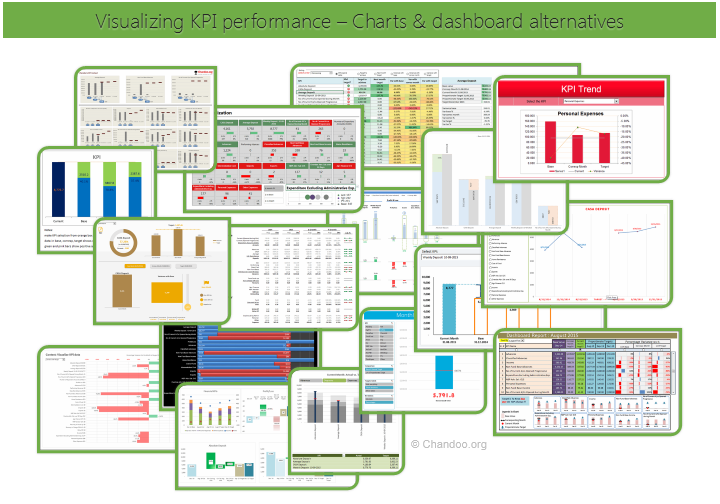
Hello all, prepare to be amazed! Here are 43 creative, fun & informative ways to visualize KPI data.
About a month ago, I asked you to visualize KPI data. We received 65 entries for this contest. After carefully reviewing the entries, our panel of judges have discarded 22 of them due to poor charting choices, errors or just plain data dumps. We are left with 43 amazing entries, each creatively analyzed the data and presented results in a powerful way.
How to read this post?
This is a fairly large post. If you are reading this in email or news-reader, it may not look properly. Click here to read it on chandoo.org.
- Each entry is shown in a box with the contestant’s name on top. Entries are shown in alphabetical order of contestant’s name.
- You can see a snapshot of the entry and more thumbnails below.
- The thumb-nails are click-able, so that you can enlarge and see the details.
- You can download the contest entry workbook, see & play with the files.
- You can read my comments at the bottom.
- At the bottom of this post, you can find a list of key charting & dashboard design techniques. Go thru them to learn how to create similar reports at work.
Thank you
Thank you very much for all the participants in this contest. I have thoroughly enjoyed exploring your work & learned a lot from them. I am sure you had fun creating these too.
So go ahead and enjoy the entries.
PS: I am sorry if your entry is not shown on this page. We had to disqualify 22 entries due to various reasons.
KPI Dashboard by Alberto Almoguera

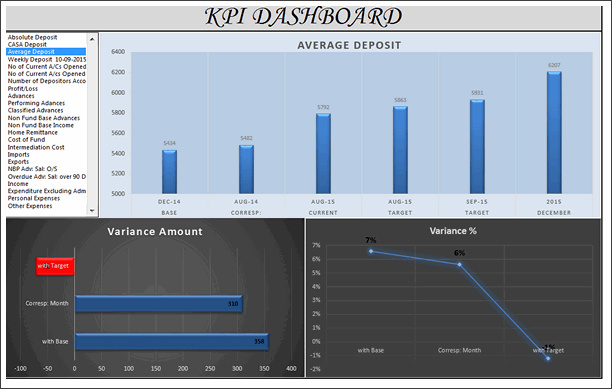
- Interactive with selection mechanism
- Interesting representation
- Lower charts can be replaced with sparklines / in-cell to declutter
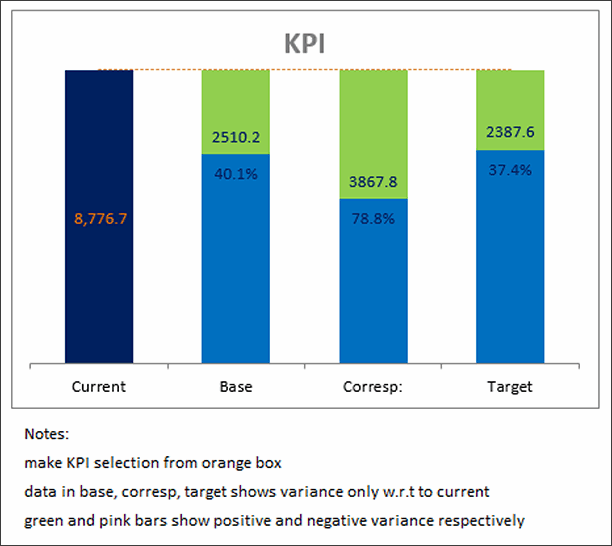
KPI Chart by Amit Sinha

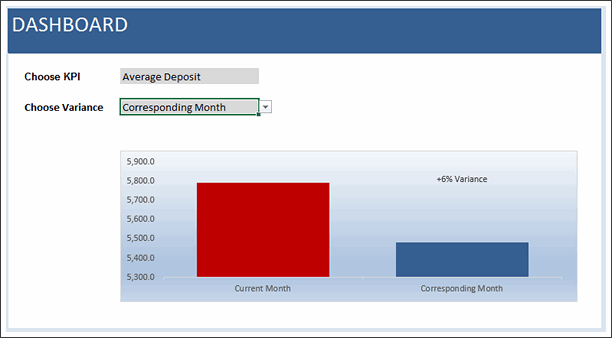
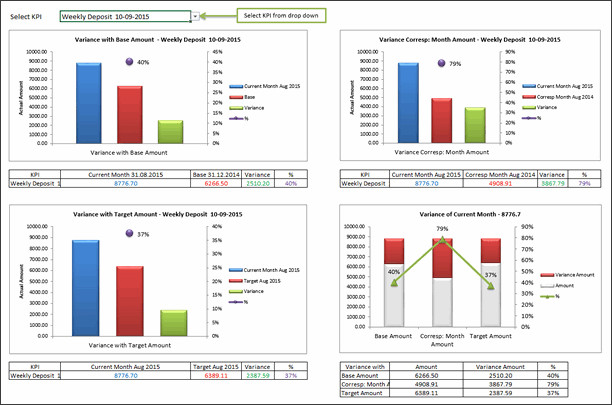
- Comparison and variance analysis
- Could use some insights – plain text instead of second chart?
KPI Chart by Ben Spalding

- Thermo-meter chart
- Feels over formatted, could have used simple colors.
KPI Chart by Chad Markel

- Interactive
- In-cell charts
- simple colors and easy to read
- May be sorting?!?
KPI Dashboard by Chetan Bhavsar

- Interactive
- Sortable
- The charts are well designed & labeled.
- Could have removed the table and kept charts (or reduced the content in table) as it is duplication.
KPI Dashboard by Francesco Petrella

- Interactive with slicers
- In-cell charts
- colorful & elegant
Become Awesome in Excel & VBA – Create dashboards like these…

- Learn how to create interactive dashboards & reports using Excel
- Develop your own macros & VBA code
- 50+ hours of video training
- Learn at your own pace
- Click here to know more
KPI Dashboard by George Gourgoulias
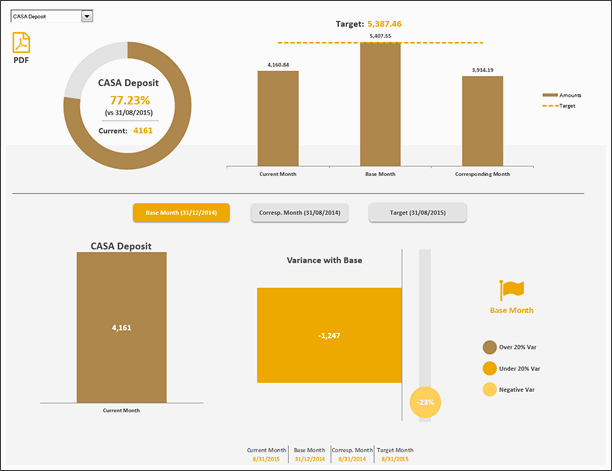
- Interactive with VBA / form controls
- Elegant and beautiful
- Ability to publish the report as PDF
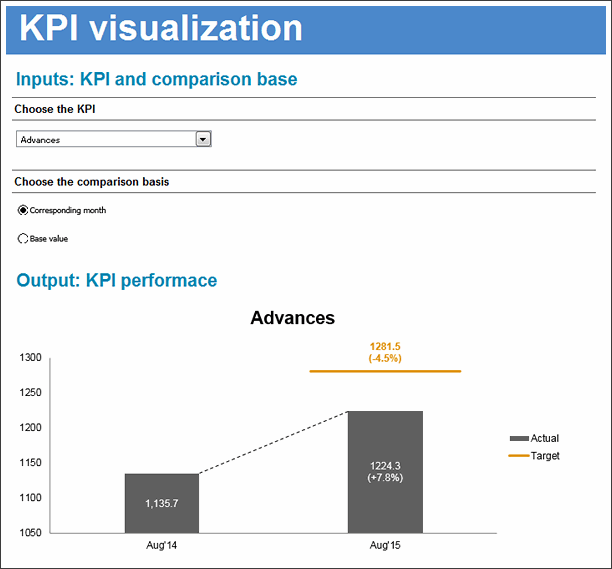
KPI Chart by Indranil Sarkar
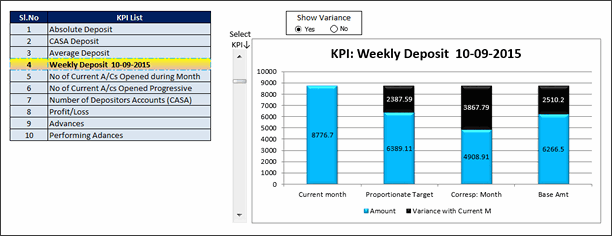
- Interactive
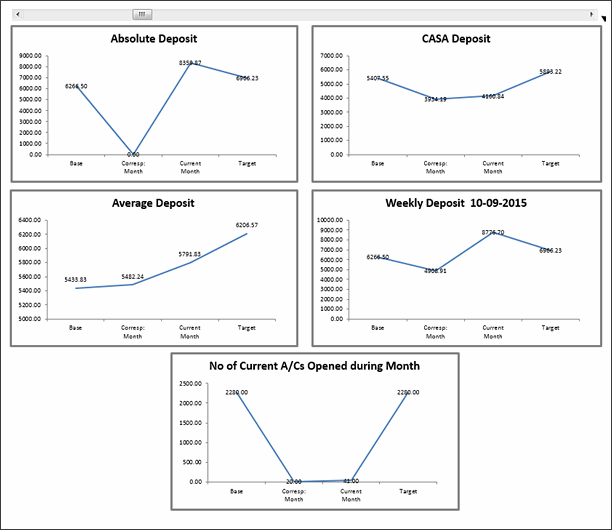
- Scrollable list to select KPIs
- Could use alignment and simpler formatting
KPI Chart by Janet
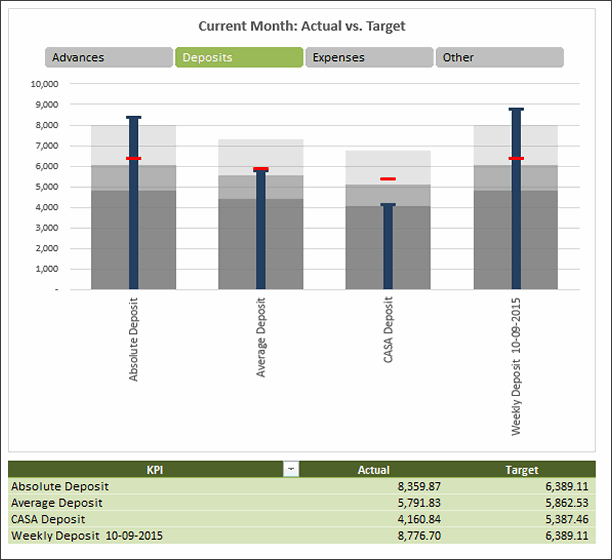
- Interactive with slicers
- Bullet charts
- Could use labels / explanation
- Also, horizontal is better
KPI Dashboard by Jiakun Zheng
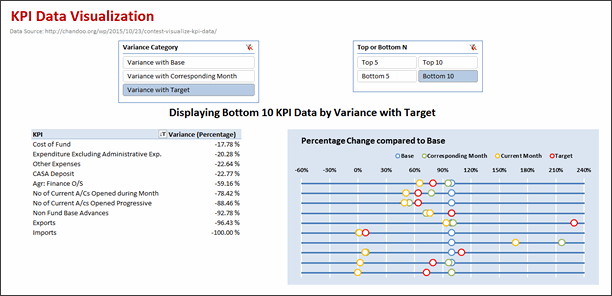
- Interactive with slicers
- power pivot (XL 2010+)
- Alignment problems, poor labeling
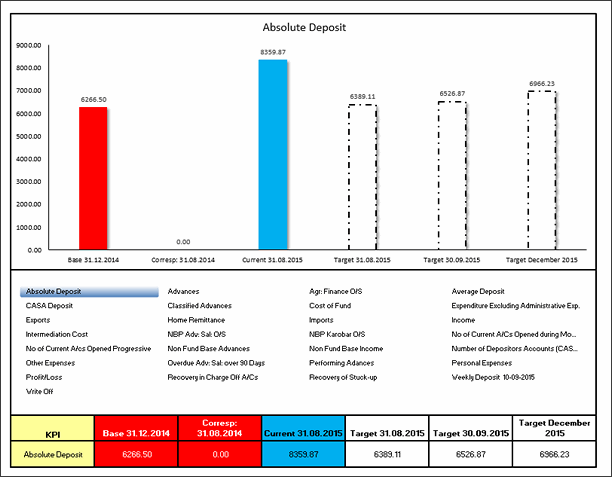
KPI Chart by Jonathan Decker
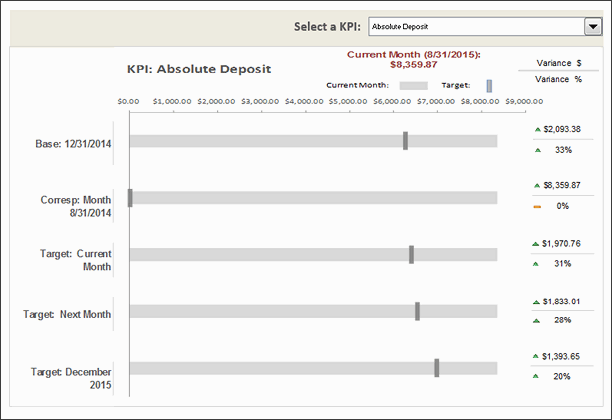
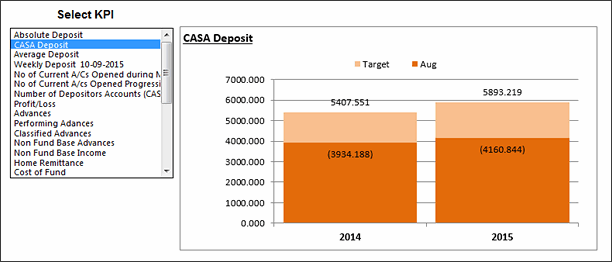
- Interactive
- Simple colors
- The current month bar feels repetitive. Could have used a line?
KPI Dashboard by Joon Tan
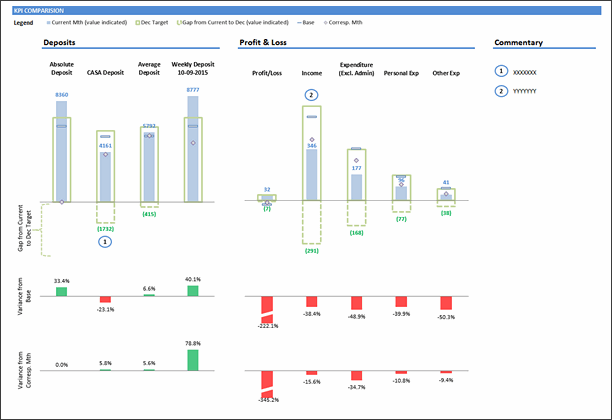
- Simple charts with elegant presentation
- Ability to add commentary
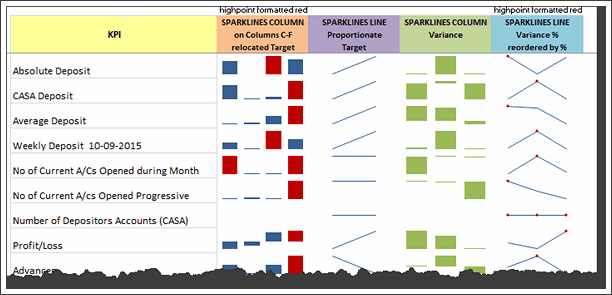
KPI Chart by Karthik Ranggarajan
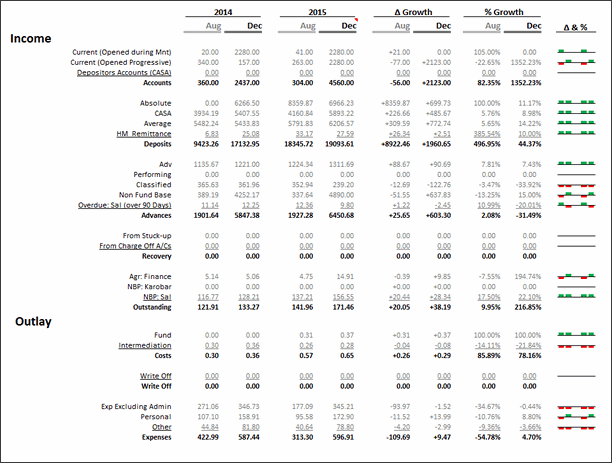
- Sparklines
- Elegant table design to present the information in simple way
- Good colors and layout
KPI Chart by Kaushik Joshi
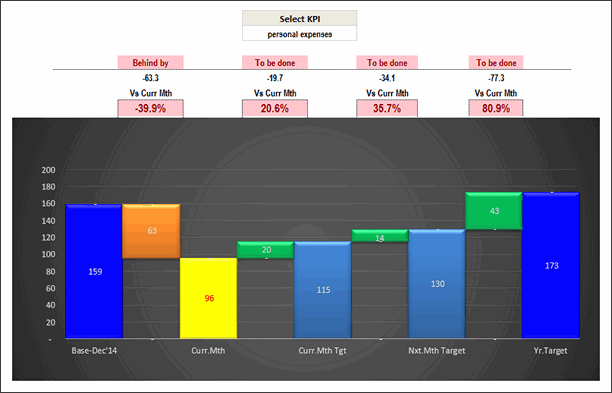
- Waterfall chart
- Interactive
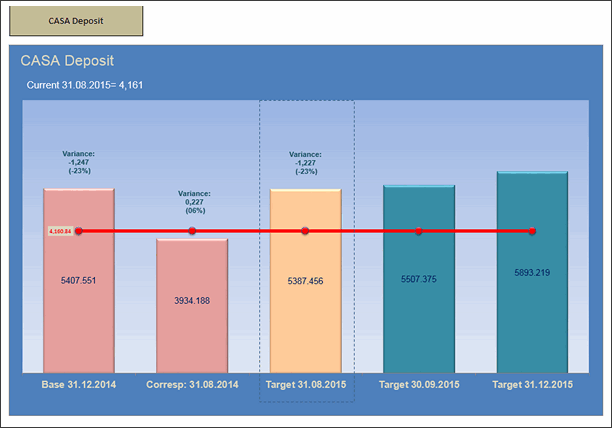
- Interesting representation, reduce the colors
KPI Dashboard by Keriman Hande
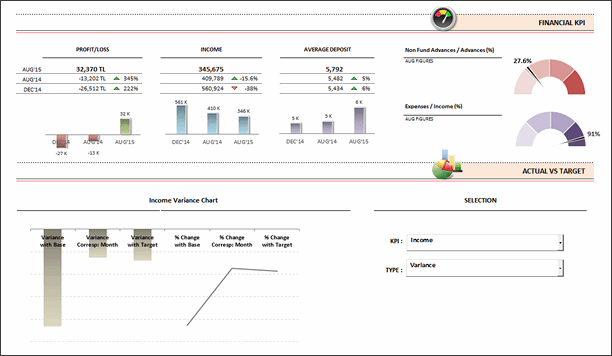
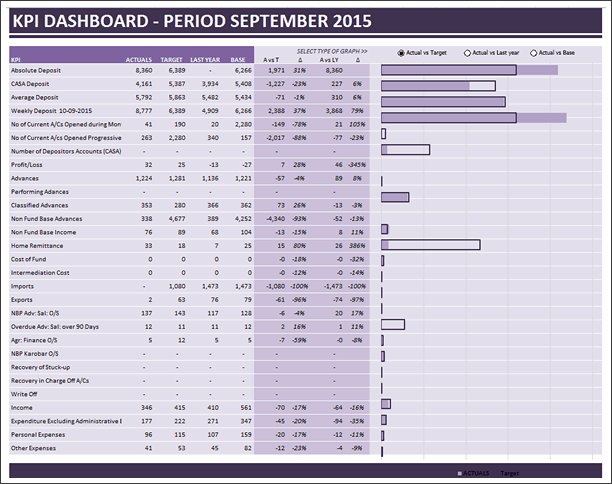
- Summary of key KPIs on top and drill down at bottom
- Ability to view variance or amounts
KPI Dashboard by Krishna Teja
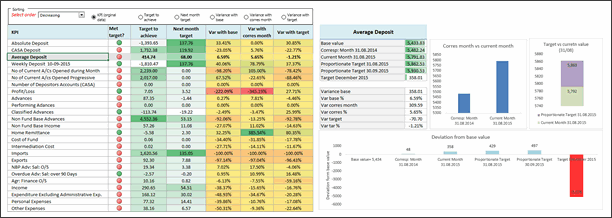
- Interactive with VBA / form controls
- Ability to sort, drill-down to selected KPI
- Feels a bit cluttered, reduce the columns
- Could use alignment and simpler colors
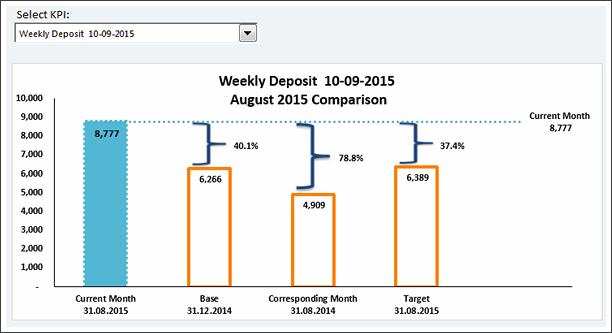
KPI Chart by M.Hussain Kawosh

- Interactive
- Grouped KPIs to multiple charts
- Could use explanation, not sure how to read the charts / grouping
KPI Chart by Marie-Anne Andre

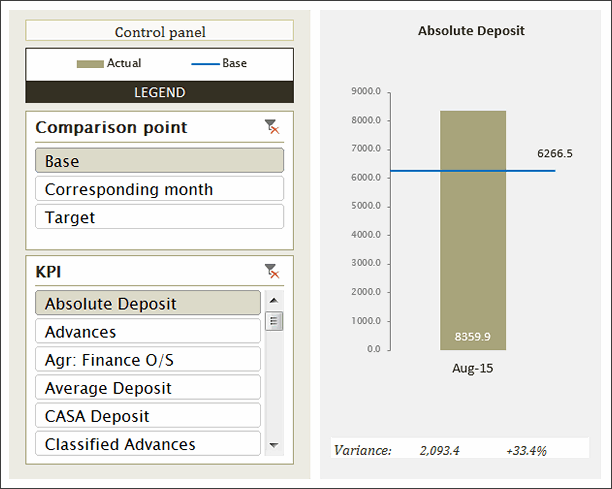
- Interactive with slicers
- Interesting design and presentation
- Reduce the control panel size and give more insights.
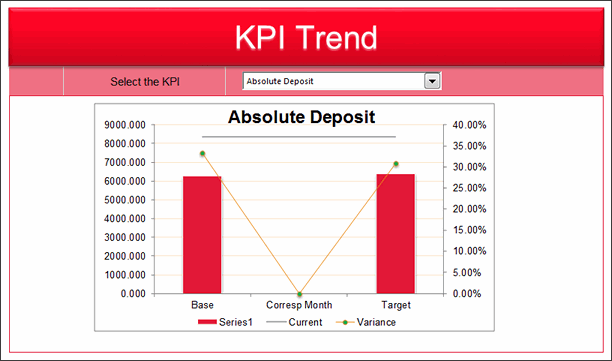
KPI Chart by Narayan Digambar

- Interactive
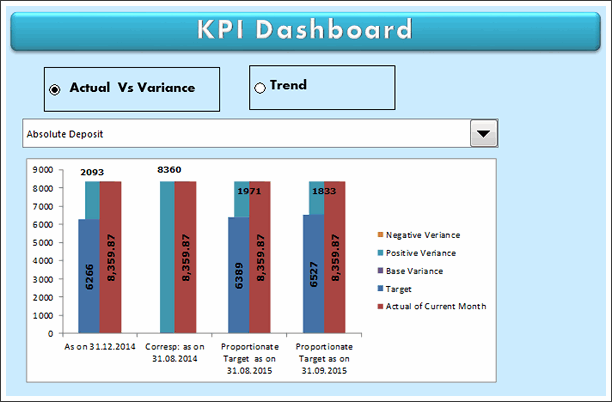
- Interesting take on the analysis – trend vs. variance
- Picture links
- Could use alignment and simpler colors
KPI Chart by Rabi Mahapatra
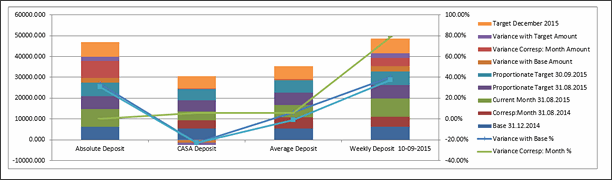
- Technically a data dump, but I give credit for the creative hexagonal KPI analysis.
KPI Chart by Ramananda V
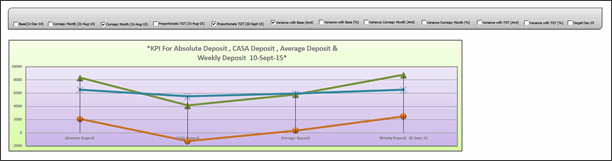
- Interactive
- Compares handful of KPIs amongst each other
- Could use less formatting
KPI Dashboard by Reynaldo Peña
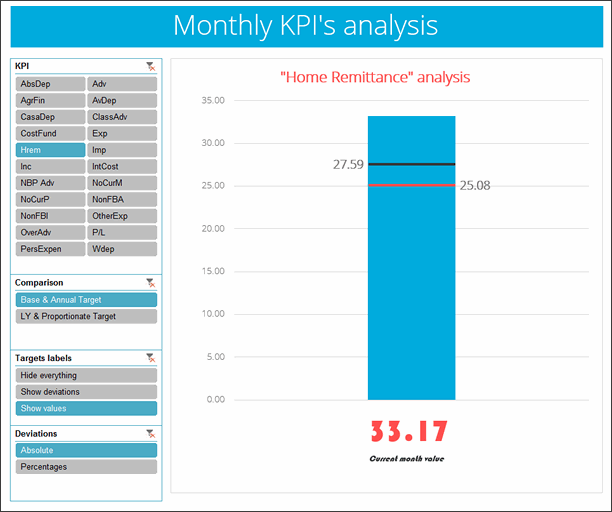
- Interactive with slicers
- Clear and elegant design
- Various comparisons and insights
Become Awesome in Excel & VBA – Create dashboards like these…
- Learn how to create interactive dashboards & reports using Excel
- Develop your own macros & VBA code
- 50+ hours of video training
- Learn at your own pace
- Click here to know more
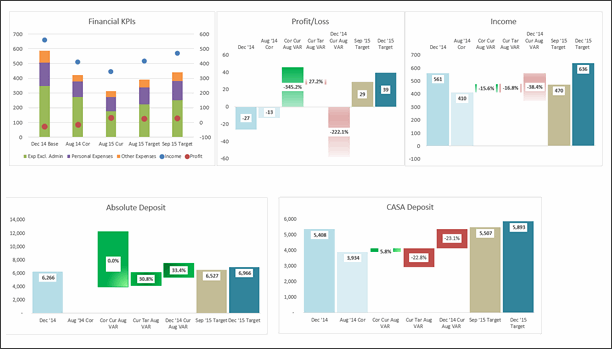
KPI Chart by Ronaldo Balas

- Interactive
- Interesting design, but feels over formatted. Reduce special effects, the caps on columns feel like stacked columns and confuse.
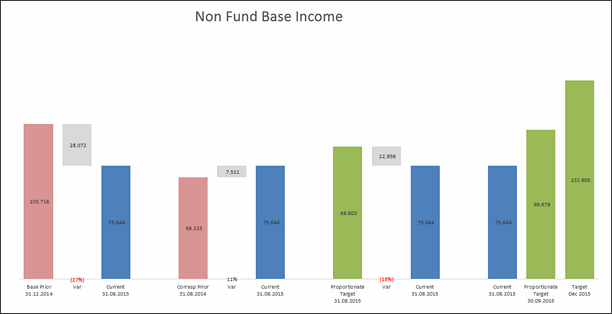
KPI Chart by Utkarsh Shah
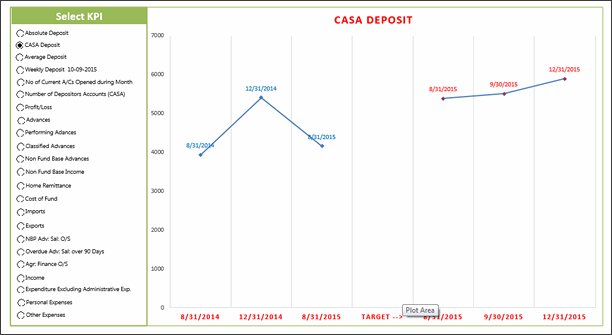
- Interactive
- Error in the option button selection (25 visible KPIs vs 23 buttons)
KPI Chart by Wil Davis
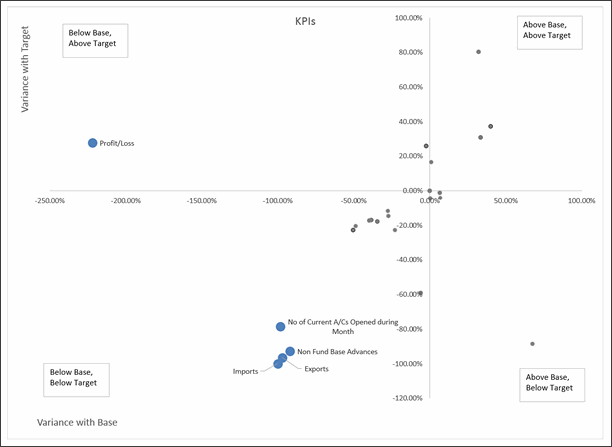
- Scatter plot with KPI performance
- Interesting representation
- Ability to drill down select KPI
Become Awesome in Excel & VBA – Create dashboards like these…
- Learn how to create interactive dashboards & reports using Excel
- Develop your own macros & VBA code
- 50+ hours of video training
- Learn at your own pace
- Click here to know more
Techniques used in these dashboards & charts
If you want to create these kind of charts & reports at work, I suggest reading up the Excel Dashboards & Excel Dynamic Charts pages. Also check out below links to know more about specific techniques.
- Form Controls
- Data validation
- Pivot tables
- Slicers
- Clickable Cells (VBA)
- VBA
- Formulas
- Sortable Tables
- Data bars (CF)
- Conditional Formatting
- Scrollable Tables
- Picture links
- Sparklines
How do you like these charts & dashboards? Which are your top 5?
Quite a few of these entries are really impressive. You can learn a lot by deciphering the techniques in these workbooks. Many thanks to everyone who participated. I will publish the winner names in next few days. Meanwhile, share your comments and tell me what you think. Share your top 5 entries too. 🙂


54 Responses to “6 Tips for Writing Better VLOOKUPs”
Hi, I am loving the VLOOKUP series this week. 🙂
Could you please expand a little on why you don't recommend using 1 or 0 in place of true or false? I am in the habit of doing this.
"You can even omit the last argument if it is 0"
Excel's default for the last argument is TRUE. Because of this, it's dangerous to omit the last arguement. I would use either FALSE or 0. Never omit if you want an exact match.
Nice series, Chandoo!
.
Your readers may be interested to know that the quickest formula method to do lookups in Excel is an array-entered INDEX.
.
This is one of the many topics covered in the Excel Hero Academy:
Excel Hero Academy
.
Regards,
Daniel Ferry
Excel Hero Academy
Dear Daniel,
I had used index-match with absolute reference for the ranges but when I am resorting the table the formula is not recalulating the lookup value combination.
Regards,
Anish Menacherry
@Anish
Can you post the question at the Chandoo.org Forums
http://chandoo.org/forum/
Please include a sample file so we can review the issue
1. Never use VLOOKUP/HLOOKUP - Always use Match /Index
2. Sort your data before performing a Loookup
3. Use 1/-1 option Match as it is at least 10 times faster than the 0 option- But modified to perform an exact match rather than an approximate match as described below
a) A Column containing a Match Fucntion to Find the Position with the 1/-1 option
b) A Status column containing a Index to check the status (present/not present)
c) Multiple array entered Index colums to pick
In tip number 5 you state, "you can even omit the last argument if it is 0" which is not correct. If you omit the last argument, Range_Lookup, is TRUE, as Mike Alexander points out.
Excellent series - Need some help from the expert. how easy it is to add/expand a named range in a lookup formula?
@Mike & Gregory: I am sorry for the confusion. The formula =VLOOKUP(value, range, column #) assumes last argument as TRUE.
Where as the formula =VLOOKUP(value, range, column #, ) assumes last argument is blank or empty which internally gets treated as 0.
And that is what I mean by you can even omit last argument. I state that "Remember, you must place a comma (,) after the column number if you are planning to use this." otherwise, this will not work.
@Andrew: I suggest not using 0 or 1 as they are more cryptic and lead to confusion when your spreadsheet gets to someone else's hands.
@Daniel: Thanks for that.
@Sam: Good tips. I would just add that using VLOOKUP / HLOOKUP is ok as long as they solve the problem you have and do not take too much time. The performance improvements you get with array entered index or other techniques are minimal when dealing with small and moderately sized data sets.
@Sundeep
Very easy
Have a read of: http://chandoo.org/wp/2009/10/15/dynamic-chart-data-series/
Particularly Point 3. Create a new named range and type OFFSET formula
@Hui - Thanks.
If I have a large workbook with many Vlookups and if I change the range to named range...is there an easy way to change all the formulas? It is more of wishful thinking than a question 🙂
@Sundeep... You can use Apply names from formulas ribbon to apply names to a selected range. This technique works when the ranges are mapped to static references. Dynamic refs. thru OFFSET are bit more tricky.
You can use the find / replace to automatically replace all $A$1:$C$1000 with dynamic range lstData. See this: http://chandoo.org/wp/2009/02/17/spreadsheet-formulas-edit/
@Sundeep
On the Formulas Tab, Click on the Drop Down on the Define Name button and select Apply Names
Select one or all Named Ranges and apply
Excel will go through your worksheet/s and change the Ranges for Named Ranges.
i cannot believe i missed the new to 2007 formula "IFERROR". your mention of this will help reduce the number of characters in many formulars i use (with "ISERROR") by at least 40% along with commensurate reductions in spreadsheet size and calculation speed... not to mention future reduction in typing and debugging time in formulas. thank you. and thank excel.
Newbie here.
I am not able to understand the Tip#1. Use of "val", "tbl". I tried and it kept on giving error.
Chandoo's Tip#1: =VLOOKUP(valSalesPerson,tblData,3,FALSE)
Does it need column headings? And how do you l lookup the value I am looking.
Thanks in advance.
[...] 6 VLOOKUP Tips [...]
[...] VLOOKUP, INDEX, and MATCH: Useful for looking up any text values [...]
I need some help with creating a formula. I have a list of names on tab 1. (About 20) On tab 2 I have a list of names and there total sales (About 3,500) I created a name range for both the first list of names on tab 1 (Producer) and a name range for the second list on tab 2 (Agent_List) The sales on tab 2 for each producer is in the 7th colume.
I need the formula to identify name of Producer (Tab1) from the Agent_List and then choose the total sales for that producer.
This is the formula I put together and I only get #REF!
VLOOKUP(PRODUCER,AGENT_LIST,7,FALSE)
@JimH
I assume you are adding a column next to the Agent_List on Tab 2 and looking up values from the Agent_List and retrieving values from the Producer list
.
So the format for your equation will be:
=VLOOKUP(A2,Producer,7,FALSE)
or
=VLOOKUP(Agent_List,Producer,7,FALSE)
.
Note that the named range Producer must be at least 7 columns wide, not just Column A or you will get the #REF! error also
Hi
Can anyone please help or this totally impossible in excel? I am trying to do a vlookup with a range of cells that contains "comments" in them and unsuccessful.
Thank you
@Lala
You cannot search within comments unless you use VBA
My tips are:
Pay attention to data types - no fly if mixing text and numbers. I run into this problem a lot with files downloaded from access that have a tendency to mix data types on me when it hits excel.
Pay attention to $ - If pulling from the same workbook, $ won't auto fill on your range and you will potentially miss hits.
Yeah, the data type mixing has bitten several folks I work with in the rear.
EG: I work at a company where marketing source codes are 10-alphanumeric. But, some codes are like "12345" while others are "123abc". When access or sql dumps to excel, the numerical ones convert to numbers while the text ones stay text.
So, what I do is create a reference column next to them in which I do a =TRIM([column]). Trim not only removes front/back spaces, it converts a value to text data type. This is useful, b/c sometimes sql db admins will store data with a fixed string length (eg: a column may get stored as char(50), which means it will have 50 chars no matter if it has to add extra spaces at the end to pad it out.) When you dump this to excel, the extra spaces remain at the end. So, the Trim command not only converts numbers to text, it removes padded spaces at the end. Very useful when working with sql dumps.
I have two sheets, in first sheet i have given a criteria of month (like jan, feb), then on another sheet i have month wise sheet like
jan feb mar
a 2 5 8
b 5 9 8
c 9 12 89
now i need in first sheet if i give criteria jan then answer is 2+5+9, or if i give feb then answer is 5+9+12 and like that, how to get that??
I am pretty well versed in VLOOKUP but I have a challenge I can't figure out. When I complete the VLOOKUP in one cell, it works fine. When I drag the formula down (using $ where necessary) the value from the first LOOKUP populates in the new cell. If I double click on the cell and hit 'enter' then the correct value is pulled in from the vlookup. Any suggestions why the formula isn't executing correctly until I hit enter?
@Nicole
It sounds like Calculation is set to Manual
Goto the Data Tab Calculation and set it to Automatic
Absolutely FANTASTIC!! Thank you so much. Slight variation on my version of Excel. I had to go to Formulas Tab then to Calculation sub-tab, Calculation Options, change setting to Automatic. Thank you thank you thank you. Saved me hours of more frustration!
[...] than maybe sorted, which it usually is anyway).Use COUNTIF or MATCH to speed up calculationAs many others have pointed out, VLOOKUP returns #N/A if the lookup value is not found. Instead of using a [...]
I have more than 2 columns in a table I'm so confused cuz the results i get is #N/A =(
I have a 2-sheet database. Sheet 2 has a list of Accronyms in column A and their description in column B. On sheet 1, column A is where you input your Acronym. In column B, the formula takes Acronym from column A, looks it up on sheet 2, and displays it on column B.
After some research, I found how to make custom text if there is not a match on the Acromyn. The question i have is, is that when there is no text in comumn A, sheet 1, column B, sheet 1 displays my custom text "ABBREVIATION NOT FOUND". I'm trying to write a forumla that leaves column B blank unitl there is an input in column A.
This is my current forulma:
=IF(ISNA(VLOOKUP(A4,Description!A:B,2,FALSE)),"ABBREVIATION NOT FOUND",(VLOOKUP(A4,Description!A:B,2,FALSE)))
Any help out there?
Thanks,
Jerome
Hi Jerome... Thanks for your question. Try this formula instead:
=IF(A4<>"", IFERROR(VLOOKUP(A4,Description!A:B,2,FALSE),”ABBREVIATION NOT FOUND”), "")
Works in XL 2007 or above. For older versions use this:
=IF(A4<>"", IF(ISNA(VLOOKUP(A4,Description!A:B,2,FALSE)),”ABBREVIATION NOT FOUND”,(VLOOKUP(A4,Description!A:B,2,FALSE))), "")
Btw, to learn more about IFERROR see this: http://chandoo.org/wp/2011/03/11/iferror-formula/
I have 2 worksheet, the first one is like this:
A B C D
1 DOG 1 BROWN
1 DOG 2 WHITE
2 CAT 1 SMALL
2 CAT 2 MEDIUM
2 CAT 3 BIG
THE SECOND WORKSHEET IS LIKE THIS:
A B C D
ENTER# fORMULA 1 WITH VLOOK ENTER # FORMULA 2
(RETURN ANIMAL) RETURN TYPE
FOR EXAMPLE i NEED WORKS LIKE THIS:
2 CAT 2 MEDIUM
FIRST FORMULA IS EASY NOT PROBLEM. bUT FOR THE SECOND i DO NOT FIND HOW TO DO IT. PLEASE HELP.
This would be how I would handle your second formula, in your first worksheet, I would insert a column between C & D. In that column I would have a formula to concatenate the values in column A & C (example =concatenate(a2,c2)) which would result in:
A B C D E
1 DOG 1 11 BROWN
1 DOG 2 12 WHITE
2 CAT 1 21 SMALL
2 CAT 2 22 MEDIUM
2 CAT 3 23 BIG
Then in the second worksheet formula 2 would be:
=vlookup(concatenate($a2,$c2),AnimalType columns D&E,2,false)
Great Stuff Chandoo
In your 6th post you say use SUMIF instead of VLOOKUP as it runs faster.
What if you have a spread sheet with repeated data and you only want to pull one value back?
would it be best to use a simple VLOOKUP
or something like: IF(COUNTIF < 2, SUMIF, VLOOKUP)
I have set COUNTIF < 2 (not just = 1) to take advantage of the fact that if COUNTIF = 0 you won’t get an error
Now if only you could use the column header name instead of the column index number in the VLOOKUP function.
Scenario: I have a list/table in one spreadsheet that I use to lookup values in other spreadsheets. If I insert columns in my list/table, I have to go into the other spreadsheet(s) and increment the VLOOKUP formulas' column index number to capture the right column of values.
Example: if I inserted a column in Table1, my formula:
=VLOOKUP(A1,Table1,2,FALSE) would have to change to:
=VLOOKUP(A1,Table1,3,FALSE),
it would be so much better if you could code something like:
=VLOOKUP(A1,Table1,Table1[price],FALSE)
If my lookup result is numeric data I could use sumif as suggested and use the list/table references; is there a similar function I can use for alphanumeric data lookups that uses list/table references?
[…] Read more – 6 VLOOKUP tips […]
tip:
you can use dynamic column reference for your look up if you want to pull multiple column values from another sheet with the same row reference without having to rewrite the the formula, e.g.
range a1:d1 = "header", 2 , 3, 4
b2 = vlookup($a2, LookUpRange, b$2, 0)
c2 = vlookup($a2, LookUpRange, c$2, 0)
b3 = vlookup($a3, LookUpRange, b$2, 0)
the above will bring back the value two columns away from LookUpRange in b2, 3 for c2 and 4 for d2 for the same reference, a2. By freezing just the column for your lookup reference value and just the rows for your column reference, you can drag your forums both down and right while keeping all reference both constant and dynamic... as oxymoronic as that sounds.
my TIP, building on what Andy says above re using a dynamic refrence: if you use the column functon in the header row - should someone add extra columns to the source sheet your lookup will adapt and still return the right result.
With the below formula I am getting "too many arguments for this function. any help?
=IFERROR(VLOOKUP(RIGHT(M3,7),notes!A:A,1,FALSE),"Failure to process correctly",IFERROR(VLOOKUP(RIGHT(n,2),notes!A:A,1,FALSE),"Failure to process correctly"))
Chaz - IFERROR only requires 2 arguments, you have entered 3 (the vlookup, the error message, the 2nd IFERROR).
Change your formula to the following:
=IF(isERROR(VLOOKUP(RIGHT(M3,7),notes!A:A,1,FALSE)),”Failure to process correctly”,IFERROR(VLOOKUP(RIGHT(n,2),notes!A:A,1,FALSE),”Failure to process correctly”))
Ian
Hmm, I'm not sure my formula will return the required output.
This tests if there is an error in the 1st vlookup, then checks the 2nd, and only returns the error message if both vlookups are errors. Is that what you wanted to do?
=IF(isERROR(VLOOKUP(RIGHT(M3,7),notes!A:A,1,FALSE)),IFERROR(VLOOKUP(RIGHT(n,2),notes!A:A,1,FALSE),”Failure to process correctly”),VLOOKUP(RIGHT(M3,7),notes!A:A,1,FALSE))
I am trying to use a vlookup with a named range for the lookup array. This works fine. However now I would like to replace this named range with a cell reference (which obviously contains the name of the named range) but get a N/A error message. Is this really not possible?
vlookup ( A1, named range, 2, 0 ) . This works
vlookup ( A1, F1, 2, 0 ) . Where cell F1 contains the the text with named range. This does not work.
Any tips or thoughts would be appreciated. Thank you in advance
@Erik
Use: vlookup ( A1, Indirect(F1), 2, 0 )
Works like a charm. Thank you!
Some opinions on the pros and cons of using named ranges on http://www.excelvlookuphelp.com along with a few other hot tips
Hello,
Chandoo,
Can u explain me how to use vlookup formula in 2 sheets in one excel workbook.
Hi am Using Index match function to overcome the limitation of Vlookup. But I am failed to get the same result as i get in Vlookup. in vlookup as we can expand the Columns of Vlookup in one single shot. Like Vlookup($A4,A1:G9,3,0) but same Result i Not get in Index match Function. Please help
@Satish
I will suggest that your list is unsorted and it is possible that VLookup is returning a wrong answer
Can you post a question at the Chandoo.org Forums
http://chandoo.org/forum/
Post a sample file and someone will review
I want to upload a Sample file Contain my Question. but i can't see and upload file button on the page. Please Tell how to upload the File
@Satish
You can't upload a file here
But you can on the Forums
Goto:
http://chandoo.org/forum/
Select a Forum
Start a New Thread
Upload a File, is at the Bottom next to the Post Button
Refer: http://chandoo.org/forum/threads/posting-a-sample-workbook.451/#post-73705
thanxx... Soon i will Upload It.
Dear Excel super-users,
Sourcing data from different sheets.
I'd like to specify in the vlookup formula which sheet to source data from.
This source sheet will change depending of the name of the person selected in a specific cell C1 on the sheet where the vlookup formula is being run from.
I'd be grateful for any tips to achieve this.
Regards,
Sean
dear sir /madam
please proved me lookup formula
and exp--------- insert picture formula attched excel sheet
Us the Column formula in place of the 3rd argument will save you time when you want to bring in all data columns!