

Recently, I bought a new laptop, because my old Toshiba died down. After installing the OS and other necessary tools (like browser, skype etc.), I have installed Office 2010. Since Excel is my bread and butter, I like to customize it so that I can get more work done.
So today,let me share how I customized my newly installed Excel and ask you the same question.
Customizing Excel from Excel Options
The first thing I do after opening Excel, is go to File > Excel Options.
Here, we can customize various Excel default behaviors.
Only one worksheet instead of 3
To begin with, I want to have only 1 sheet on my new workbooks as I seldom work with 2 or 3 sheets.
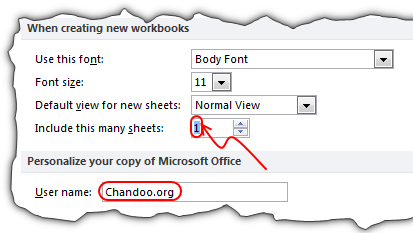
Change the user name
Since many of my workbooks are emailed to clients or uploaded on chandoo.org for you to download, I want to use our website address (chandoo.org) as my username.
Enable Developer Ribbon
After this, I went to customize ribbon and checked the Developer Ribbon box. This ensures that I can see the developer ribbon in Excel so that I can use features like form controls, macros etc.

Note: If you are using Excel 2007, you can find this in Popular tab in Excel Options.
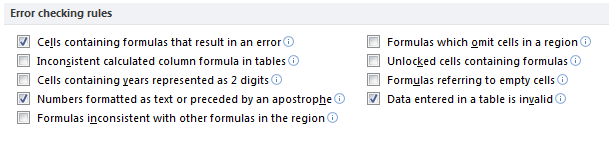
Disable Error Checking Options
Excel has a friendly feature called as error checking. By default this is enabled and Excel shows warning messages whenever you have made some predefined errors while using Excel. For example, you would get a warning whenever your formulas omit adjacent cells in a region.
While this is useful, I find it annoying as most of the time I know what I am doing. So I disabled almost all of the error checking rules except the ones that I want.
You can do this from Formula options in Excel Options screen.
Tell Excel to take frequent backups of your files
Since the work I do in Excel feeds my family, I want to make sure nothing is lost. Apart from using external back-up applications, I want to use built-in backup features in Excel. You can set these settings from Save tab in Excel options.

Customize Quick Access Toolbar
There are quite a few things in Excel that I use on regular basis. To begin with, I use shapes, alignment tools, text-box, select objects on regular basis. So I add these to my QAT. I will be adding more items to QAT as I use more features on this laptop’s Excel.

Adding Excel to Taskbar
This next is not an Excel tip but Windows tip. Since I use Excel thru-out the day, I just add it to taskbar (by right clicking on Excel in Programs and choosing Pin to task bar.)
What about you?
Those are the bare-minimum customizations I made to my Excel 20101.
What about you? How do you customize your own Excel to make it productive & easy to use. Please share using comments.
More Tips on Customizing Excel
If you want to use Excel productively, then customizing how it behaves is the first step. Here are some handy ideas you can try,
- 10 Tips to make better & boss-proof spreadsheets in Excel
- How to create new ribbons in Excel 2010
- Pin frequently used documents to Excel’s file menu
- 15 Productivity Tips for Excel users (Excel 2003 and above)
- How to add your macros to Quick Access Toolbar
- More Excel Productivity Tips, Keyboard Shortcuts & Mouse Shortcuts
PS: Wish you a happy weekend. We are taking the kids to Safari World today (Friday), for a day of giraffes, monkeys, dolphins, elephants and sun.


21 Responses to “Distinct count in Excel pivot tables”
The distinct count option works well but I have found that if I have a date field and want to group by year, month, etc. that option seems to be disabled. I need to do both, distinct count and group by year/month.
Example data; sales orders with item quantities with dates.
Challenge; sum the item quantities, count the distinct orders and group by month. How do I do this?
Perhaps that's not possible due to the grouping?
@Al... When you use data model based pivots, you cannot group values manually anymore. Why not use Excel 2016's default date grouping option? In this case we have just a few dates, so Excel is not grouping them, but if you have an year's worth of data, when you make the pivot with date in the row label area, Excel automatically groups them. If you have fewer dates or want to use your own grouping, just create a table with all dates, add columns with month, week, year etc. Then connect this table (these types of tables are usually called as calendar tables) to your data on date field as a relationship. Now you can create reports by month, quarter etc easily.
Is this the only way to do it in 2013? I find it rather cumbersome to have to create another data table listing dates with the another column for MONTH() and YEAR() to be able to summarise data for senior level...
I know people find adding calendar tables cumbersome, but it is a best practice and let's you add more layers of analysis quite easily. For example, adding analysis by weekday vs. weekend or by financial quarter or YTD calculations (you would need either Power Pivot DAX or some very carefully setup pivot table value field settings)
I had absolutely no idea this was possible. Very useful, nice work!
Doesn't work for 2010 version though (or at least not my works version)
Hi ,
The post has the following in it :
These instructions work only in Excel 2016, Office 365 and Excel 2013.
when i have 2 different Pivot tables, one without the enabled “Add this data to data model” option, and the other one with it enabled.. is there anyway i can link slicers between them?
if the answer is NO,, what to do ?
Quick note, the “Add this data to data model” option is not available for the Mac version.
perhaps outside scope of this article but I have found when I attempt to create a pivot table from an external data source (connection to a sql view) the "Add this data to data model" becomes greyed out. Anybody experienced and found a solution so I can start getting distinct count in my pivot tables?
Is there a way to still add a calculated field when using distinct count?
I found I can't change the date source after tick the " add this data to the data model", can you help to adv how to change the date source in such case?
Is there a way to update the source once you have added to the data model? I receive a new spreadsheet weekly and would like to update the connection so my tables pull from the new source.
Hi Crhis, I like how you have hulk (superhero) as your avatar. Do you know that there is a superhero in Excel too? It's Power Query. You can use it to solve your problem in a simple click. Here an intro if you need some guidance.
Powerful Introduction to Power Query
A big Thank you. It worked.
Hi, have survey data that I need to analyze but the challenge is that my key fields are showing horizontally. I tried to transpose the fields using Power Query, but unfortunately the new fields are returning same values on a pivot table despite using distinct values
How I can a do a pivot table with discount conts in some columns and then generate shor report filter pages. pls it drives crazy
Hi. Why grand total pivot of distinct count is 13? shouldn't it be 67?
Great Answer! Saved me lots of time!
Thank you!!!
Worked awesome! Thanks!!
Hi Chandoo,
I am using pivot tables for distinct count and now I need to update them with new set of data. But when I update the source data, all the columns and formatting of Pivot table disappears and I need to build it from Scratch.
Is there a possibility that I can update the source data with new rows added and also retain my pivot tables?