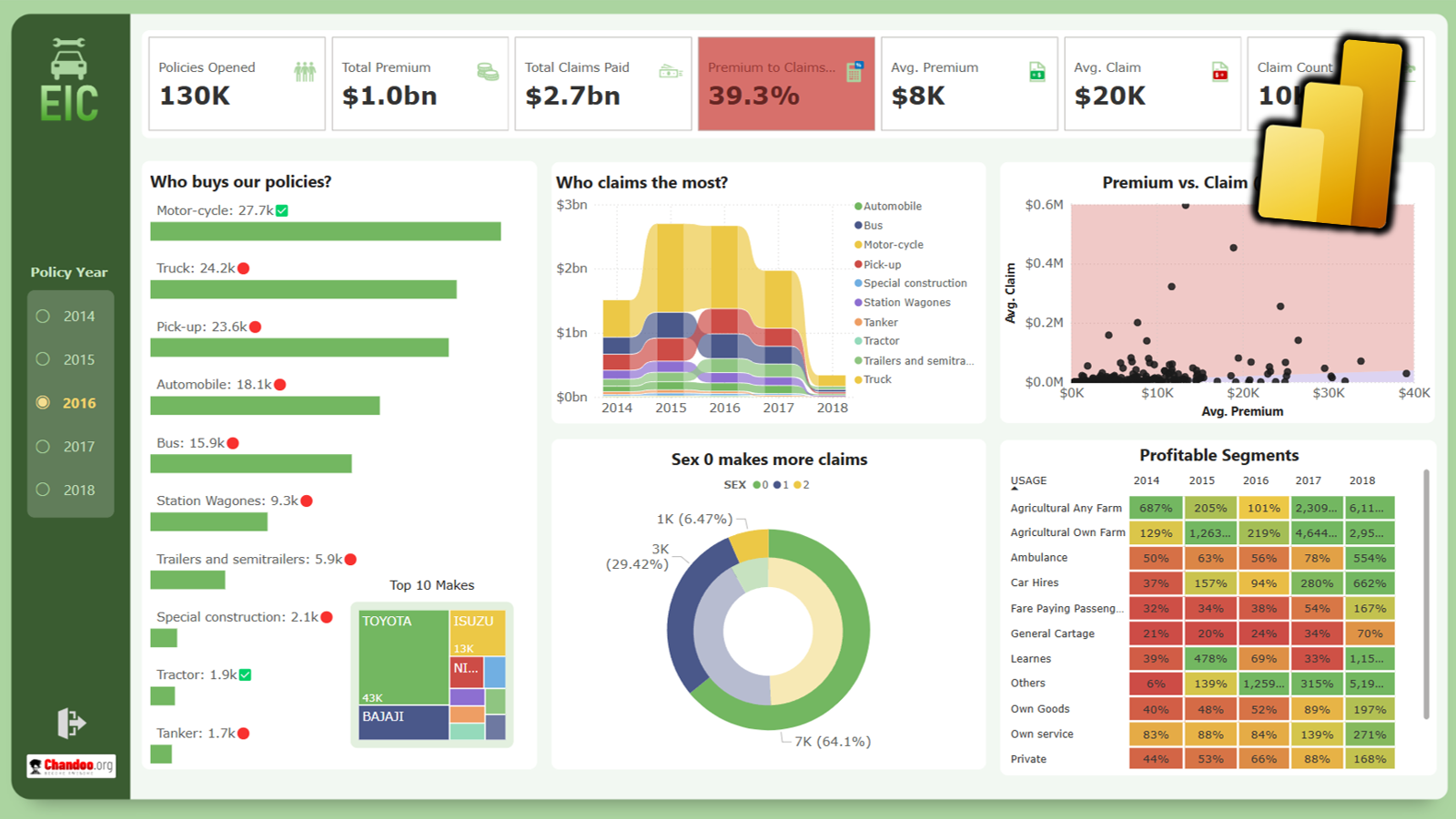
Do you know that you can apply conditional formatting rules to visuals in Power BI? In this post, let’s learn how to conditionally format visuals in Power BI. Something like this:

To conditional format charts in Power BI, follow below instructions.
- Select the visual you want to apply formatting rules.
- Go to Format pane and click on “Data colors”.
- When you hover on the label “Default color”, you notice three dots. Click on them to activate “Conditional format” screen.

- Here you can define a rule for coloring the chart. There are 3 types of conditional formats (as of writing this post in last week of July, 2019). They are,
- Color scales
- Rules
- Field value
Color scales:
As the name suggests, this will create a continuous color scale from minimum to maximum value. You can opt for diverging scale to include a midpoint color too. I am not a big fan of this for normal charts (although I do use it on tables / matrix visuals).

Rules:
This gives you flexibility to define a rule based logic for coloring. You can write rules to color chart elements based on number or item rules. See this example to understand how to set up a rule to highlight all cities where “Quantity per Transaction” is less than 8.2 in different color.

This is how our final chart would look:

Field Value:
You can also write a measure (or have a table field) that returns HEX code (or RGB code) for the color you want to use for each chart element. If you have such a measure, you can use Field value based rules to set them. For example, you can create a measure like [Column Color] and link it.
[Column Color] = IF([Quantity per Transaction]>8.2, "#999999", "#c82222")
When you link this [Column Color] measure to the chart on Field value rule, your columns will be either of those colors (#999999 or #c82222) based on the [Quantity per Transaction] for each item in the chart.
How to make rules based on dynamic values?
As of now, the conditional formatting in Power BI only accepts rules based on fixed (hardcoded) values. But we can create an intermediate measure to overcome this limitation. For example, we can create a measure like this:
[Rule outcome for highlighting] = IF([Quantity per Transaction] > [QpT Target], 1, 0)
We can then use [Rule outcome for highlighting] in the rules and color based on the fixed values of 0 or 1.
How to conditionally format visuals in Power BI – Video tutorial
If you are still confused or need some guidance, please watch this 10 minute video. It explains all 3 types of conditional formatting with examples. Watch the video below or on our YouTube Channel.
Download Sample Workbook – Conditional formatting in Power BI
Please download the sample file for this tutorial here. You can see a demo of all three types of rules. Feel free to examine the data model, measures or create something on your own to learn how it all works.
Learn more about conditional formatting in Power BI:
Microsoft has been enhancing conditional formatting feature in Power BI over time. Just recently (in July 2019 release) they have launched support for icon rules (similar to Excel conditional formatting icons) for tables & matrix visuals. Learn more about conditional formatting in Power BI by reading Power BI docs.
More Power BI examples & tutorials:
- Getting Started: What is Power BI?
- Tip: Creating beautiful reports in Power BI – 5 tips
- Full example: Employee Turnover dashboard in Power BI
- Recommendation: Best books for learning Power BI
Do you use conditional formatting in Power BI?
I have been using CF more often in my Power BI training / work as it is a powerful way to highlight important information without cluttering your reports.
What about you? Have you toyed with conditional formatting in Power BI? Got any interesting tips to share? Please post them in the comments.



36 Responses to “Visualizing Financial Metrics – 30 Alternatives”
Although I am one of the contestants, I must wholeheartedly admit that the Dashboard of Chandeep is the best of all. It's design, colors, message-conveying is the greatest. My regards!
I would like to learn how Chandeep highlighted the graph when he made a selection on the slicer.
Any links to previous posts perhaps where this was covered by Chandoo?
Thank You
Ahmad
Dashboard from Abhay simply rocks. To the point and conveys the intended message even for a novice.
Infographic by Pinank - is looking good
I have also contributed to this contest. I am really inspired by various entries in above post. Based on following parameters i would like to rate these:
1. Explanatory - Whether dashboard will be used to explain certain thing or mention a story. This type of dashboard will be static.
2. Exploratory - Here user would like to interact more with the dashboard to extract the relevant story or meaning which is not apparent. Hence, this type dashboard needs to have more interactivity.
3. Scalability - If new or more data can be added to dashboard and still the functionality will work. If user wants to add more companies, years, etc. will it work.
Based on above criteria I would rate following entries as top ones:
1. Explanatory - by Pinank
2. Exploratory - by Chandeep
3. Scalability - In most of the entries additional work would be required to include more data except for mine. new years or companies can be easily added and analysed in chart by me.
These entries are really inspiring i will definitely use it to revise my dashboard.
Abhay's dashboard is good however, if Chandeep can go with the trend analysis Abhay has done (line graphs), then maybe Chandeep's dashboard can excel.
And now I'm angry that I haven't noticed contest announcement earlier and I've sent what I've sent... Building a dashoboard was supposed to be my goal but lack of time forced me to sent sth simplier and now I can see how big mistake it was (when it comes to fighting a competition like this). Nice work guys! It's realy inspiring! Even less advanced works are intresting because of different task approach. So wance again: thanks 🙂
If I had to choose the best ones (IMHO) I would go for William and Edouard as a second place (for both). Despite some weak sides (like label errors or "work place" next to a final chart) they meet my sense of clear data visualisation and contain intresting interactive elements.
The best entry is definitly Chandeep's. Although there was some failing with automatical comenting feature (#arg! in my Excel'10) it's full of advanced dashboarding tricks which makes it easy to read. Furthermore, as one of the few he finished(?) his project - it opens in a "secured mode", with no place to mess anything, no data trash - just choose, point and read/print.
It all deserves to get the Grand Prize!
and BTW: when can we expect another contest? 🙂
Big round of applause to everyone who participated. I'm amazed at the creativity of our community. 🙂
My vote would be for Chandeep, MF Wong, and Miguel.
I have not contributed, but have read this post with a lot of interest. I would like to congratulate all participants for there work & inventiveness.
My #1 spot goes to Gerald for showing all the data in 1 graph & to have still kept it simple & readable.
I would give a prize for innovation to Pinank for the use of icons.
Great to see so much creativity.
I have not contributed also, but have wait his post for a long time (because I have the same kind of issue in my "daily life").
My top 3 is the following :
- Pinank for the effeiciency and for the style
- Arnaud for the calculation behind the chart
- Miguel for the elegant business oriented dashboard
All the entries look very good. However I feel Pinanks entry seems the best as it is very explanatory with good innovative thoughts.
Hi all,
Some brilliant dashboard and interactive entries - really nice stuff and lots of clever tricks.
However, given that the initial question was "Need to quickly visualize 3 variables ( Company, years, Financials) in a single […] chart", unfortunately I don't think any dashboards - as cool as they are - really answer that question. The interactives also assume that this will be opened in Excel rather than seen in a printed hand-out, which essentially means you'd need multiple charts to show all the variables or be limited to a computer screen. Even Chandoo's initial panel chart approach - which is static, and also very simple and clean - is not really a 'single chart'. Furthermore, most of the interactives don't actually show all variables at once but rather slice the data into more manageable chunks, which is not staying true to the original brief.
So, in light of the above, I'd vote for Gerald in first place, Edwin in second and finally my third chart option in third place (yes, I know, voting for yourself is poor form but unfortunately I think the original question disqualifies most of the entries).
Anyway, a fun competition and thanks for following up on this Chandoo.
I am once again in awe of the submittals to a Chandoo contest. The results are so impressive. I have been trying to build nice dashboards for years and take so many courses, but I don't seem to have the eye for design. The color choices, fonts and chart choices are so important and I'm amazed at how some people really have a great talent for making the best selections.
It's nice to have such quality inspiration!
I saw Chandeep's entry on his website and I must say that I was very impressed by it. Simply loved it. Somewhat makes it difficult to keep an open mind towards the other entries.
My ranking:
1. Chandeep for its completeness as dashboard.
2. MF Wong/Miguel for "simple" but smart graphs.
3. Pinank's entry looks like a page from a glossy magazine.
During scrolling I stopped at Chirayu's entry: easy to the eye.
But honestly congrats too all for having the balls to participate and thank you for sharing your creativity!! Hat's off to you.
Miguel, MF Wong, and Pinank.
Thanks to Chandoo and everyone who contributed for the great ideas.
Hi,
I personally liked the dashboard of:
1. Chandeep - His dashboard is clear, crisp and informative, his color combination and design is awesome, also he has shared few details like operating leverage plus he has added few comments. In totality, its a complete packaged dashboard.
2. Miguel - His dashboard is simple and all the information is visible in one shot.
It's very interesting looking through these - you can definitely tell who's done courses in dashboard design and with whom!
I particularly liked Pawels 'sperm chart' 😉 ... squint your eyes - you'll see what I mean). each of the charts or dashboards are put together well - but I agree with Elchin on this one - Chandeeps dashboard set 'tells a story' of the data. Student of Mr Few??
Without a doubt, Chandeep deserves #1. #2 goes to Abhay, and #3 to Pinhank, for the great presentation style if nothing else.
MF Wong
Do not apologize for any delay! Moving from one town to the next only 10 miles away is tough enough - let alone a family moving from one country to another!
THANK YOU for this excellent post!
As one of the participants, I have been looking forward to this post for long. But totally understood the reason of delay, so never mind! Hope all is well in NZ.
Thank you very much to those who like my chart! 🙂
Also thanks Chandoo for suggesting a name for it "Container Chart", which I have never thought about.
Personally I like the infographic by Pinank. Very outstanding design and use of icons. My two-cent worth: Just the lower part of "Yearly Trend" is actually good enough to answer the question, isn't it? 😉
Cheers,
What an outburst of creativity!
Vote for Chandeep and Pinank!
Agreed!
Awesome dashboards
Infographic by Pinank is awesome
Thank you so much for sharing!! i learn so much from these posts
Highly appreciated
Ahmad
South Africa
Fantastic responses from all the contestants. Some really great ideas. I'm inspired and will adapt some of these to my own dashboard work. Thanks for hosting such a great contest!!
Thank you for sharing this valuable resources !!!
I have only a couple of question that wasn't able to solve regarding data-origin.
Nowadays I have the data coming from a "current" situation from a big database containing all kind purchase-orders information of many different projects. I can calculate the current status of each project investments, but I am not able to track automatically the progress of it month to month or week to week by freezing the calculated metrics on each date. This would let me calculate new graphs and the speed of investments execution.
My question would be, if it is possible to calculate something with an excel formula and automatically freeze this values in a new row or new column. I guess that right now, Basic is the only way, but I guess that there could be a function to copy-a-range, insert-range-as-value-only as a new row or a new column or display everything down or left.
This would preserve the excel formulas defined, and add new data, everytime that it is re-calculated.
Any idea?
Great post , loved all chart representation. Congratulations to all participants and winners.
I need updates to this article.
I didn't even realize this got posted. Came across it today. Thanks
Fantastic post but I was wondering if you could write
a litte more on this subject? I'd be very thankful if you could elaborate a
little bit further. Thank you!
Hi Chandoo,
I comeback after a long time on your Blog. So I saw it lately. Its a brilliant idea.
I like all entries and these are amazing efforts from all participants.
Regards
The report presented by Pinanik is excellent and very innovative. Could be an interesting work for portfolio presentation