Excel Training Recommender – Interactive Excel Tool for you

Share

Facebook
Twitter
LinkedIn

First a Quick Announcement

Our VBA Class enrollments will be closed this Friday (Sep 16). If you want to learn VBA & Excel, please consider joining our course. More than 120 students have already joined us in the second batch and are learning VBA as you read this.

Click here to learn more about the VBA Classes and join us.

Moving on…,

As you may know, Chandoo.org offers quite a few Online Excel training programs. Over the last few weeks, many of you have emailed us and asked which training program is best for your situation. This got me thinking. “It should be easy for YOU to know what is best.”

So today morning, I locked my office room, took out my drawing pad and designed the most comprehensive course recommendation engine. It starts with a survey asking you 12 detailed questions. Then we make you go thru an Excel exam with 15 questions to test your proficiency with the tool. Then the engine would do a lot of calculations and finally recommend a list of training programs that suit you.

Then I threw it out.

Because, it was too complex.

Instead, I made a beautiful Excel workbook that asks you only 2 questions and tells you which training programs are best for you.

How our Training Recommender works?

  1. You tell us about your Excel skill level
  2. You tell us why you use Excel
  3. You get a list of recommended courses
  4. There is no step 4. I just like 4 bullet points for every thing.
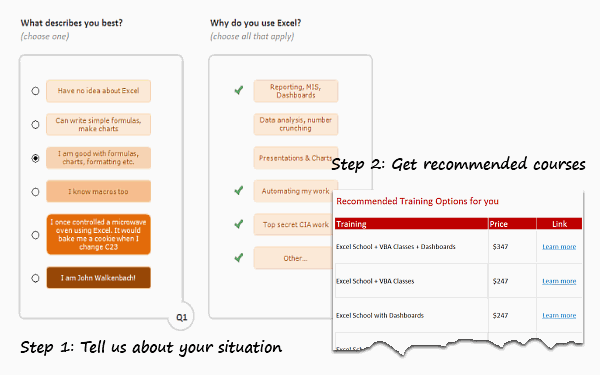
Excel Training Recommender - How it works?

How to get your recommendations?

Simple. Click here to download the tool. Open it using Excel 2007 or above. Just answer the 2 questions to see your recommendations.

How does the Training Recommender Work?

I made a short video explaining how the workbook is constructed. Watch it below or on our Youtube Channel.

Do you like the Training Recommender?

I really enjoyed constructing this. It shows what is possible in Excel.

What about you? Do you like this?

Similar Articles & Ideas

Since I run a small business, I always look for ways to use Excel to enhance areas of my business. Here are some more ideas that you may find helpful.

Last but not least…

This is week is the last week to join our ongoing VBA Classes. Next batch will be in 2012.
So go ahead and enroll here.

Facebook
Twitter
LinkedIn

Share this tip with your colleagues

Excel and Power BI tips - Chandoo.org Newsletter

Get FREE Excel + Power BI Tips

Simple, fun and useful emails, once per week.

Learn & be awesome.

Welcome to Chandoo.org

Thank you so much for visiting. My aim is to make you awesome in Excel & Power BI. I do this by sharing videos, tips, examples and downloads on this website. There are more than 1,000 pages with all things Excel, Power BI, Dashboards & VBA here. Go ahead and spend few minutes to be AWESOME.

Read my storyFREE Excel tips book

Overall I learned a lot and I thought you did a great job of explaining how to do things. This will definitely elevate my reporting in the future.
Rebekah S
Reporting Analyst
Excel formula list - 100+ examples and howto guide for you

From simple to complex, there is a formula for every occasion. Check out the list now.

Calendars, invoices, trackers and much more. All free, fun and fantastic.

Advanced Pivot Table tricks

Power Query, Data model, DAX, Filters, Slicers, Conditional formats and beautiful charts. It's all here.

Still on fence about Power BI? In this getting started guide, learn what is Power BI, how to get it and how to create your first report from scratch.

6 Responses to “Make VBA String Comparisons Case In-sensitive [Quick Tip]”

  1. Rick Rothstein (MVP - Excel) says:

    Another way to test if Target.Value equal a string constant without regard to letter casing is to use the StrCmp function...

    If StrComp("yes", Target.Value, vbTextCompare) = 0 Then
    ' Do something
    End If

    • Fares Al-Dhabbi says:

      That's a cool way to compare. i just converted my values to strings and used the above code to compare. worked nicely

      Thanks!

  2. Tim says:

    In case that option just needs to be used for a single comparison, you could use

    If InStr(1, "yes", Target.Value, vbTextCompare) Then
    'do something
    End If

    as well.

  3. Luke M says:

    Nice tip, thanks! I never even thought to think there might be an easier way.

  4. Cyril Z. says:

    Regarding Chronology of VB in general, the Option Compare pragma appears at the very beginning of VB, way before classes and objects arrive (with VB6 - around 2000).

    Today StrComp() and InStr() function offers a more local way to compare, fully object, thus more consistent with object programming (even if VB is still interpreted).

    My only question here is : "what if you want to binary compare locally with re-entering functions or concurrency (with events) ?". This will lead to a real nightmare and probably a big nasty mess to debug.

    By the way, congrats for you Millions/month visits 🙂

  5. Bhavik says:

    This is nice article.
    I used these examples to help my understanding. Even Instr is similar to Find but it can be case sensitive and also case insensitive.
    Hope the examples below help.

    Public Sub CaseSensitive2()

    If InStr(1, "Look in this string", "look", vbBinaryCompare) = 0 Then
    MsgBox "woops, no match"
    Else
    MsgBox "at least one match"
    End If

    End Sub

    Public Sub CaseSensitive()

    If InStr("Look in this string", "look") = 0 Then
    MsgBox "woops, no match"
    Else
    MsgBox "at least one match"
    End If

    End Sub
    Public Sub NotCaseSensitive()
    'doing alot of case insensitive searching and whatnot, you can put Option Compare Text
    If InStr(1, "Look in this string", "look", vbTextCompare) = 0 Then
    MsgBox "woops, no match"
    Else
    MsgBox "at least one match"
    End If

    End Sub

Leave a Reply