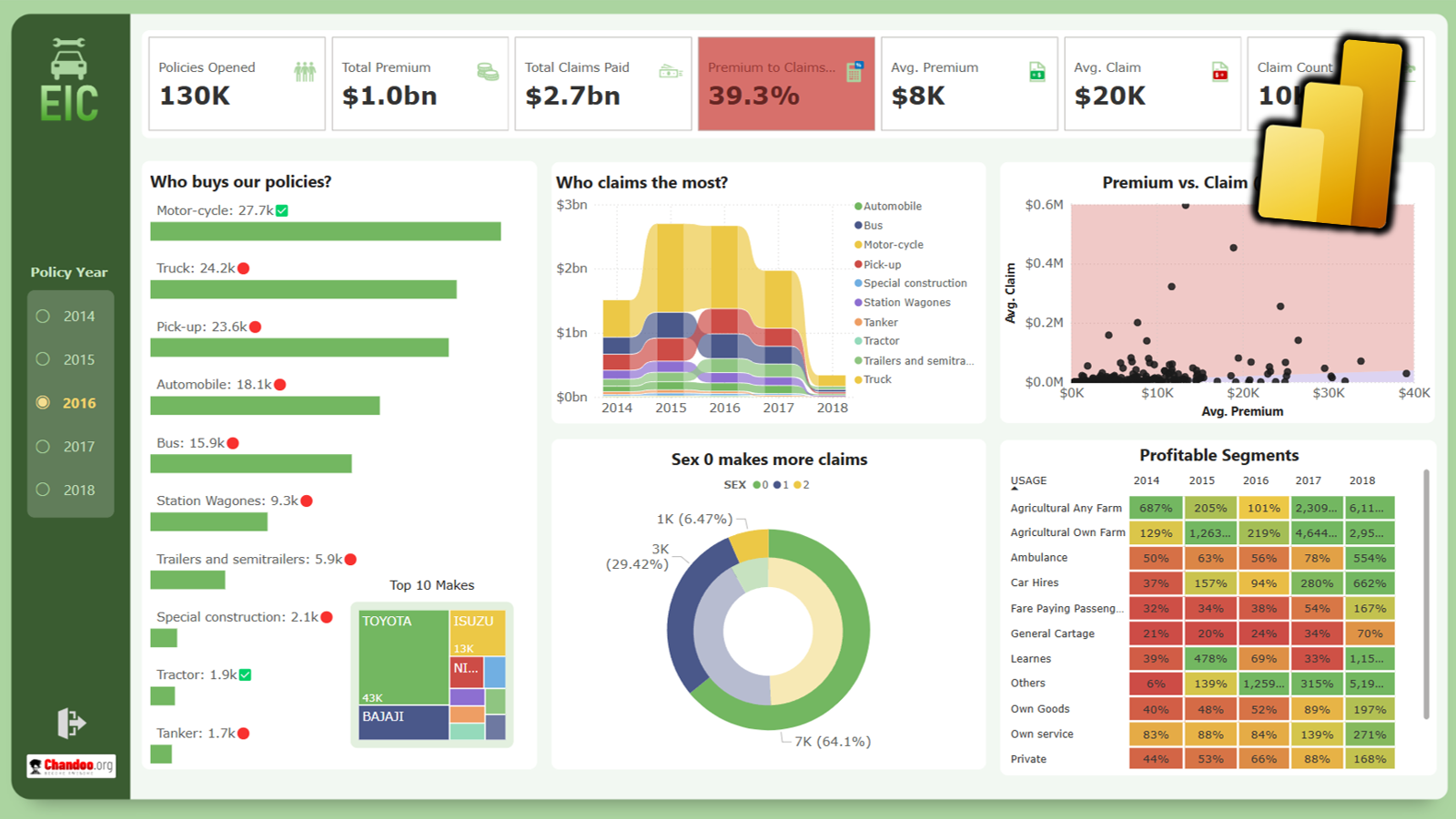
Power BI is great for visualizing and interacting with your data. In this article, let me share a technique for creating variance chart in Power BI. Variance charts are perfect for visualizing performance by comparing Plan vs. Actual or Budget vs. Actual data.
This is what we are going to build.

What you need to build a variance visual in Power BI?
You need a few basic measures.
- Actual values
- Variance
- Variance %
These measure definition will depend on what you are visualizing. So I won’t go in to that detail, but 99% of time, they will simple aggregations such as SUM or AVERAGE.
Power BI Variance charts – Video
If you want a quick walk thru of the variance chart construction, check out below video. Read on for text instructions.
Variance chart in Power BI – Step by step instructions
Step 1: Make a bar / column chart with Actual values
This is easy. Just make a bar (or column) visual with actual values. It will look like this.

Step 2: Add a similar chart for variance and place it next to the actual chart
I would just copy and paste the visual and change the measure. We will end up with this.

Step 3: Apply conditional formatting rules to color variance bars
Select variance visual, go to Format > Data colors and click on fx button to apply conditional formatting rules. You want green color for positive values and red for negative values (assuming positive variance is good, else flip your rules).
The rule setup looks like this:

At this stage, our variance chart looks like this. It has a teeny tiny problem. The sort order is not in sync between both visuals. ?

Step 4: Synchronize sort order trick
You can sort both visuals in alphabetical order, but that would make the charts less useful. So let’s stick with the descending order of actual values.
Just add “Actual Sales” measure to the tooltip area of variance bar chart. Now you can sort that chart on “Actual Sales” too. Pretty neat eh?

Step 5: Tidy up the formatting & group visuals
This is the last step. Just clean up the formatting of both charts. These are the steps:

- For actual values bar chart:
- Color the bars in something dull
- Remove Y & X axis titles
- Remove visual title
- Variance bar chart:
- Adjust Y axis “inner padding” . This makes the bars thin. See right.
- Remove Y axis – title & all
- Knock off X axis titles and visual title
- Make sure both visuals are in same height and top-aligned. Adjust the width of variance bar chart if not done.
Now just select both visuals (hold CTRL key to multi-select) and group them. This way you can move or resize them together.

That is all. Your variance chart is now ready. Enjoy it.

You can enhance it by adding a table that shows detail, something like this:

Download Variance Chart sample workbook
If you are not sure about the instructions or just want a ready to use example, here is the Power BI workbook. This file also features a tool-tip that shows performance at sub category level.
New to Power BI? Check out this excellent getting started guide.
Want something like this in Excel? See this budget vs. actual chart.
Note: Thanks to recent webinar Andrej & Reza for the inspiration to this article.


23 Responses to “Displaying Text Values in Pivot Tables without VBA”
Its possible to display up to 4 text values.
Have a look at the screen shot of an example that I had posted way back at the EHA and figure out how its done !
http://tinypic.com/r/muzywk/6
With Excel 2010 you can use Conditional Formatting to apply custom number formats which can display text. (In older versions you can only modify text color and cell background color, but not number formats.) Using CF allows for an even larger number of different display values.
[...] Display text values in Pivot Tables without VBA [...]
Hey,
Thanks, this helps. But how do you do it for multiple values where there is a huge amount of non repeating text?
@Soumya
The only way to do more than 4 values is to make the Pivot Table manually with formulas, of course then it isn't a Pivot table
You can of course do it with VBA
You may want to have a look at this description of how to do it here: http://www.clearlyandsimply.com/clearly_and_simply/2011/06/emulate-excel-pivot-tables-with-texts-in-the-value-area-using-vba.html
@Soumya
The only way to do more than 4 values is to make the Pivot Table manually with formulas, of course then it isn’t a Pivot table
You can of course do it with VBA
You may want to have a look at this description of how to do it here: http://www.clearlyandsimply.com/clearly_and_simply/2011/06/emulate-excel-pivot-tables-with-texts-in-the-value-area-using-vba.html
[...] Pivot Tables take tables of data and allow the user to summarise and consolidate the data at the same time. This is a great and very fast method of analysis but is restricted to handling mathematical functions on the value field resulting in numerical summaries. – read more [...]
[…] Read more here: Displaying Text Values in Pivot Tables without VBA […]
There is a very good way actually for handling text inside values area.
First you create a special column on the very left side and call it ID, and put unique ID (numbers only), and then create a pivot table with:
Row Labels and Column labels as you like, and in the Values labels use the unique ID number.
Move the unique ID number (copy paste) somewhere to the right and use vlookup to load the data you need using the ID as reference.
It is a bit longer way but for me it works perfectly to combine values as you like in any moment.
hope helps.
Regards,
Jon
Thank you! I finally understand pivot tables thanks to your clear, concise explanations and examples.
Good Day. This is exactly what i have been looking for. However when i try it on my pivot table or even when i try to recreate this exercise using the sample worksheet, i get this error:
"Microsoft Excel cannot use the number format you typed. Try using one of the built-in number formats."
Same thing here, Excel quite did not like the format in my PowerPivot. Any clues as to what may be going on? Thanks.
I have the same thing happening on my end. I'm running a normal pivot table on a .xlsm file.
@Danzi
What format did you use?
can you post the file ?
pls. help in table there is name, pan. amount. i have to make pivot table for example
NAME PAN AMOUNT
MR.X AAAAC1254T 500.00
MR.Y AAABR1258C
MR.A CFVDE2458T
MR.Z AAVCR12548C
MR.X AAAAC1254T
MR.Z AADCD245T
pls. help in table there is name, pan. amount. i have to make pivot table for example
NAME PAN AMOUNT
MR.X AAAAC1254T 500.00
MR.Y AAABR1258C 1000
MR.A CFVDE2458T 2000
MR.Z AAVCR12548C 5451
MR.X AAAAC1254T 45564
MR.Z AADCD245T 4500
how to get pivot tabe so i get PAN no. against Name.
I found an easy way to get text values in pivot table.
I create an other worksheet in wich each cell has a formula that copy the pivot table. The trick is that the formula does a lookup for the numbers in the pivot table.
The formula looks like that:
=IF(ISNUMBER(table!A1);VLOOKUP(table!A1;Code!$A$1:$B$65;2);IF(ISBLANK(table!A1);" ";table!A1))
Code is a worksheet where there is a liste of text /numbers correspondance.
As a bonus The new sheet is easier to format
Additional trick:
In my case, i encoded differents codeid with a power(2, codeId-1) so that summing then is equivalent to concatenate them.
1-A
2-B
4-C
8-D
yields :
5 - AC
14 - BCD
Hi
I want to ask if pivot can display dates in pivot field. As in a column i have customers and in row different items i want to know there last purchase date. anyone help in this??
Hello Guys, Need your help
I am doing some analysis of the cycle time of the product i.e how much time a product takes from manufacturing to the central warehouse.
I have batch numbers for the product and against them i have to pull out the diff. dates
Like the base date is from where the manufacturing start. So i have the batch number,against it's manuf. date. Now i have to pull out the date when it was quality released.
I have the quality released data but the data have duplicates, like i will have two dates or may be three for the same batch. So my main objective is to pull out the date which is latest among them.
BATCH NO. DATE of Mfg. DATE of Quality release
A1 12/4/2014 (HERE I HAVE TO PULL value)
Next Sheet
BATCH NO. DATE of Quality Release
A1 14/5/2014
a2 23/5/2016
A1 12/5/2014
A1 13/6/2014
From this sheet i have to pull up the latest date format of date here is dd/mm/yyy
TIA
[…] needed to present text instead of counts in a pivot table value column. Here is an excellent resource for Excel manipulation, in addition to an overview of pivot […]
This is great thank you.
Wow!!! Excellent!! It helped me a lot.
I am developing training tracking sheet for 200 employees with training completed date. Each employee will be attending 25 courses. How to indicate actual dates in pivot table value field.