

Often, we need to input special symbols like €£¥©½» in to our Excel sheets. Now, how do we do that?

Simple, you can use Insert > Symbol to add several different kinds of symbols.
See this animation to understand how you can add symbols to an excel cell. (the file is kind of big, so give it a few seconds to load)
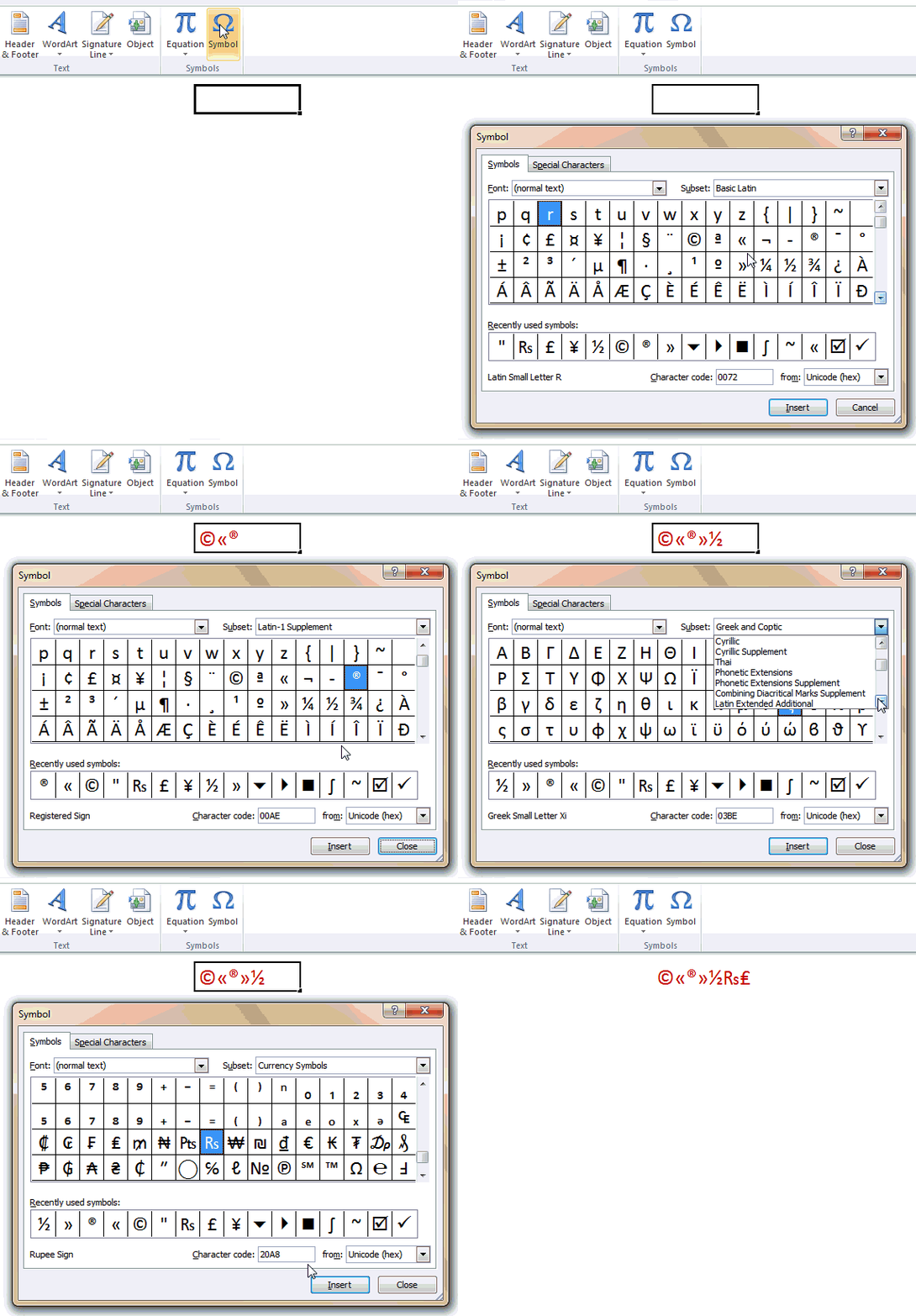
5 Bonus tips on using Symbols:
- You can just double click on the character to insert it. No need to press Insert button.
- You can quickly open insert symbol dialog by pressing ALT+I and then S. (related: 97 keyboard shortcuts to boost your excel mojo)
- You can use the symbols in formulas too. For eg. you can show ? or ? or ? based on change of one value wrt to another. Like this:
- =if(A1>A2, “↑”, if(A1<A2,”↓”,”↔”)) (related: in-cell charts)
- Quickly access symbols to specific to currency, arrows or greek chars (if you are in to that sort of thing) by using the drop-down at top-right (see above demo).
- Change the font to Wingdings / Webdings to see some useful and fun characters. You can spice dashboards or reports with these.


17 Responses
I preach this sometimes:
use a named range for your symbol. IE: =if(a2<b2,down,up) where down contains your down arrow and up contains your up arrow.
Very good illustration. What program did you use to create that gif file?
@Gregory: Thanks. I use camtasia screen-recorder to record and produce output as animated GIF shown above. You can get a trial version here: http://techsmith.com/
@Dan: Good idea. Even I use the same method as arrow symbols get referred alot.
That’s what I use, but your stuff looks much better. Hmm…
Hi Chandoo,
First of all – thank you very much for setting up this site with a mine-full of excel usables. Your blogs have become my reference these days.
India has adopted a new symbol for Rupee, is there a way we can insert this in MS applicatons (particularly Excel). Currently I do this by changing the font to “Rupee Foradian” individually. I was looking for a shortcut which i can make in excel and insert while writing – something like remapping a key which is not used.
Cheers
When entered = sign, to enter a formula in excel, then all menus in the insert menu become inactive, thus i can’t use symbols in formula. pls help me. thanks
@Umoru
Instead of using = , in a blank cell just go straight to the Insert menu and enter your symbol in the cell
Now you can edit the cell F2 select the symbol, Copy/Paste where you want it.
Hi Chandoo:
I’m using Excel 2007. How do I insert symbols into excel 2007 formulas? I’ve scoured the site and haven’t found an answer that works yet. Thanks.
You have a few options
1. Use a Formula like: =IF(A2>5,”a”,”?”) the character has been entered as a symbol in another cell and then copied into the formula
2. You can use the =Char() function like: =IF(A2>5,”o”,char(210)).
In either of the above cases you can set the font of the cell to match what character set you want to use.
That is a formula like =IF(A2>5,”A”,”B”), when the cell is set to wingdings will show the relevent characters from the Wingding font namely an Ok and a Thumbs Up hand sign
Hi Chandoo,
First of all, I want to thank you for your website. This is such a great resource! I learn from it daily!
I love your posts on Conditional Formatting and In-cell Charts with instructions for great data visualizaiton ideas. Most definitely my boss would be in awe if I could do this. However, I can’t make the in-formula symbols work. I have tried all suggestions from this discussion thread, but still can’t make it work. I started thinking that it might not work because I use Excel 2010. Please advise. Thank you!
@Innaya
Which symbol/technique doesn’t work in 2010?
@Innaya
Following up as per your email, but so others can also see what the solutions may be
.
1. If you use a formula like =if(a2
Hello,
I spend a lot of time on this blog learning but I still cannot figure out how to insert the symbol into the excel formula, and without changing the font to Wingdings, have the actual symbol appear in the formula (like the actual arrow appear in quotation marks in the formula). Any advice?
Thanks!
@Amy
This can be confusing at timesCan you post a sample of the formula you are trying to use?
Can you post a sample of what output you expect?
The article describes how to create currency pair (Forex) icons using country flag images for use with an Excel Ribbon Gallery. Only elementary graphics design skills are required.
See more at:
http://www.spreadsheet1.com/forex-icons-in-an-excel-ribbon-gallery.html
i wana know how we insert Special Characters In cell which already have another formula (exp. cellNo. C10 have formula =A10+B10, and ans. is 10, but i want display in cell C10 *10
hi chandoo! this is a really nice site. wish i found this sooner.
can you pls help me with this: i’m tying to put these symbols èéê (in windings) in my formula. here’s the sample formula =IF(B7>B6,B7&” é”,IF(B7<B6,B7&" ê",B7&" è"))
the output should be a number together with the arrow sign.
but how do i make it appear as such? instead of the arrow signs what appears are these èéê
i've tried entering the formula without the = sign so that i can change the font to windings for specifically for these (èéê) only but when i put the = sign it reverts back to being letters instead of the arrow signs. thanks!