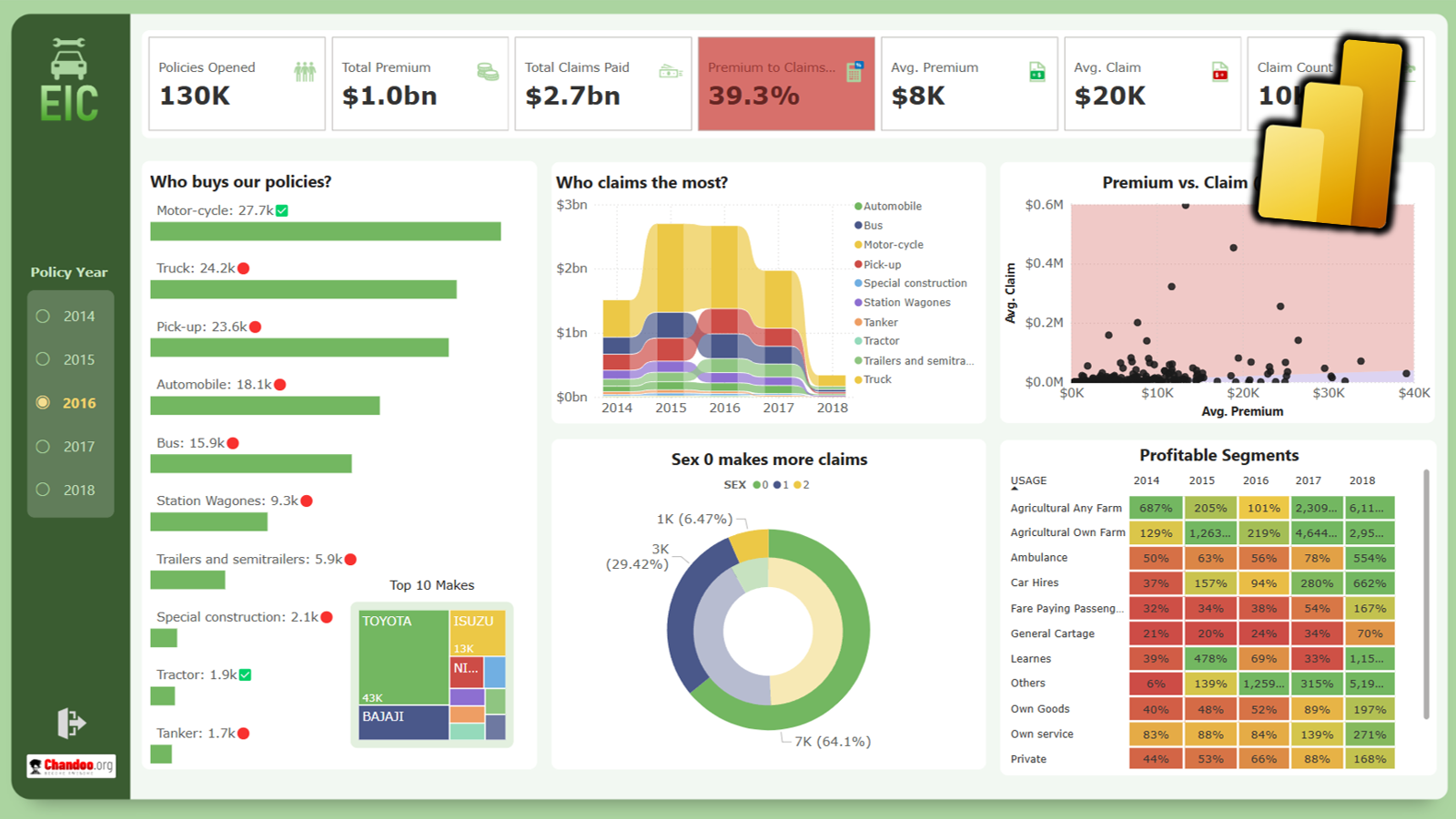
Power BI is great for visualizing and interacting with your data. In this article, let me share a technique for creating variance chart in Power BI. Variance charts are perfect for visualizing performance by comparing Plan vs. Actual or Budget vs. Actual data.
This is what we are going to build.

What you need to build a variance visual in Power BI?
You need a few basic measures.
- Actual values
- Variance
- Variance %
These measure definition will depend on what you are visualizing. So I won’t go in to that detail, but 99% of time, they will simple aggregations such as SUM or AVERAGE.
Power BI Variance charts – Video
If you want a quick walk thru of the variance chart construction, check out below video. Read on for text instructions.
Variance chart in Power BI – Step by step instructions
Step 1: Make a bar / column chart with Actual values
This is easy. Just make a bar (or column) visual with actual values. It will look like this.

Step 2: Add a similar chart for variance and place it next to the actual chart
I would just copy and paste the visual and change the measure. We will end up with this.

Step 3: Apply conditional formatting rules to color variance bars
Select variance visual, go to Format > Data colors and click on fx button to apply conditional formatting rules. You want green color for positive values and red for negative values (assuming positive variance is good, else flip your rules).
The rule setup looks like this:

At this stage, our variance chart looks like this. It has a teeny tiny problem. The sort order is not in sync between both visuals. ?

Step 4: Synchronize sort order trick
You can sort both visuals in alphabetical order, but that would make the charts less useful. So let’s stick with the descending order of actual values.
Just add “Actual Sales” measure to the tooltip area of variance bar chart. Now you can sort that chart on “Actual Sales” too. Pretty neat eh?

Step 5: Tidy up the formatting & group visuals
This is the last step. Just clean up the formatting of both charts. These are the steps:

- For actual values bar chart:
- Color the bars in something dull
- Remove Y & X axis titles
- Remove visual title
- Variance bar chart:
- Adjust Y axis “inner padding” . This makes the bars thin. See right.
- Remove Y axis – title & all
- Knock off X axis titles and visual title
- Make sure both visuals are in same height and top-aligned. Adjust the width of variance bar chart if not done.
Now just select both visuals (hold CTRL key to multi-select) and group them. This way you can move or resize them together.

That is all. Your variance chart is now ready. Enjoy it.

You can enhance it by adding a table that shows detail, something like this:

Download Variance Chart sample workbook
If you are not sure about the instructions or just want a ready to use example, here is the Power BI workbook. This file also features a tool-tip that shows performance at sub category level.
New to Power BI? Check out this excellent getting started guide.
Want something like this in Excel? See this budget vs. actual chart.
Note: Thanks to recent webinar Andrej & Reza for the inspiration to this article.


15 Responses to “Modeling Interest During Construction (IDC) – Excel Project Finance”
Thanks again for a very helpful post.
I had a similar problem when trying to model a balance sheet and profit and loss projection. The problem was that interest expense (in P&L) was dependent on a cash shortfall (in BS) which had to be funded. The cash shortfall depended on how much interest was paid, so the mutual dependency made a circular reference.
I addressed it with a macro that calculated interest outside of the P&L, then pasted the calculated amount into the P&L as a value. The model was out of balance, but by repeating the pasting and calculating loop the imbalance reduced to zero. It was a bit messy, and had to be repeated every time a line changed - but it worked.
If I have to do it again I'll read this article again first and see if it can be done more elegantly.
Hi,
The use of a circular reference can be avoided in this case. Just make use of the geometric sum to calculate the interest required. I’ll walk through the example from the spreadsheet.
First calculate the cash needed each year without the interest expense. So you year 1 you need 55 Mn, year 2 105 Mn, and 190 Mn for year 3. The total amount to borrow for year 1 is then (50 Mn)/(1-interest_rate) = (50)/(1-0.1). For years 2 and subsequent the amount borrowed is the cash needed in that year plus the interest_rate times the amount already borrowed. For year 2 (105 + interest_rate * sum(previous debt raised))/(1-interest_rate)=(105+0.1*61.1)/(1-0.1).
This process avoids the need for a circular reference, and makes the calculation more stable.
Thanks,
Tristan
The question is for the year 1 in your case, the amount works out to 45 mn. However in the year 2 you have applied the loan amount as 61.1 mn.
Am I missing something ! Please help !
very helpful information!!!
using circular references and to make model more stable we can use combination of "IF" and "ISERROR" functions. i.e
=if(iserror(formula1),"",(formula1))
this formula will return blank value if there is any error otherwise give the result required.
I usually use this in my models and it makes them very stable......
🙂 🙂 🙂
@Terry: Thats right. Exactly same problem is seen in Interest - Cash cycle in P&L and Cash Flow statement as well. In our trainings on financial modeling in excel, we demonstrate using both the circular loops as well as the macros to take care of this problem. Circular loops have their own pitfalls. If the model enters into a state of error, the error percolates!
@Tristan: Thanks for pointing out. I agree with you that if circular loops can be avoided, they should be avoided.
@Yogesh: This is one way of avoiding the problem. Although circular loops have another problem that they make your sheet slower. Each time, there is a change in the sheet, all the calculations are redone. So if they can be avoided, they should be avoided.
Please note that this was an example (a large one indeed) and I didn't have space to speak about the pitfalls of this approach! I just wanted to illustrate an approach and am glad that some of you found it useful!
I think while posting, there is an error in the images! The last image should be flipped with the one that is posted in step VII!
I think you can try the following simple solution given by Microsoft itself to make the circular works:
Windows: Excel Options -> Formulas -> Put a tick on "Enable iterative calculation"
Mac: Excel -> Preference -> Calculation ->Put a tick on "Limit iteration"
You can change the maximum number of calculation iterations as well as the maximum changes which iteration stops for goal seeking or for resolving circular references based on the number you type in the maximum change box.
Thank you.
Hey All
I heard that we can take care of the circularity with the help of macro for IDC. Can anybody help on the steps to construct the macro for the same.
Regards
Vinay
Hi Vinay,
If you look closely, you are essentially copying the values from the interest calculation to the IDC in project cost.
Basically you can record a macro, that takes the values from interest and pastes special the values in IDC row in project cost.
Then you can run that recorded code in a for loop.
Hope this helps.
Thanks Param for reply.
But before calculating interest, i need to provide for Upfront Equity and Equity, which are essentially part of total project cost. Hence, i need to put in Upfront Equity and Equity to calculate the IDC which is again hitting the total project cost.
Bit of confused on how to remove this circular reference.
Regards
Vinay
Wow, this was a brilliantly simple post. I was looking online for a while before I found this page. Never seen this been explained so beautifully yet so crisply before. Thanks for saving my ass at work! (i'm relatively new to finance + modeling)
I'm not sure why but this web site is loading very slow for
me. Is anyone else having this issue or is it a problem on my end?
I'll check back later and see if the problem still exists.
[…] Project Finance Modeling using Excel – Part 1 & Part 2 […]
I have been reading your blog since my college days. Today, I'm writing just to say thanks.
We have calculated Financial Rate of return of a hydropower projects, and the observer has raised an observation regarding Total Project cost with IDC Rs. 8616.01 million (PKR) and with-out IDC 8352.46 million (PKR). How does the Financial nalysis be calculated on the basis of with-out IDC Or With IDC?????
Please helpf. if possible to spare some time.