

This is the fourth installment of project management using excel series.
Preparing & tracking a project plan using Gantt Charts
Team To Do Lists – Project Tracking Tools
Project Status Reporting – Create a Timeline to display milestones
Part 4: Time sheets and Resource management
Issue Trackers & Risk Management
Project Status Reporting – Dashboard
Bonus Post: Using Burn Down Charts to Understand Project Progress
 Timesheets are like TPS reports* of any project. Team members think of them as an annoying activity. For managers, timesheets are a vital component to understand how team is working and where the effort is going. I will not get in to the merits and pitfalls of timesheets. However, I feel that by using Microsoft Excel capabilities you can create a truly remarkable timesheet tracking tool and still leave your team members un-annoyed.
In this tutorial we will learn 3 things about timesheets and resource management using Excel
- How to setup a simple timesheet template in excel?
- How to make a more robust timesheet tracker tool in Excel?
- How to use the timesheet data to make a resource loading chart?
1. Make a Simple Excel Timesheet Template
According to Wikipedia, timesheets are used for
Timesheets may record the start and end time of tasks, or just the duration. It may contain a detailed breakdown of tasks accomplished throughout the project or program. This information may be used for payroll, client billing, and increasingly for project costing, estimation, tracking and management.
By defining a simple and straight forward template in Excel and using it to track time (or efforts) in your projects, you can easily consolidate the data, compare efforts and make any necessary analysis.
At its simplest form, the timesheet is nothing but list of team members and list of activities in a matrix. Look at the below example:
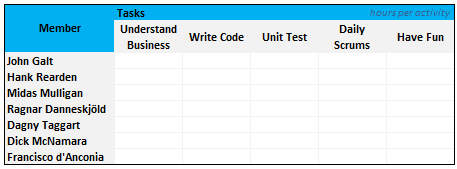
You can easily create such template in excel.
2. A More Robust Excel Timesheet Tracker
While the time sheet format shown in the above section is good, it is a wrong format if you need to analyze the timesheet entries of a 100 member project. Also in large projects usually members do few activities at a time. That means the above format (in section 1) will result in a sparse matrix.
Using a tracker log format is much more convenient to both record and analyze timesheet entries. Look at the example below:

We can use excel features like data validation drop downs, shared workbooks to make the timesheet entry and management a breeze.
3. Create a Resource Loading Chart – Project Management
Resource loading charts are a good way to show how busy the team members are in a project. At the outset the resource loading chart is nothing but a heatmap.
Look at an example resource loading chart below:

You can make a resource loading chart in MS Excel by following the below steps:
- The pre-condition for the resource loading chart is that we have clear data available to make one. This is where the robust timesheet tracker shown in section 2 of this post comes handy.
- First create a blank table in excel with team member names in first column and week numbers in first row. (Please note, you can make other types of resource loading charts by changing the Row and Column headers. For eg. You can show resource loading by Project and Team member)
- Assuming we have the time sheet data in the format shown in Section 2,
- Assuming “log_member_names” refers to the member name column and log_weeknum refers to the last column in the timesheet, we can write a simple COUNTIFS formula like this =COUNTIFS(log_member_names, “John Galt”, log_weeknums, 3)
- Once we calculate values for all team members using the above formula, we can apply conditional formatting to make the heat map. In Excel 2016 / 365, this is one step.

- That is all.
Download the Excel Timesheet & Resource Loading Chart Templates
You can download the excel time sheet template, timesheet tracker log template and resource loading chart template from here. Click the below links:
- If you have Excel 2016 / 365 or 2007 or above, download the .xlsx template
- If you have Excel 2003 and earlier, download the .xls template
- Download 24 Project Management Templates for Excel
What Next?
Timesheets are a great way to understand how the effort is spent. Even though project estimation models have become more and more effective, still lots of projects are overshooting budgets and timelines. And this is where timesheets can help you as a manager. While estimation looks in to future, timesheets look at past. Timesheets give feedback to your estimation models. This can help you in making better estimates in future.
In the next installment of this series, learn about tracking issues and risks using excel spreadsheets.
If you are new to the series, please read the first 3 parts as well.
- Preparing & tracking a project plan using Gantt Charts
- Team To Do Lists – Project Tracking Tools
- Project Status Reporting – Create a Timeline to display milestones
- While at it, also check out the bonus post about Burn Down Charts.
Resources for Project Managers
Check out my Project Management using Excel page for more resources and helpful information on project management.
Your thoughts and suggestions?
What are your ideas about timesheets using excel? Does your organization use excel as a way to manage timesheets or do you use some time tracking software? What is the granularity of detail captured in timesheets? As a project manager, what use do you find in time sheet data?
Share your ideas and experiences using comments.
*PS: If you are wondering what the heck TPS reports are, then you are spending way too much time with Excel buddy. And while at it, you missed the greatest comedy of all time. Go watch office space, now!
PPS: the TPS report image is from wikipedia.


7 Responses to “Project Dashboard + Tweetboard = pure awesomeness!!!”
I would like to see actual hash-tagged DM tweets go out to the specific information consumers. That would be an interesting way to communicate the key daily data to interested parties.
A Twitter-like secure application like Yammer might be a good fit with this.
For example, how about daily tweets to selected user groups (secure) that would display sales, bookings, cash receipts, cash disbursed and a second version that would show the same info for MTD, QTD or YTD figures.
@Dan, it would be great. I did not taught about implementing it on this dashboard because twitter is blocked to the whole intranet here. However, there's a discussion here about how can we send these tweets to blackberries (probably through e-mail) automatically. (I'd like to see this implemented on a jabber restricted network as well, but here it'll probably not happen)
The wrap-up versions you mentioned doesn't apply to my particular scenario, but on a sales tweetboard it would be a great tool indeed - choosing who will receive which message according to hashtags. I'll think on something, thanks for the advice. 🙂
(Ah, btw, I'm Fernando... 🙂 )
@Dan: That is a fun idea. Instead of tightly integrating twitter functionality with a dashboard, i think it would be cool if we have a "tweet this" button that users can click after selecting a range of cells. We can easily show a dialog with the concatenated output of the selected cells and ask user to edit the text and eventually "send to twitter".
For eg. you can select the annual sales figure cell and click on "tweet this" button upon which a dialog will show the value. Then you can pre-pend it something like "DM @boss look at our sales this year: "
@Aires.. thanks once again.
Wow it looks really good. Not sure though how much the tweet facility would help in real world project management, but certainly having a dashboard on a project should be a key deliverable when learning how to manage a project
The other use of this is during the software development life cycle especially when you have parallel streams of development and testing going on. Using a dashboard is a quick way for everyone on the team to see where the project is at and how it all fits together.
Regards
Susan de Sousa
Site Editor http://www.my-project-management-expert.com
Hi Chandoo,
I purchased the project management toolkit but the dashboard shown above with the imbedded scroll bars. Is it included in the project pack??
Thanks
Sue
The gantt chart section of this dashboard is similar to one I have recently created: http://xlcalibre.com/hr-dashboard-gantt-chart-traffic-light-reportIt has a similar approach with scroll bars, but has a couple of additional features. I've tried to incorporate a traffic light report element, and also allow the timescale to adjusted so that can view it by days, weeks or months.I really like the other tables that you've incorporated, I may well try to replicate them to improve my version!
I am a monitoring and evaluation consultant in international development, and one of the services I offer is to help non-profits and foundations develop performance dashboards. I often advise them to develop dashboards for ongoing programs, rather than for one-time or pilot projects, because of the time involved. I am trying to find out from a few people how long it takes you to develop a project management dashboard, and to what extent the indicators vary from one project to the next.