
Excel School Closing in a Few Hours – Join Now!

Share

Facebook
Twitter
LinkedIn

Excel School 3 - Online Excel Training Program - Registrations closing in a few hoursI have a quick announcement and an awesome graph for you.

First the announcement:

As you may know, I run an online Excel Training Program called as Excel School. I have opened registrations for 3rd batch of this program on September 14th. Thank you very much for supporting this program wildly. In a few hours, I will be closing the registrations for Excel School.

Click here to sign up for Excel School

(if you don’t want to join Excel School, we are still cool. Here is a free excel school. It is as awesome as morning coffee & donuts and totally healthy.)

How many students have joined so far?

At the time of writing this post (around 10 AM Indian time on 29th), we have 211 students signed up for Excel School 3. This is certainly quite a bit more than what I expected. But, I am also confident and eager to help as many of you as possible. So go ahead and join the program, because, you want to be awesome.

New content in Excel School 3 – Two hours on Dashboards

Apart from all the great and fun lessons in Excel School, I will be adding 2 more hours on Excel Dashboards. In this lesson you will learn,

1. What is a dashboard? – Definition, examples
2. Simple process for creating Dashboards using Excel
3. Making a dashboard using Excel in a step-by-step video
4. Tricks of the trade – tips, ideas and concepts you should learn to make awesome dashboards

When do the registrations close?

I will be closing new registrations by 11:59 PM (Pacific Time) Today. Pacific (Day) Time is 7 hours behind GMT (UTC). See the below graph to know when registrations close in your timezone:

Excel School 3 - Registration Closing times

(if you are still lost, see this handy table to know what time Excel School closes in your timezone.)

When is Excel School 4 coming up?

I will not be re-opening excel school this year. I am planning to spend time with students, answer their questions and have fun with my kids. I will be re-opening registrations during Jan 2011.

So Sign-up already!

Now the awesome graph

You see the world map with closing times above? Your guess is right. It is made in Excel.

Here is how I constructed it

  1. First I downloaded an outline map of world (here is one).
  2. Then I calculated the closing times in various timezones using simple data formulas (here is a how-to – scroll to end)
  3. Then I made a scatter plot with Y as zero and X as horizontal position of the country with some random values.
  4. Then I set the world outline map as background for the plot area.
  5. Now, I adjusted x values so that the scatter points align with various countries
  6. Then I added 100% vertical error bars on plus side to show the vertical lines.
  7. Finally I added the closing times as data labels (you need to manually point each label to the source, but its ok)

See this illustration to understand the chart:
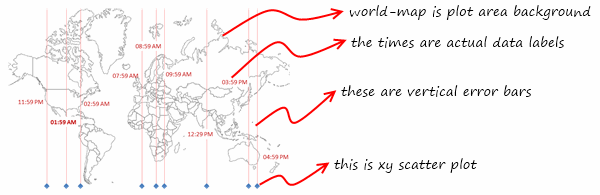
Excel School Closing Times Graph - How I constructed it?

Download Time Across world – Graph template

I have made a template to show time across various places in world.

Click here to download it.

Thank you

Thank you so much for making Excel School 3 happen. Your support and quest for knowledge motivates me. Thank you.

Facebook
Twitter
LinkedIn

Share this tip with your colleagues

Excel and Power BI tips - Chandoo.org Newsletter

Get FREE Excel + Power BI Tips

Simple, fun and useful emails, once per week.

Learn & be awesome.

Welcome to Chandoo.org

Thank you so much for visiting. My aim is to make you awesome in Excel & Power BI. I do this by sharing videos, tips, examples and downloads on this website. There are more than 1,000 pages with all things Excel, Power BI, Dashboards & VBA here. Go ahead and spend few minutes to be AWESOME.

Read my storyFREE Excel tips book

Overall I learned a lot and I thought you did a great job of explaining how to do things. This will definitely elevate my reporting in the future.
Rebekah S
Reporting Analyst
Excel formula list - 100+ examples and howto guide for you

From simple to complex, there is a formula for every occasion. Check out the list now.

Calendars, invoices, trackers and much more. All free, fun and fantastic.

Advanced Pivot Table tricks

Power Query, Data model, DAX, Filters, Slicers, Conditional formats and beautiful charts. It's all here.

Still on fence about Power BI? In this getting started guide, learn what is Power BI, how to get it and how to create your first report from scratch.

19 Responses to “How to Distribute Players Between Teams – Evenly”

  1. Roshan Thayyil says:

    An excellent solution, especially for large data sets.

    Another solution without using solver would be to assign the player with the highest score to Team 1, the 2nd to team 2, 3rd to team 3, 4th to team 3, 5th to team 2, 6th to team 1, 7th to team 1 and it continues. This method would end up with a Std Dev of 0.001247219. This works best with a distribution with lower Std Dev for the dataset.

    Full Disclosure: this is not my idea, remember reading something a few years ago. Think it may have been Ozgrid

    • Roshan Thayyil says:

      thinking back I now remember why I read about it. About 10 years back I had to distribute around 300 team members into 25-30 odd teams. Used this method based on their performance scores. I used the method I described to do this and the distribution was pretty fair.

      Solver would have saved me a ton of time though 🙂

  2. I think the issue with you first Solver approach was that you took the absolute value of the sum of team deviations (which should always be zero except for rounding) instead of the sum of the absolute values (which is a reasonable measure of how unbalanced the teams are).

  3. Here's another simple algorithm you could use: you start from the top (with players sorted from high to low), and at each step allocate the next player to whichever team has the smallest total so far. You can implement it dynamically with some formulas so it will update automatically when the data changes.

    If the scores were more widely distributed (so that this might end up with not all teams the same size), you could add a constraint to only pick among the teams which currently have fewest players at each step, or just stop adding to any team when it hits its quota.

    When I tried it on the sample, I got the three teams below, with a STDEV of 0.000942809 (i.e. about half of what Solver got to).

    Team 1: John, Hugo, Tom, Josh, Eric, Zane, Charles, Andrew
    Team 2: Barry, Michael, Kenny, Joe, Xavier, Patrick, Oliver, William
    Team 3: Henry, Steven, Ben, Frank, Kyle, Edward, Cameron, Lachlan

    Thanks for sharing!

    • Ishaan says:

      Hi,
      I was looking at all the solutions and this is closest to what I intended to do. I am dividing a bunch of players into 3 soccer teams. Players availability is also a factor while deciding the teams.
      So the steps the excel needs to do is as follows:
      1) In availability column if "yes" go to next
      2) Equally divide 'Goalkeepers', 'Strikers', 'Defenders' basis their quality
      So the end result gives each 3 teams a balance of players playing at different positions.
      Can this be done on Google spreadsheet with only availability as an input from the user and rest calculates by itself.
      Sorry for asking such a pointed question, but I have been struggling to find a solution for it for sometime now!

      • Robin says:

        Hi Ishaan,

        I am working on a similar problem at the moment, so I am wondering if you ever found a solution and if you are willing to share what you did.

  4. Konrad says:

    Hi everyone, this is a variation of the famous Knapsack Problem https://en.wikipedia.org/wiki/Knapsack_problem.

    I had to use a VBA implementation recently as part of a problem, where we ar trying to allocate teams of an organization into different locations (we are a large company with many different team). The goal was to optimally allocate teams to individual buildings without putting too many teams into one building and not splitting teams apart.
    As we had around 400 teams of different sizes, solver couldn't handle it anymore. Luckily there is a Knapsack algorithm implementation in VBA readily available on the internet :).

    I also went with a heuristic approach first!

  5. Joe Egan says:

    An interesting mathematical solution but what if Eric and Xavier can't stand each other or Patrick is best friends with Steven - the real life problems that effect "even" teams.

    • Hui... says:

      @Joe

      You can add more criteria like
      If Eric and Xavier can't stand each other
      =OR(AND(E15=1,E16=1),AND(F15=1,F16=1),AND(G15=1,G16=1))
      It must be False

      If Patrick is best friends with Steven
      =OR(AND(E5=1,E17=1),AND(F5=1,F17=1),AND(G5=1,G17=1))
      It must be True

      Note that the 2 formulas above are exactly the same
      except for the ranges
      One must be True = Friends
      One must be False = Not Friends

  6. Gustavo Sousa says:

    Nice post Hui!

    I download your workbook and just try to change in options the Precision Restriction from 10E-6 to 10-8 and the Convergence from 10E-4 to 10E-10. The process take almost the same time, but the results was great.

    The standard deviation I got was 0,000471.

    Team 1: John, Tom, Kenny, Frank, Eric, Xavier, Edward, Zane
    Team 2: Steven, Hugo, Ben, Joe, Josh, Oliver, Cameron, William
    Team 3: Barry, Henry, Michael, Kyle, Patrick, Charles, Andrew, Lachlan

  7. Charlie says:

    Great application of Solver! Thanks for the link!

  8. Chuck says:

    Great explanation. Well done... However, I tried with 6 teams of 4 players and solver never did finish.

  9. Akbar says:

    How about vba code for the same data set.
    I have 3 column A B C wherein A has text and B has number Wherein C is blank. And in C1 been the header C2 where I want the name to come evenly distributed the number which is in Column B.
    My Lastcolumn is 1000.

  10. HRMFT says:

    Sorry if I'm being slow here, but how is 'Team Score' calculated? I've gone through the explanation several times but it seems to just appear.

    • Hui... says:

      @Hrmft

      This process uses the Solver Excel addin

      Solver is effectively taking the model and trying different solutions until it gets a solution that meets all the criteria
      Then solver puts the solution into the cell and moves to the next cell

      So yes it appears to "just appear"

  11. Caroline says:

    Hi ! Thank you so much ! Works great 🙂

  12. Jim Cruse says:

    I cannot get the fourth Equation to work in my excel spreadsheet
    You have =($E$2:$G$25=0)+($E$2:$G$25=1)=1 as a SUMIF solution, I have, =($F$2:$H$13=0)+($F$2:$H$13=1)=1 as my solution but it does not work. The only thing I changed is the ranges. Any suggestions?
    Thank you.
    Jim

  13. Jim Cruse says:

    I cannot get the fourth Equation of TURE or FALSE statements to work in my excel spreadsheet You have =($E$2:$G$25=0)+($E$2:$G$25=1)=1 as a SUMIF solution, I have, =($F$2:$H$13=0)+($F$2:$H$13=1)=1 as my solution but it does not work. The only thing I changed is the ranges. Any suggestions?
    Sorry I left some of it out in the previous question,
    Thank you. Jim

Leave a Reply