

This article is part of our VBA Crash Course. Please read the rest of the articles in this series by clicking below links.

- What is VBA & Writing your First VBA Macro in Excel
- Understanding Variables, Conditions & Loops in VBA
- Using Cells, Ranges & Other Objects in your Macros
- Putting it all together – Your First VBA Application using Excel
- My Top 10 Tips for Mastering VBA & Excel Macros
In part 4 of our VBA Crash Course, we are going to create our very first VBA application using what we learned so far.
Our first Application – What is it supposed to do anyway?
Remember the “We Are Nuts” example. We are back to it. This time, we will create a daily sales tracker application that makes your job a breeze. But saying words like breeze when defining your next VBA application is a dangerous thing. So lets list down all the things our little Excel VBA workbook should do.
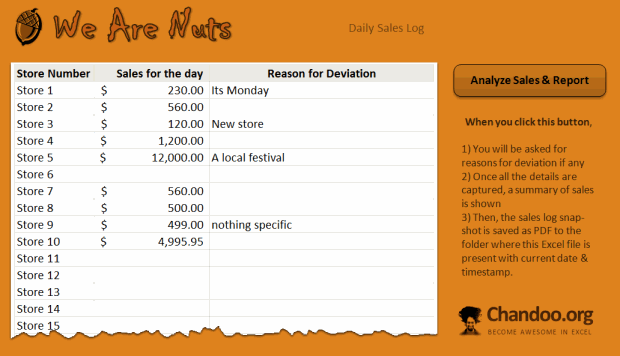
- The current method of using Inputboxes to capture 24 sale values and any reasons for deviation is tedious. So our application should instead process the values from already entered values and ask for reasons (thru inputbox) only when the sales are too low or too high.
- At the end of processing the sales, we want to see a short summary of how we did for the day. Something like this,

- Once we finish viewing the statistics a snapshot of the daily sales & along with summary statistics should be saved to current folder as PDF for later reference.
Designing our first VBA Application – Key Ingredients:
In this section, let us understand how our application should be designed and what goes in to it.
First, let us look at various things our application need to do, in a schematic. This types of diagrams are called as flow charts.

Key Ingredients of our Daily Sales Tracker Application:
Lets look at each area of our application and understand what VBA technique or statement helps us to do it.
- Process one store sale at a time: This is achieved with the FOR EACH statement [Related: What are VBA loops?]
- Capture reasons for deviation: Lets do InputBox() for this
- Calculate Summaries as we go: Some variables to calculate the summaries as we go. And a few IIF() formulas to help us update the values where needed. (PS: IIF is Inline IF Formula)
- Display Summary Statistics: We will use MessageBox() for this.
- Save a snapshot of the report: This is done by Range.ExportAsFixedFormat() method. [Related: understanding cells, ranges & other VBA objects]
Demo of our Daily Sales Tracker VBA Application
Here is a quick demo of our Daily Sales Tracker Application
Download our Daily Sales Tracker VBA Workbook:
Click here to download the Daily Sales Tracker VBA Workbook. Enable macros, enter some values and play with it.
If you just want to examine code, see this page.
What Next – My top 10 tips for using VBA
In final part of our VBA crash course, Learn my top 10 tips for mastering VBA.
If you have not read, please read the first 3 parts of this series,
- Introduction to Excel VBA – What is it & How to write your first VBA Macro.
- Understanding Variables, Conditions & Loops in VBA
- What are Excel VBA Objects and how to use them?
How do you like this VBA Application? How would you enhance it?
This application is one simple example of what you can do with VBA. Learning how to use Excel & VBA can enable you do several more awesome things at your work & life.
Do you like this application? How would you have designed it? Please share your ideas & tips using comments.
Join Our VBA Classes
We run an online VBA (Macros) Class to make you awesome. This class offers 20+ hours of video content on all aspects of VBA – right from basics to advanced stuff. You can watch the lessons anytime and learn at your own pace. Each lesson offers a download workbook with sample code. If you are interested to learn VBA and become a master in it, please consider joining this course.


17 Responses to “Budget vs. Actual Profit Loss Report using Pivot Tables”
Good Work, Yogesh & Chandoo! Thanks.
Hi everybody,
first sorry I am late to say something about this topic;actually I was waiting last part
second I am not accountant I am an Engineer
third """"Very Important""" the idea is not about Loss but I am sure it is profit
Based on third it shows:
1- How to use EXCEL
2- How to use pivot TABLES
3- How to collect and arrange DATA
4- How to make reports
Many Thanks
Hi Yogesh and Chandoo,
Thank you for sharing your knowledge!
You guys are great!
thanks chandoo and yogesh, thanks for you lessons, are great!....i have a idea for a budget. I try to do it..... thanks for all
Thanks a lot for sharing the most powerful tool worldwide "knowledge"
Warm greetings from Peru
Hi -
This is a really great article because it's a simple and common thing you'd want to do with a pivot table but not at all obvious how to do it! So - muchas gracias to Chandoo and Yogesh!
One thing - I couldn't get past the group error in the sample file. I would click on ungroup but it didn't seem to have any effect. I'd appreciate it if anybody has any pointers here.
-Juanito
Hi Chandoo
I am also having the group error. Can't seem to ungroup? Appreciate if you explain further on the steps required in order to get to calculated items.
Many thanks and keep up the great work.
Cheers
Adam
Hi Chandoo,
I'm struggling resolving the problem depicted below:
I have a set of data, with (among others) a "Region" field (can be APJ, EMEA, or AMS), and a "Country" field.
Unfortunately, I need to group data by the following 4 Regions: APeJ, Japan, EMEA and AMS.
I first tried to make a pivot with Region and Country in the rows (or columns), and then group Country data as per the above.
Alas, as soon as I have a new Country that appear in my data set, my groupings are broken, and I have to redo the job of ungrouping, grouping etc.
I thought I could try to use calculated item, by adding first a new column to my dataset concatenating Region_Country, and create an "APeJ" calculated item that would sum all the "APJ_*" and substract the "APJ_Japan", but again, no clue, as I can't find a way to use any wild card in those formulas.
Given that I already found extremely helpful tips and tricks in your site that helped me manage that bunch of data, I'm pretty sure you'll have a bright idea on how I can solve that one!
Thanks in advance for your lights!
Hi Catherine...
In such cases, I advice using an additional column in the data itself. You can set-up a grouping table else where with country in first column, region in second column. And then in the data, you can add an extra column and use VLOOKUP to fetch the region based on the country.
Then feed this entire data (with extra column) to pivot table and use the extra column to group the data.
Hi Chandoo,
Thank you for your prompt answer.
I finally came to the same conclusion - after a rest 🙂 . I was probably too tired Friday evening (it was rather late), having spent hours in manipulating all my surveys data so as to pull rolling averages, make nice graphs and so on, and was trying to find a complex solution when there was a simple one.
Thanks again,
Catherine
Hey,
Great post!
I for example have different database structure with the following fields :
Date, Expense, Income, Sum (Income - Expense), Category (Sales, Cost of Goods and etc).
Creating a P&L report for the whole year works great. Including gross margin % and etc.
Though, creating P&L report by QTR/Month is becoming impossible since i get the following error : “This PivotTable report field is grouped. You cannot add calculated item to grouped filed.”
Is there a solution for this kind of problem?
Like Adam and Juanito, I also cannot ungroup.
Would appreciate it if you can add a few more lines and a screenshot or two on where to put the mouse cursor to ungroup.
Hi, I have figured out the ungrouping problem. One of the earlier steps was to group by month, if you pull the month back down to the column then right click and then select ungroup, then pull the month back up so you end up with just data source and budget/actual as the headings, then you can continue on.
To solve the ungroup problem, my method is:
Copy the "data" sheet to a whole new Excel workbook
and directly work on Part 6.
And since it is a fresh copy, Excel don't show me the "can't ungroup" problem. Hope this help.
Thank you Yogesh for this wonderful tutorial.
Kent, Malaysia
Just when i thought pivots were awesome i learn about inserting the calculated fields and that makes them more awesome. chandoo where have you been all my life.
Hello - your P&L pivot version has really impressed my boss and would like to use it. I have applied it for a actual vs budget vs forecast model I have created. One problem. In your variance above the operating profit percent % variance shows 33.8% but I want it to show (0.01) point or the true diff from prior budget.
I know I can add calculation to the side but boss would like to see it in pivot table.
Please help
Thanks
I have a further query which may solve my above dilemma. Is it possible to add a column that calculates percent increase. So in the example above a new column would be added to show variance %.
Any help would be appreciated.
Thanks