

 This post is a testament that readers of this blog are way cooler and enterprising than I am. Justin, who I must say, has some really amazing excel skills, contacted me in April with a VBA Script he made that can draw two circle Venn diagrams in excel. He wrote,
I regularly need to show the intersection between different populations (venn diagrams) and have struggled to find anything useful in XL2000 or XL2003
Most examples are static pictures of circles created in a graphics program to which users add labels – hardly ideal
While still a WIP – I’ve come up with a simple 2 circle venn tool.
It uses drawing objects [msoShapeOval] (nice to get the transparency)
I saw the script and was really impressed by the way it worked. I wrote back to him asking if it is ok to share this with the readers on PHD. And he said OK. Ever since I have been wanting to share this wonderful little tool with all of you.
Without further ado…
Venn Diagrams in Excel
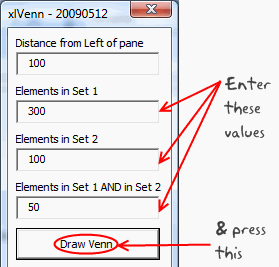
1. First download the Venn diagrams in excel zip file from here [xls version here].
2. Now when you try to open the file, you must enable macros (in excel 2007, you may want to set the security to low and then reopen the file)
3. Click on the big button you see in the first sheet and specify the venn diagram details (how many in each circle, what is the intersection amount)
4. Click the “Draw Venn” button and you have a sparkling venn diagram ready
Once again, I really appreciate Justin for putting together such a nice tool and sharing it will all of us. Thank you 🙂
PS: If you like this, do say thank you to Justin in comments. I am sure he can take pretty much any amount of appreciation.


66 Responses to “Budget vs. Actual Charts – 14 Charting Ideas You can Use”
[...] Update: Check out the results at Budget vs. Actual Charts [...]
Hi there:
I'm interested in understanding exactly how contestants #'s 1, 8 got their surplus or shortfall to show up at the top of the bar (is this overlapped or stacked somehow) and change colour? I hope this makes sense. I've tried to find samples and I can see contestant 8 (cuboo) may have used something called graphomate but I can't use this.
I need to create a bar chart that shows budget, and actual variance whether it be a surplus or a shortfall and I would like make it look like option 1 or 8 above but haven't a clear idea how to do it...any help would be greatly appreciated!
Regards..Linwe
[...] heute können alle Beiträge auf “Pointy Haired Dilbert” gesichtet und bis zum 12.04. bewertet werden. Falls mein Vorschlag - Nr. 8 - gefällt, freue ich [...]
Danken Sie Excel friend!
#6 is the best here. Simple, no extraneous visual effects.
I was all set to vote for #9...until I noticed its lack of y-axis labels. So I have to go with #6 also.
I think #6,#9 is enough .
#9 is my favorite
Nice data/ink ratio 😉
I agree with Jon - #6 for me.
8 & 14
I go for # 9 (simple) and #14 (complete)
I go for cuboo #8
cheers
#6 for overview at a glance / top management
#8 for deeper analysis / those who need more detailed information
#14 although I think you only need the bottom panel and I then would stack the Center charts vertically to make Center comparisons easier.
#10 gets my vote.
If there is a second place, then #14
denise
Hi, if I was not wrong, Samples 3,4 and 5 were created using Tableau software and not Excel. For more information on Tableau you might want to visit http://www.tableausoftware.com/. It was initially designed by Prof. Pat Hanrahan and his PhD students. I am not their salesperson but I thought someone might want to know more about this particular technology.
Hi Tin Seong Kam:
Thanks - I have looked at Tableau before. I have also found the means to reproduce something similar to chart 8 without using graphomate, and also chart 7. I proposed chart 9 as well but the overlap is confusing to some.
I am really not too concerned about showing actual budget figures but the variance in $ and % is important for my particular use. That is why I gravitate to the charts that seem to easily tell us that we have a surplus or a shortfall.
Thanks!
Linwe
11, 6, 9 (presque pareil)
7 pour la clarté
cuboo #8 ist my favorite
best regards...
8
8 is fantastic
I prefer N#8 - N# 1,7 & 8 use the settings of Rolf Hichert...
6 : The GURU (read "Jon Peltier ") has spoken,
SOO easy on eyes!
Hi Chandoo,
I liked Cuboo's submission. So #8 gets my vote.
Regards,
Sumit
Number 8 by far. Even though it's not part of the data display, the comments feature sells me. Variance explanations are as important as the actual variances.
I visually prefer #8, but #3 is really easier to understand, even if it lacks a lot of information (inverting budget/actual), legend, etc...
[...] All in all there are several great entries suggesting a good variety to present budget vs. actual performance. Go check them out. [...]
[...] reshape, zoo by learnr A reader of a Pointy Haired Dilbert blog enquired about best ways to visualise budget vs. actual performance. In response PHD challenged his blog readers to contribute their visualisations made using Excel or [...]
anyone willing to post their xls for these? Some really excellent exmaples.
To avoid the summary execution of the person presenting these to an executive team these charts must handle overspending as well as underspending, be comprehensible in 5 seconds and show the key fact clearly. The key fact isn't budget or actual - it's the magnitude of the gap!
Therefore:
#14 for nailing the key fact and being able to handle overspending. The winner therefore.
#6 for nailing speed-reading and being able to handle overspending, but somewhat obscuring the key fact. Second place.
#8 for nailing information depth and aesthetics. Third place.
I really wanted #8 to win, but that's the technician's view not the end-user's.
[...] Todas as contribuições podem ser vistas no seguinte endereço: Budget vs. Actual Charts – 14 Options You can Use Posted on April 5th, 2009 http://chandoo.org/wp/2009/04/05/budget-vs-actual-charts/ [...]
Social comments and analytics for this post...
This post was mentioned on Twitter by NancyJHess: I like to explore fav tweets of those I follow. Here is one from DutchDriver http://twurl.nl/17eiap Creative visual charts: Budget vs Actual...
number 8
clean, full of info, qualitative as well as quantitative
Hi,
I Like 4 chart in above as per the following ratings:-
no 1# -> 14***
no 2# -> 7***
no 3 # -> 8**
no 4# -> 1.3**
I will be greateful if someone can send me the process of making all above 4 charts.
Virender
[...] Budget vs. Actual Values in Charts – 14 more options [...]
[...] Budget vs. Actual – 14 charting options [...]
Does anyone know what type of chart #6 is (chart name?)? Also, how do I create this is Excel 2007?
@Shazbot
I'd call it a Column and Bar chart, but don't get hungup on names
To make it try this:
Setup the chart as a Clustered Column Chart
Change the Series so there is 100% overlap, ie: One column is in front of the other
Change the Budget series to a line chart
Set the line color to none
Set the marker style to a Flat Line
Change the marker width to make it the same width as the bar
Change colors and other chart properties to suit
Does anyone have an idea on how to create chart #1?
Thanks
Caroline, please see the german page: http://www.hichert.com/de/software/exceldiagramme/55
there you can find the original example for nr1.
best regards,
stefan
Caroline
This is a Clustered Stacked Column Chart
Which has the column under the Shortfall/Excess colored the same as the Budget
Have a look here
http://chandoo.org/forums/topic/question-about-budget-v-actual
&
http://peltiertech.com/WordPress/clustered-stacked-column-charts/
Hi,
Is it possible to get the source files like the other visualisation challenge (on sales).
Thanks,
Vijay
Dear Chandoo,
I discovered your site by pure chance and I am really thrilled about it and I am learning a lot.
Is it possible to post the source file for this visualisation challenge?
Thanks,
Vijay
[...] Budget vs. Actual Charts in Excel [...]
Dear Chandoo,
How do I create Chart #10 (comparing Budget vs Actual Performaces) by cost center by quarter without the cumulative performance. Do you have an actual example that I could use?
Thanks,
Greg
HI
Does anyone can help me to a to create chart #7? I'm beginer in excel , I started to work two weeks ago and my boss ask me to follow the budget/actual until the end of the year.
SO I really need your help.
Thanks in advance
p.s Sorry for my english ( i'm french)
@OKI, Greg
I have made a mockup of #7 and #10
It is available at:
http://chandoo.org/wp/wp-content/uploads/2009/04/Bud-Act-visualizaion-challenge-7+10..xlsx
#10 is a straight, Pivot Chart/Table but the data has been rearranged to get it into the pivot table
#7 is 2 charts, being a simple Bar Chart and a Scatter Chart with 100% Error Bars
I have used Named Formulas for the two charts.
HELLO Hui
Thanks you very much for your hepl , i really appreciate
Have I nice week
Hi,
I was wondering how can you replicated chart 1.3? The bars looked like there overlapped on two different axis?
Tony
I think 1 & 3 are good.
Hi Chandoo,
Please can you provide a link of the excel sheet for 1. Chart "3 colors and everything is clear"
I would like to drill into the spreadsheet and learn the secrets as how the chart was made.
Many thanks,
Sawan
@Sawan
It is probably 12 seperate charts, I will assume snapped to the underlying cells to ensure they are the same size
The left 3 Charts have a vertical Axis
The bottom 4 Charts have a horizontal Axis
The remainder have no axis
The remaining text maynot be part of the charts but is probably cell content
Saludos,
Como puedo descargar estos maravillosos ejemplos para estudiarlos y analizarlos deseo aprender a realizar este tipo de graficas en Excel.
Gracias,
Dear Chandoo and Hui,
Please would you help me (step by step if possible) to create Chart #8?
Many thanks in advance!
Dear Chandoo,
I think chart #8 is really great. Would really appreciate if you can show basic step to create it.
Thanks 🙂
Hi all,
Is there any step by step tutorial to recreate the the chart #1 please?
Would really appreciate if someone could show me how it done.
Regards
Sawan
Can someone tell me how do you create chart number 2? Thanks!
Am I the only one that can not display any of the images? Would love to take a look at these. This is the ONLY page on the whole website I have had this issue with. 🙁
Dear All,
how can i create chart # 7? is there any link where i can subscribe to your website by paying a certain amount. i want to learn some good excel techniques.
please let me know.
Cant see the images 🙁
Where can I find the link to download some of the above charts?? these are extremely usefull chart and would like to utilize the same.
Waiting for the reply.
Thanks..
I am interested for # 1,6,7,8,9,10,11 its very exciting for me .
Hi,
Just wanted to check, is there any possibility that pivot table or drop down work in power point?
Regards
Satyapal
@Satyapal... you can only use static images or slide animations in Power Point. Not features like pivot tables or drop downs. However, you can embed the entire workbook (or sheet) in a presentation. When clicked this will just open Excel so your users can play with the data.
Is there any instalment kind of facility available for joining the online course of Rs.12000/-.
Regards
Ramesh N
Hi,
I badly want to replicate #10. Can someone help me.. I've checked google to help but I can't figure out how to add the total 🙁
Regards,
Tim