These Pivot Table tricks massively save your time

Share

Facebook
Twitter
LinkedIn

Pivot tables are powerful. Use these 6 tricks to save time when working with them.

Excel Pivot Table Tricks to save your time and make you awesome

1 - Double click to see details

Ever wondered what numbers add up to the total in a pivot table value area? Simply double click to investigate. Excel will show all underlying values. 

Extra tip: Don’t forget to delete such detail worksheets as they can create duplicate data.

pivot tricks - 1 - drill to details

2 - Format value fields quickly

The default value field formatting is useless. Often, we need to change the values to currency or accounting formats. You can do this quickly by right clicking on the values instead of going to Value Field Settings > Number Formats route.

See this image to understand the process.

pivot trick 2 - format quickly

🙏 Thanks to Srinivas who taught me this trick on my YouTube channel (link)

3 - Include filtered items in subtotals

Let’s say you have a pivot table with Sales by product & region. You filter out some products. The grand totals change. This can be inaccurate.

If you want to to include filtered items in the totals you can use the option in “Subtotals” menu in ribbon. Oh wait a sec, that is grayed out 🤔🤔🤔

pivot tricks 3 - include filtered values in totals - disabled

Turns out you can ungray it. All you need is to use data model. Click on “Add to data model” in the insert pivot screen you are able to use this feature. 

🙏 Thanks to Ryan who taught me this tip on my YouTube channel (link)

4 - Consistent pivot charts with a simple trick

Let’s say you have a pivot chart linked to a slicer showing sales by product in selected region. As you don’t sell all products in all regions, the chart looks jumpy with inconsistent axis.

Something like this:

pivot tricks 4 - inconsistent axis

You can make the axis consistent by formatting the row label to show “items with no data”. To do this, select the row labels area of the pivot, right click and go to “Field settings”. Now from display area, enable “Items with no data” option.

pivot tricks 4 - items with no data option

Your chart looks much better.

pivot tricks 4 - consistent axis

5 - Repeat row labels

Tabular form is my favorite layout for pivot. It looks clear and easy on eyes. 

Do you know that you can enable “Repeat item labels” option to make the tabular layout even better.

pivot tricks 5 - repeat item labels

Bonus tip: When you repeat item labels, you can use Pivot Tables in other formulas (like SUMIFS) easily. 

6 - Multiple pages with Report Filters

You got a handy little pivot report that details the performance of a region. Now you want to make similar reports for rest of the 16 regions too.

You can use Report Filters to quickly create all versions of this report in one click. Here is a demo of how report filters work.
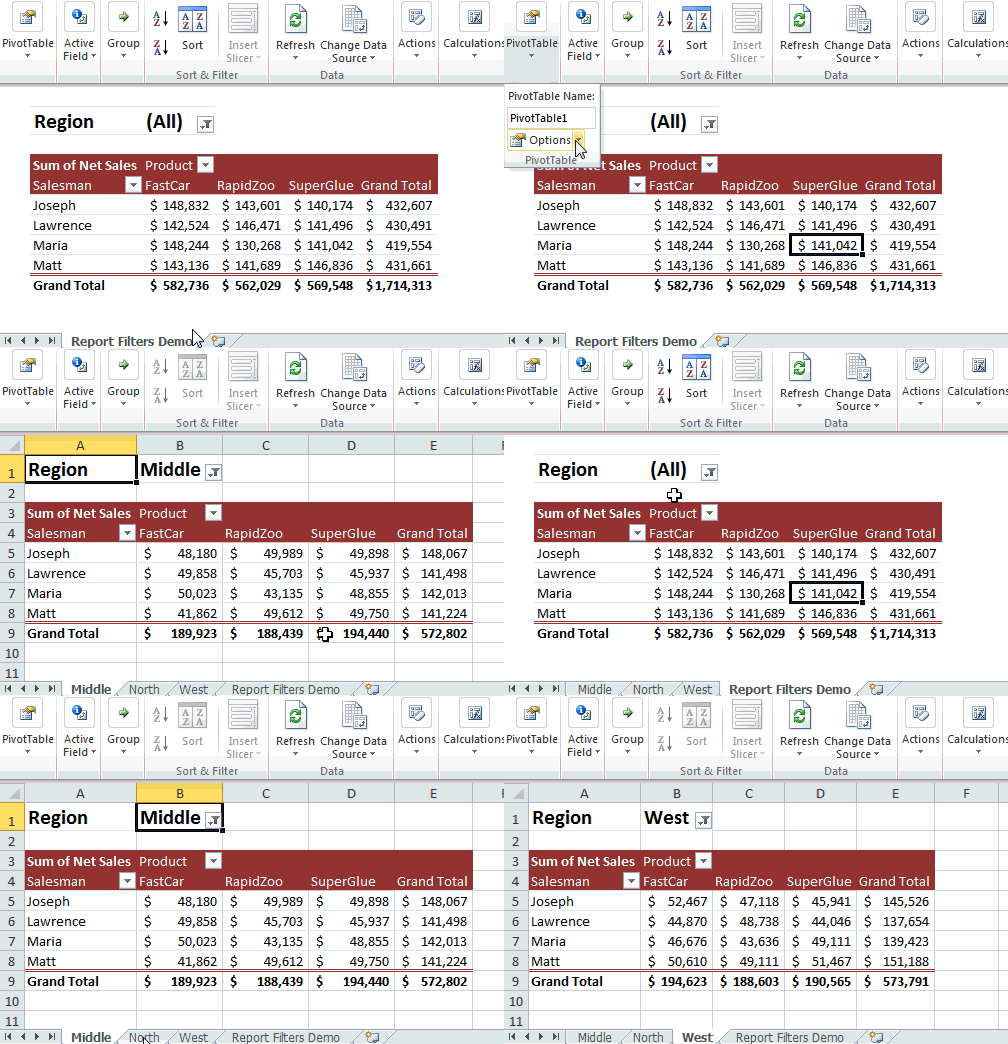
 

Report Fitters in Excel - used to create multiple versions of a report - Demo


Click here for more tips & info on Report Filters.

Pivot Table Tricks - Video

If you want to view all these tricks + my new haircut, check out below video. You can also watch this on my YouTube channel here.

More Pivot Table goodness

Work with data often? Then learn Pivot tables you must.

Check out below pages to pick up valuable pivoting skills.

Got some tricks? Teach me...

You can teach an old dog new tricks. If you know a cool & useful Pivot Table trick, post it in comments. I am eager to learn from you.

Facebook
Twitter
LinkedIn

Share this tip with your colleagues

Excel and Power BI tips - Chandoo.org Newsletter

Get FREE Excel + Power BI Tips

Simple, fun and useful emails, once per week.

Learn & be awesome.

Welcome to Chandoo.org

Thank you so much for visiting. My aim is to make you awesome in Excel & Power BI. I do this by sharing videos, tips, examples and downloads on this website. There are more than 1,000 pages with all things Excel, Power BI, Dashboards & VBA here. Go ahead and spend few minutes to be AWESOME.

Read my storyFREE Excel tips book

Overall I learned a lot and I thought you did a great job of explaining how to do things. This will definitely elevate my reporting in the future.
Rebekah S
Reporting Analyst
Excel formula list - 100+ examples and howto guide for you

From simple to complex, there is a formula for every occasion. Check out the list now.

Calendars, invoices, trackers and much more. All free, fun and fantastic.

Advanced Pivot Table tricks

Power Query, Data model, DAX, Filters, Slicers, Conditional formats and beautiful charts. It's all here.

Still on fence about Power BI? In this getting started guide, learn what is Power BI, how to get it and how to create your first report from scratch.

One Response to “SQL vs. Power Query – The Ultimate Comparison”

  1. Jim Kuba says:

    Enjoyed your SQL / Power Query podcast (A LOT). I've used SQL a little longer than Chandoo. Power Query not so much.

    Today I still use SQL & VBA for my "go to" applications. While I don't pull billions of rows, I do pull millions. I agree with Chandoo about Power Query (PQ) lack of performance. I've tried to benchmark PQ to SQL and I find that a well written SQL will work much faster. Like mentioned in the podcast, my similar conclusion is that SQL is doing the filtering on the server while PQ is pulling data into the local computer and then filtering the data. I've heard about PQ query folding but I still prefer SQL.

    My typical excel application will use SQL to pull data from an Enterprise DB. I load data into Structured Tables and/or Excel Power Pivot (especially if there's lot of data).

    I like to have a Control Worksheet to enter parameters, display error messages and have user buttons to execute VBA. I use VBA to build/edit parameters used in the SQL. Sometimes I use parameter-based SQL. Sometimes I create a custom SQL String in a hidden worksheet that I then pull into VBA code (these may build a string of comma separated values that's used with a SQL include). Another SQL trick I like to do is tag my data with a YY-MM, YY-QTR, or YY-Week field constructed form a Transaction Date.

    In an application, I like to create a dashboard(s) that may contain hyperlinks that allow the end-user to drill into data. Sometimes the hyperlink will point to worksheet and sometimes to a supporting workbook. In some cases, I use a double click VBA Macro that will pull additional data and direct the user to a supplemental worksheet or pivot table.

    In recent years I like Dynamic Formulas & Lambda Functions. I find this preferable to pivot tales and slicers. I like to use a Lambda in conjunction with a cube formula to pull data from a power pivot data model. I.E. a Lambda using a cube formula to aggregate Accounting Data by a general ledger account and financial period. Rather than present info in a power pivot table, you can use this combination to easily build financial reports in a format that's familiar to Accounting Professionals.

    One thing that PQ does very well is consolidating data from separate files. In the old days this was always a pain.

    I've found that using SQL can be very trying (even for someone with experience). It's largely an iterative process. Start simple then use Xlookup (old days Match/Index). Once you get the relationships correct you can then use SQL joins to construct a well behaved SQL statement.

    Most professional enterprise systems offer a schema that's very valuable for constructing SQL statements. For any given enterprise system there's often a community of users that will share SQL. I.E. MS Great Plains was a great source (but I haven't used them in years).

    Hope this long reply has value - keep up the good work.

Leave a Reply