If you use Microsoft Excel to organize data (say, a list of documents being produced), you may have run across The Cell That’s Too Small For Its Data. You know, you’ve got a bunch of stuff typed into a cell (not because you’re rambling, but because you need all that information, dang it), and it just breaks out of the borders of the cell and keeps on going:
And if that’s not annoying enough, if you have to type something into the cell to the right, then you’ve just cut off the last part of that other cell:
Here are a couple of different tricks to try:
Wrap text. If it really doesn’t matter where the line wraps (as long as everything stays within the same cell), then the thing to do is format the cell so that the text wraps automatically. Although the different versions of Excel (from 2002 through 2013) have various buttons and commands to do this, the one foolproof method that works in all versions is this:
- Right-click your mouse inside the cell.
- You’ll see a menu that looks like this:

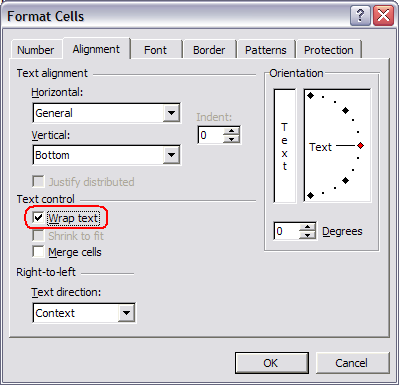
- Once you have the Format Cells dialog box open, go to the Alignment tab and check the “Wrap Text” box:
- The text in that cell will now wrap automatically.

In the Ribbon-based versions of Word, this is a one-click operation. Just go to the Home tab and click on Wrap Text:
Good news: You can apply this formatting to more than one cell at a time. You can select multiple cells by holding down the CNTRL key while clicking on them, select entire columns or rows by clicking on their headers (the “A, B, C” on top of columns or the “1, 2, 3″ to the left of rows), or even select the entire spreadsheet by clicking on the upper-left-hand corner (where the A and 1 meet). Once you’ve selected all your cells, then just follow the steps above.
Inserting a line break within a cell. But what if you want to control exactly where the line breaks (say, you want an address to appear like this):
Even easier! After you type each line, just press
ALT-ENTER on your keyboard to insert a hard return.
Controlling vertical alignment. By default, data in cells is aligned at the bottom. This can create some readability problems if some of your cells have multiple lines:
If you have a particular preference as to whether all the data across the row lines up at the top, the bottom, or in the center, select all the cells you want to re-align, then right-click to get the menu (as we saw above), choose Format Cells, and go back to the Alignment tab.
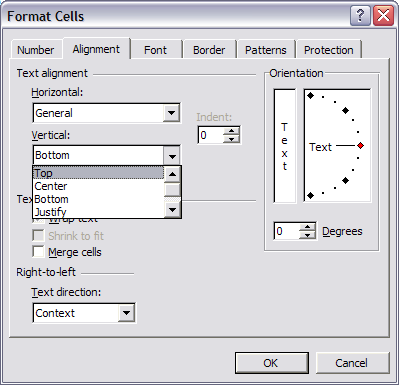
See that drop-down menu that says “Vertical” (above)? That allows you to change the vertical alignment within the cells you have selected. If you want everything to line up across the top, then choose “Top.” If you want everything centered, choose “Center.” You get the idea, right?
I AM NOT THE AUTHOR.
.